Showing posts with label Robert A. Heinlein. Show all posts

Wednesday, January 08, 2014

New SF Reviews at SFFWorld - Howard and Heinlein

Mark and I kick off another year of reviews at SFFWorld with two Science Fiction novels.  Mark looks at a classic while I look at a brand-spanking-new novel, both aimed at younger readers.

Strange Chemistry has been publishing some excellent novels since launching in September 2012.  While I haven't read every book published under the imprint under the deft guidance of Amanda Rutter, the books I have read have worked extremely well for me.  Such is the case with Amalie Howard's The Almost Girl (which the more the title rolls around in my head, the more it sounds like an episode of Doctor Who), the first of a duology.

http://www.sffworld.com/2014/01/almost-girl-amalie-howard/
In The Almost Girl, Howard never lets the plot or her characters settle into a rut. Something is always pulling the narrative forward with urgency, whether an action scene when Riven is battling the zombie-cyborg Vectors, or if she examining her feelings about Caden. The parallel worlds, zombie-soldiers, genetic manipulation gave a great science fictional feel to the world of Neopses. It isn’t clear just how similar our world is to Neopses, but it seems like either a future version of our world or perhaps a world like ours with a divergent point in its past. Regardless, the two worlds contrast each other effectively.

Howard’s characterization of Riven as a hardened soldier came across well, and even more so, the emotions she struggled with about her sister Shae. As the novel deals with two parallel worlds, Howard cleanly divides the novel between the two, with the first half taking place on Earth and the second half taking place mostly on Neopses. In some ways, the locales of Neopses where the action takes places had the feel of a mash-up between The Cursed Earth (of Judge Dredd fame) and Coruscant (of Star Wars) that may have lost some of its lustre. Neopses seems to be a world, as we learn through some of its inhabitants, that is trying to cling to any of its lost greatness.

Mark continues his re-read of the Heinlein classics reissued in the Virginia Edition with The Rolling Stones:

http://www.sffworld.com/2014/01/1281/
Reading Heinlein’s books in (mainly) chronological order for the first time, I am now picking up more of Heinlein’s evolution as a writer. At this point he has become more confident and has begun to develop and reinforce what many would consider ‘the Heinlein voice’. His dialogue has become lively and energetic. His characters have now started to settle into what would become a Heinlein archetype – bright and intelligent, which at times shows that ‘hectoring and lecturing’ that would be apparent in his later work.

The Rolling Stones is a story like Between Planets that takes place on a wider canvas – this time, it’s Luna, Mars, the Asteroid Belt, around Saturn – but whereas previous tales have focused around one key character, this time the plot is predominantly about a family.

...

For all my gripes, we have here characters that Heinlein will keep returning to in the future. He has used similar archetypes in the past, too – the family of Jim Marlow on Red Planet isn’t that different – but here, the templates are given full rein.

Friday, August 02, 2013

SFFWorld Review & Interview Round up: Micahel J. Sullivan, David J. Peterson, Heinlein and Hearne

Here's a gathering of recent reviews and interviews that we've  have posted to SFFWorld over the past few weeks. Recent interviews include:

David J. Peterson, who created the languages of Dothraki and Valyrian for Game of Thrones

SF Said author of Phoenix.


Most recently, I reviewed Michael J. Sullivan's The Crown Tower (Volume 1 of The Riyra Chronicles.  I found this to be a successful prequel to his Riyria Revelations


Hadrian Blackwater is a former soldier and arena fighter wandering the world, looking for purpose. Hadrian is on his way to meet with his father’s old acquaintance at Sheridan University, when a young boy known only as Pickles encourages Hadrian to board a boat. Along the way, several people are killed on the boat, almost including Hadrian himself. When Hadrian finally arrives at the university he discovers his father father’s old acquaintance is Arcadius, the Professor of Lore at Sheridan University. What’s more surprising is that the mysterious hooded man whom he suspected of killing the people on his boat is waiting in Arcadius’s office. The man, of course, is Royce Melborn whom Hadrian’s father’s friend pair up and assign a mission of stealth – to steal a book from the Crown Tower.

Running parallel to Hadrian’s storyline is that of Gwen DeLancy, the “hooker with aheart of gold.” [WARNING: Clicking that link will send you to the rabbit hole known as TVTropes] As much as The Crown Tower is an origin of sorts for the Riyria (Hadrian more so than Royce), Sullivan devotes nearly as much narrative to Gwen’s story. Here, Sullivan gave the novel its truest villains in the drunk, violent customer Stane and Gwen’s boss, Raynor Grue. When Stane kills a prostitute in The Hideous Head Tavern and Alehouse (Grue’s establishment) and gets away with it, Gwen decides she needs to leave Grue’s employ to start her own brothel, Medford House.


Mark's re-read of Heinlein's classic novels as part of the Virginia Edition. The latest is for Farmer in the Sky:


There’s some nice links to some of the earlier novels and stories. The Space Patrol (see Space Cadet) is mentioned, as too the song The Hills of Green Earth and its blind composer Rhysling. Colonies on Mars and Venus, briefly mentioned, relate to Heinlein’s other tales. Heinlein was clearly starting to make his stories of the future interrelate. He even introduces the idea that there has been in the past a space-faring race that has left their mark in space.

So, what does Heinlein bring to the table that is new this time around?

The first shock is that the first part is written from the point of view of Bill. After the previous books were traditional second-person perspective, this is a bolder stylistic move, and one that creates a more personal standpoint. The second shock is that from the start the book does not read positively. This is a surprise, as the juveniles were stories written predominantly for boys and meant to highlight the virtues of the Scouts, and yet from the beginning this is not the positive characteristics you expect from a Scout. On the first page Bill has to deal with a trainee Scout who he calls a twerp from the outset. There is an argument between Bill and his widowed father George over George’s decision to embark on the Mayflower. The world around them is clearly not good, with food rationing in place and rations often cut, George going without meals to ensure that their nutrition intake is sufficient.


Last week, I reviewed the fifth installment of Kevin Hearne's entertaining Iron Druid Chronicles, Trapped:


Five books deep into a series that appears as if it can go at least double that number provides a writer with a certain level of comfort, as it can for the readers of that series. After all, that’s part of why readers return to successful series and why authors continue to write them. On the other hand, progression and stagnation can enter as the series progresses. Not so with Hearne’s Iron Druid Chronicles, each book builds on the predecessor and most importantly no action Atticus or any other character takes is without consequences. Atticus killed possibly the most recognizable Norse god and two books later, the ramifications of that action (and Atticus’s actions in early novels) and the events surrounding it are plaguing the last Druid. In short, Hearne continues to admirably walk the fine line between safety/comfort and progression/consequences.

An element that’s always been an undercurrent of these novels is Hearne’s reverence for storytelling.  Whether in the backstory of Atticus or the short mythic stories other characters tell to Atticus (the stories Väinämöinen’s told in Hammered, the ‘truth’ about the Svartálfar Norse dark elves revealed here in Trapped), the past always ties into current events and provides powerful, resonant, and layered storytelling. Again, the idea of consequences as a powerful theme in these novels becomes more apparent.

Wednesday, February 13, 2013

Daylight Red - New Reviews at Tor.com & SFFWorld

I’ve got a new review up at Tor.com, a novel for me that had an extremely high anticipation factor and Mark continues his read-through of the Virginia Edition of Robert A. Heinlein’s work.

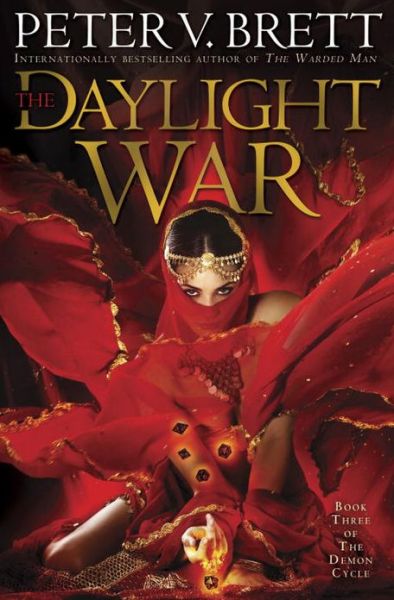
My review is The Daylight War by Peter V. Brett, the third in is five-book Demon Cycle. I was very pleased with the novel as you may see if you click through to the review.


While the demons are still very present in The Daylight War, humanity’s remnants need to get their collective heads together before the demon threat can effectively be vanquished. In many post-apocalyptic stories—and a case can be made for The Demon Cycle as a post-apocalyptic story—the trigger event marginalizing human society becomes window dressing as the story progresses and the human character’s conflict takes center stage.

...

The mythology/worldbuilding behind the demons hinted in the previous volume is revealed slightly more here in The Daylight War, as Brett peppers in chapter passages from the POV of the demons, providing readers with a glimpse of their society and race as a whole. Whether he will continue to expose more of the demons’ nature and origins remains to be seen, but I enjoyed the slow reveal unfolding here and I am very curious to see how much of the demons’ history Brett will allow readers to see.

Mark Heinlein read-through catches him up with Red Planet


What surprises me most on re-reading is how complex this book really is behind the obvious plot narrative. We have ancient Martian races, social revolution and rather manipulative humans on a Bonestellian style planet. Our hero is, as was rather traditional for these books, a teenage human male, whose growing up (see: rite-of-passage) was rather frontier-like. On the cutting edge of space colonisation, Jim Marlowe is a pioneer. It’s not by accident the original edition was subtitled on the cover, ‘A colonial boy on Mars’.

Rather surprisingly, Willis still reads as an engagingly depicted character that would gladden the heart of any young reader, although he/she/it is basically a canine substitute (and is something that Heinlein will use again in later books such as Star Beast and The Rolling Stones/Space Family Stone, for example.) It’s not by coincidence that Tor Books once referred to the novel as ‘One Boy and his Martian.’ Supremely loyal and endearingly enthusiastic, these days I can see the similarities between Willis and Edgar Rice Burroughs’s Woola more clearly.

Wednesday, July 18, 2012

Two SF Greats Reiewed at SFFWorld: Brin and Heinlein

A day late since the book I review this week took a tad bit longer to read (a good thing as I feel a more deliberate read allowed me to enjoy it more) and the weekend was extremely busy to the point that I didn’t have the opportunity to even open up the laptop Saturday or Sunday for an extended amount of time. Meanwhile, Mark continues his trek through the genre’s past.


Most readers of this blog are familiar with David Brin. He’s a giant of the SF field despite not having published a novel in over a decade. Well, Existience is his (ready for the cliché) triumphant return to the form and before I leap to the cover and review excerpt, has me eager to read more from him. Here’s part of what I thought about Existience:


The novel begins about a half a century in the future in a world not too dissimilar to our own, save for a slightly changed US, and a world hit with a destructive nuclear event. The Mesh, which is one of the many internets us viewable all times with special glasses like Google Glasses and AI is an every day fact of life. Although the world has suffered catastrophes, like the aforementioned war and a melting of polar ice caps, and changed drastically, Existence is not a dystopian novel even if it is set in a somewhat post-apocalyptic environment. Early on, one of the points Brin makes through his characters and the world-building is that people survive and persevere. Though bad things have happened, people will continue on and adjust. It is both a novel of ends and beginnings, a novel of first contact and a novel that approaches an answer to the question partially framed by the Fermi Paradox “Are we alone in the universe?”

Part of this world-building is achieved through snippets cushioning each relatively short chapter. These snippet chapters range in content from debates about the artifact between two prominent figures, journalistic entries from Tor, and other such passages to give an authentic feel to the world. For my reading sensibilities, this structure worked well to impart authenticity and keep the pace of the novel at a nice level. The structural element that was a bit jarring was the abrupt leap in time in some sections, particularly from the first ¾ or so of the novel to the chapters that conclude the novel.


Mark, the resident genre historian SFFWorld has been reading through his Heinlein Virginia Edition and his latest revisiting of an old Heinlein tale is Sixth Column

  
This one is what they call ‘a fixup’, originally being in three parts in the January, February and March editions of Astounding Magazine, under the editorial tuition of John W. Campbell. It became a slightly revised novel in 1949, with the author’s real name rather than his pseudonym, and a little tidying up.


It’s hard for me to decide whether this tale is a tribute or a criticism of L. Ron Hubbard, who both Heinlein and Campbell knew well. Campbell was an interested party in Hubbard’s development of Dianetics, and the idea of a religion being created to cover up other activities does sound like a veiled criticism that could be equally applied by its decriers to Scientology. It has been suggested by some critics that Calhoun, the stiff and rather disliked scientist who eventually ends up insane, believing himself to be an incantation of the god Mota, is at least partly based on Campbell himself.

Whilst Campbell’s version emphasised the race aspect, Heinlein’s tried to make it more scientific and using the so-called ‘soft sciences’ such as psychology and sociology to make the tale work. It is no accident that Whitey has a civilian background in advertising.


Wednesday, July 27, 2011

Chadbourn, McNeill, and Heinlein Reviewed at SFFWorld

Another three reviews this week at SFFWorld, two from Mark one from me. I’ll sandwich my review between two of Mark’s, the first of which will be The Scar-Crow Men, the second installment of Mark Chadbourn’s Will Swyfte/Swords of Albion series::

Things are clearly not well in Elizabethan England. This is a darker tale than The Sword of Albion. Plague spreads across London’s streets and the Queen has moved her court out of London for fear of catching the disease.

This one starts off fast: there’s a grisly death involving big spiders in Saint Paul’s Cathedral, followed by the death of one of Will’s closest friends. Will is seen as someone clearly upset by this and also under suspicion of becoming more susceptible to atheist ways. Will is convinced his friend’s death was not in a common bar brawl but seems to be being covered up. Convinced that the murder was caused by men who wish Will no good, Will investigates why his friend was killed and by whom. And there seems to be a scheme to kill England’s spies: with Will being the best known spy in England, he’s a major target. The Unseelie Court seems to be making a move, and Will seems to be in line for assassination..


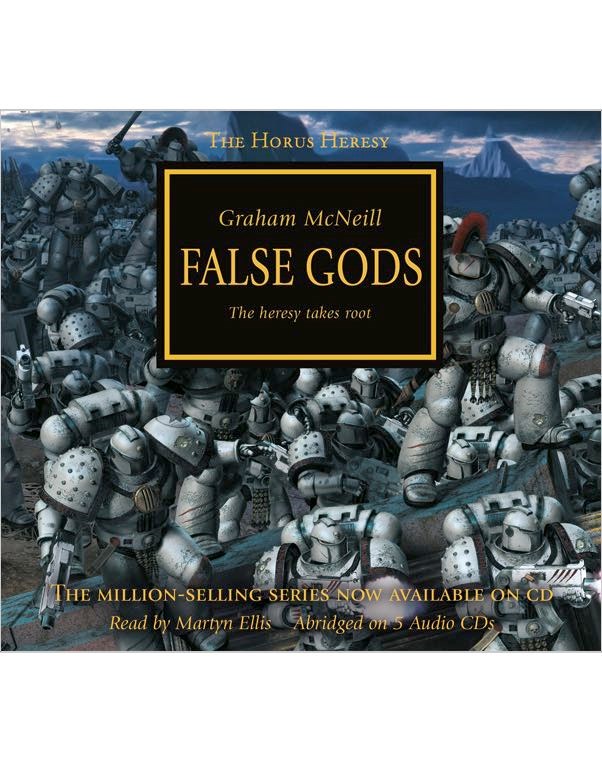
I made my second foray into Warhammer 40,000’s Horus Heresy saga with False Gods:
This was my first experience with Graham McNeill’s fiction and I’m both happy and saddened by that fact. Sad because I’ve missed out on what could possibly be some great fiction and happy at the prospect that I’ve got another author’s work to consume. McNeill is one of Black Library’s top writers and handing him the reigns of the second novel their marquee series is proof that their faith in him is justified. What impressed me most about the story was McNeill’s abilities at balancing philosophical/theological ideas/themes along with the expected action of a Military SF novel. The strongest element of the novel, for me, was the depiction of Horus healing in the Warp as he grows frustrated with the neglect he feels the Emperor is showing him along with the nature of the universal reality and conflict.


All told, I am fascinated with the over-reaching story arc unfolding in the Horus Heresy and plan on following along, either in this superb audio versions or the original printed volumes in addition to more of McNeill’s work.


We’ll round out today’s post with Mark’s review of a revised classic Heinlein novel, Puppet Masters ,
The Puppet Masters is Heinlein’s version of an alien invasion tale, written at a time when such tales were popular in film and in prose.


The tale itself is quite simple. Told in the first person, ‘Sam’ Nivens (not his real name) is working for the US secret service. This means different names, different places, different faces (as I find on the first page a blonde in bed with Sam, who wasn’t there in my original version!)


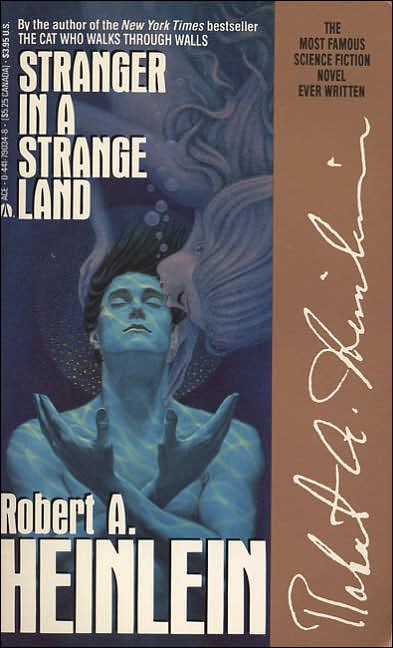
This is perhaps where I see a transition between the juveniles and say, Stranger in a Strange Land: this still has the excitement and the pace of the juvies, but the addition of the posturing lecture seen in later books such as Stranger. That and the need to get naked. Sometimes ‘more’ can mean ‘less’, and I’m reminded of that, as I was when I read the longer version of Stranger in a Strange Land – I’m in two minds to decide whether this longer Puppet Masters is one of those examples.


Tuesday, February 01, 2011

Book Reviews & Discussions - Aaronovitch, Heinlein, GRRM, Weber, & Wingrove

Mark added another trifecta of reviews late last week and I added my usual Monday review yesterday to SFFWorld.

Before jumping into the reviews, I’ll point out our two Book Club discussions at SFFWorld:

Fantasy:


Wild Cards I edited by George R.R. Martin


Science Fiction:


Stranger in a Strange Land by Robert A. Heinlein


The first review I’ll mention is Mark’s review of Ben Aaronovich’s Rivers of London (Midnight Riot in the US). Aaronovich spent some time writing for Doctor Who:


In a slightly creepy Lovecraftian twist, we find that behind all these initially random incidents there is something darker, deeper and more insidious at work – a invisible malevolent thing, that seems to want revenge by inciting violence and unrest amongst the masses of London. Something that Peter and Chief Inspector Nightingale must stop.


Partly reminiscent of Gaiman’s Neverwhere, part Mike Carey’s
Felix Castor, this is an entertaining romp that doesn’t come across too badly. The first-person perspective and tone is light, much lighter than Carey’s books, for example, though this is interspersed with some quite nasty violence: a baby thrown out of a window, people having their faces explode.


To say that David Weber is one of the more prolific authors in the genre would be stating the obvious. At the end of 2010, he published Out of the Dark, which is an expansion of his entry in the Martin/Dozois-edited anthology Warriors. Here’s what I thought of the novel:


The story itself very much had the feel of a disaster novel. In some ways, I was reminded of Walter Jon Williams’s The Rift or even Stephen King’s The Stand for the varied characters and their related storylines Weber introduced in the first third of the novel. Weber shows us individuals in the military who are on the front lines in the United States and have lost their families, he shows us retired military people who are well prepared and form the beginning of a resistance, and he also introduces us to a military unit stationed in Romania that teams up with a local guerilla force in order to combat the alien threat.

The ending definitely has that Deus Ex Machina feel (as did the novella), but while I thought it was somewhat effective, I also thought it could have been played a bit more rationally especially compared against the other rational elements of the novel. I won’t spoil what the “surprise” is, but it may be one of the worst kept surprises in genre fiction published 2010 and the hints are quite blatant up to the ending.


In the UK, one of the more interesting publishing projects kicking off is the re-publication of David Wingrove’s Chung Kuo series (I’d suggest anybody interested in the series check out Adam Whitehead’s blog posts on the series republication). Anyhoo, Mark reviewed the first book in the series, well as it turns out a prologue to the series, Son of Heaven:


Son of Heaven is a completely new prelude to the series and begins to set up scenarios for the rest of the series.

Overall, the book focuses on one main character, Jake Reed, at different times before the Chinese invade England (Ying Kuo). The first part of the book is set in Autumn 2065, subtitled ‘The Last Year of the Old World’ and deals with Jake’s life in rural Dorset, twenty years after the global upheaval known as ‘the Collapse’. It is an odd combination of unchanging rural idyll, steeped in history and tradition but with a contemporary survivalist mentality. Strangers are viewed with suspicion, and when raids occur, shot. This was reminiscent to me of John Christopher’s The Death of Grass.

For the sake of clarity I will admit that when I read the original (twenty years or so ago!) I was impressed. The books were new, exciting and well thought out (at the beginning, anyway.) They were quite adult and pleasingly complex.


I’ll close out the summary of reviews with Mark’s review of what could be a monumental biography project covering the life of one of The Big Three of SF: Robert A.Heinlein Robert A. Heinlein: In Dialogue with His Century: Volume 1 (1907-1948): Learning Curve. Here’s what Mark thought of the book:


So the credentials seem to be there. It must also be noted that this hefty book has not been rushed in its production, with considerable time to research and write it. Patterson’s website says, ‘On January 1, 2000, Mrs. Heinlein phoned Bill and asked him to undertake the formal biography of her husband, which he commenced researching in February 2000. The research phase occupied the years 2000 through about 2003, and he commenced writing in the latter part of 2002. Mrs. Heinlein saw and approved the first 120,000 words of the biography (including the Heinlein family history which has been moved to an Appendix in the published first volume of the biography).


The $6,000,000 question though is whether we need to know as much information as is given here. Frankly, no. I suspect that this book, as readable as it is, will cater for an audience that already has an interest, and probably (like me) for the SF aspects. As you might gather, this doesn’t happen until after the midway point of this large volume. Consequently some readers may be disappointed, or get bored with the lengthy details of Heinlein’s childhood and naval training.