This is the first Tuesday in December (also St. Nicholas Day), but that won’t stop the reviews!! Two more reviews were posted to SFFWorld this past week, one from me and one from Mark.
As a follow-on to his interview with the Vandermeers Mark posted his review of the landmark tome The Weird currently available in the UK via Corvus and available next year via Tor (YAY!):
Last week I posted my review of the latest installment of David Weber’s Safehold saga. I nearly forgot I had a review of the first book, Off Armageddon Reef sitting in my files (in an incorrect folder) for a couple of years, so now is as good a time as any to post the review. This is the novel that really hooked me into the series (obviously) and started me on my path to becoming a fan of Weber as a whole. For my money, this is one of the stronger opening volumes on the shelves.

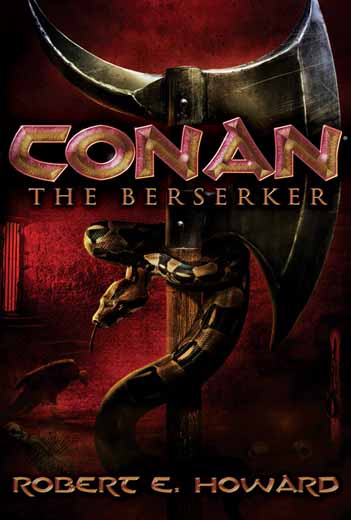
The mighty-thewed barbarian continues to see his tales being reprinted in the UK in what look to be very nice editions. As such, Mark reviewed the second repackaging entitled Conan the Berserker:
As a follow-on to his interview with the Vandermeers Mark posted his review of the landmark tome The Weird currently available in the UK via Corvus and available next year via Tor (YAY!):
Where this collection really scores is that there is a lot here even the experienced expert will find new. Many of the tales have been translated from other languages, especially for this edition, and so were new to me. Authors I have heard of (Belgium’s Jean Rey, for example) I was now reading for the first time. There’s Kafka and Borges here, but new to me were France’s Michel Bernanos, Spain’s Merce Rodreda, Italy’s Dino Buzzati and Japan’s Ryunosuke Akyutagawa. What this confirmed to me was that there is an amazing world of the Fantastic beyond the English prose.
…
I haven’t even tried to review the tales in depth here. I was pleased to read some old favourites but was more pleased to read stories I’d never heard of before. Consequently there was a joy in just not knowing where a story was going to lead.
There is enough here for everyone. It is awesomely weird. There are stories of drama, of fantastic mythology, of creepiness and unease, of tales in the past and ones that might just be happening now.

Last week I posted my review of the latest installment of David Weber’s Safehold saga. I nearly forgot I had a review of the first book, Off Armageddon Reef sitting in my files (in an incorrect folder) for a couple of years, so now is as good a time as any to post the review. This is the novel that really hooked me into the series (obviously) and started me on my path to becoming a fan of Weber as a whole. For my money, this is one of the stronger opening volumes on the shelves.
The novel begins in the 25th Century, during the twilight of human civilization on Earth. Although humanity has expanded beyond the confines of the Solar System, the alien Gbaba have nearly exterminated humanity in a galactic war that has lasted decades. In a last ditch effort to keep humanity alive, a great space Ark is constructed to transport humanity thousands of light years away to the planet that comes be known as Safehold, far beyond the reach of the Gbaba. With most of humanity eradicated by the Gbaba, only the highest ranking military leaders commandeer this mission. One of the sacrifices; however, is that in order to survive, the remaining survivors are implanted with false memories. These memories wipe away the knowledge of the Gbaba, advanced science and mathematics, bringing the level of technology to the age of sail. You see, the Gbaba are able to detect radio waves and other aspects of technological growth as civilizations approach the space faring technology and have wiped out civilizations in the past.
…
Clearly, Weber has big things planned for this novel, and this epic series. The story then jumps 800 years as society has come to know that God created them and placed them on Safehold 800 years ago. The story is joined at this 800 years later juncture as Shan-wei’s counter-plan takes form – he implanted the memories, perhaps even the soul, of one of his people (a young woman named Nimue) into a program that would awaken to help return humanity’s freedom of thought and knowledge of the past to the people of Safehold. As the personality of Nimue slowly reawakens and comes to learn about human history on Safehold over the prior 800 years, she realizes that because of the theocracy that has been established, her best bet at fitting in and having an effect on the people is to be a man, so she adopts the name Merlin.
The mighty-thewed barbarian continues to see his tales being reprinted in the UK in what look to be very nice editions. As such, Mark reviewed the second repackaging entitled Conan the Berserker:
And so to Conan: the Midlife Crisis, in the second volume of this re-released series, publishing the original Conan tales in chronological order. The first of the three volumes, Conan the Destroyer, was reviewed HERE, with Volume Three, Conan the Indomitable, to follow. Here Conan is at his most vibrant, less the inexperienced youth of the earlier tales and not yet the grimmer, more sombre King of Aquilonia in the later tales.
…
This will make many fans happy: both tales are regarded as classic Conan. People of the Black Circle is often regarded as one of the best Conan tales, a story of the countries of Vendhya and Ghulistan (though we would perhaps call them India and Afghanistan respectively today). It is, at its heart, a revenge tale, the tale of Devi Yashmana who seeks revenge for the death of her brother, Bunda Chand, the King of Vendhya. Conan kidnaps the Devi, intending to use her as hostage in return for seven of his men. Together Conan and the Devi create a grudging alliance. Conan wants his men back, Devi wants to kill the Black Seers of Yimsha. We later discover Kerim Shah, a secret agent who killed Bunda on the orders of King Yezdigerd of Turan.