Showing posts with label Best of. Show all posts

Monday, January 05, 2026

2025 Reading Year in Review

Once again, the post that truly keeps the Blog o’ Stuff alive, the “Highly Anticipated” annual installment of “What Did Rob Enjoy Reading the Most Last Year?!??!” That’s right folks, for the fourth in a row and 15th year overall, here are the books I enjoyed reading most the previous year! As I’ve done every year, here are the previous years I’ve put up a reading year in review, 2024, 2023, 2022, 2021, 2018, 2015, 2014, 2013, 2012, 2011, 2010, 2009, 2008, 2007, 2006.

As I've done every year for the past decade and a half, I've contributed to SFFWorld's Favorite of the Year lists: Fantasy, Horror, Science Fiction, and Film/TV. We focus only on 2025/current year releases on our there are a lot of good books out there from previous years I haven’t read.

Horror, once again, is the genre that takes up the most space in the pie chart of “genres Rob read” in 2025. Fantasy is always going to be in my heart and is a fairly close second place, but Science Fiction keeps sliding down, unless you count some of the novels that tow the line between Science Fiction and Horror. The annual statistical rundown of the nearly 97 books I read in 2025:
  • 56 2025/current year releases 
  • 1 2026 release 
  • 41 reviews posted to SFFWorld (including the Halloween Countdown Reviews)
  • 56 can be considered Horror
  • 44 can be considered Fantasy
  • 13 can be considered Science Fiction
  • 21 books by authors new to me 
  • 49 Books by women
  • 10 total debut
  • 17 audiobooks
  • 1 Non-Fiction
So, without further adieu, below are the books I enjoyed reading the most in 2025. It was really tough to rank this group of books because there’s a very high level of quality and enjoyment across them all. Unlike our annual tally at SFFWorld, I’m not going to break these out by genre since a few of the novels can fit into more than one genre/category. I’ll start with my favorite overall novel, then go alphabetically by author’s last name. Oddly, the earliest last name in the alphabet on this list is “F.” Maybe I’ll note something additional about a few titles, too.

King Sorrow by Joe Hill
(Takes the top spot overall, it perfectly marries Horror and Fantasy)


Hill tackles a lot in this story and he is more than up to the task he sets for himself. One of the skills I most appreciate in a writer is when they are able to finely balance a story between epic and intimate. King Sorrow balances those elements very powerfully. We meet these characters at a critical time in their lives, young college-aged students (Gwen is a couple of years younger). For many people who attended college, decisions made at that inflection point of their lives – falling in love, deciding on a major which can direct a career path, friendships built – often to have lifelong affects. Many of my friends (myself included) met their wives when in college, many of those same friends or friends from that circle of friends, are in a job nearly 30 years later because of the path they started in college. Some of the decisions were great ones, others… well, those decisions especially when people aren’t fully mature and in desperate straits, can have negative impacts. Summoning a demon… or in this case, a dragon to help in a bad situation would qualify as life-changing, for certain. None of our heroes expected these decisions to be so long-ranging when they spoke the words that bound King Sorrow to them from the Long Dark.

The Raven Scholar by Antonia Hodgson
(My Favorite Fantasy Novel of 2025, Top Debut of 2025)
 

Neema is a wonderful protagonist, richly drawn, empathetic, smart, vulnerable…human. Hodgson gave a point of view character who is thrust into a situation that is far beyond her comfort zone. She has no desires to sit on the throne, or compete in the tournament. Through her, we learn about the history of her nation, the magic of the world, and some secretive elements. ... The world-building is so well-done, it seems like Hodgson put a great deal of care and precision into all of the things readers don’t see on the page so that the events/characters/history readers do experience on the page feel natural and effortless. When you pare it down to the core / high concept, The Raven Scholar could be seen as Hunger Games meets murder mystery, plus courtly intrigue in a fantastical/magical setting. The Raven Scholar is full of tension on many fronts. But I won’t say too much more than that, it is very much one of those novels that works best without knowing too much about the pathways of its plot, discovering some of those revelations were wonderful. However, I feel this is a novel that would benefit quite well from a second reading.


This is the second novel I’ve read from Fracassi and it totally hooked me

In The Autumn Springs Retirement Home Massacre, Fracassi gifts readers with a most unique final girl in a most unique setting. The title gives away the setting and it can be surmised that our heroine Rose DuBois (in her 70s) may be older than the typical final girl. She is a delight and a joy to get to know..

This novel is far more than just a “Septuagenarian Slasher.” Case in point – Rose, I soon fell for her as a character, I loved her. A great writer gradually reveals layers of their story and characters and with Rose, Fracassi delivered a master-class in a slow reveal of the character. We knew what we needed to know about her when we knew it about Rose and when we knew more of her backstory it led to a wonderful, powerful reveal of just what an incredibly strong character Rose is. She kept her life history fairly close to the vest with the small circle of friends and acquaintances in Autumn Springs, just as she did with the readers.


Revelator by Daryl Gregory
 

I’ve read some stories as well as Gregory’s earlier novel (16 years ago!) The Devil’s Alphabet. Shame on me for not reading any of his work since that book because Revelator is an outstanding cult horror novel, one of the best I’ve ever read maybe. For me the highwater mark for that subset of horror is Todd Keisling’s Devil’s Creek and I’d say Revelator is on that level. Gregory does an incredible job of make place an integral character in the story, he crafts an empathetic, complex protagonist in Stella, but what he does with mounting dread and then a KICK-WHAM reveal is nothing short of amazing. My wife received this as a Christmas gift last year and said I need to read it and damn was she correct! I’ve seen the great Mother Horror singing this book’s praises for quite a while, too. I’m singing those praises, too. I read this in two days at the end of the year and the book screamed at me to include it in my favorite reads of the year, so here we are.


Play Nice by Rachel Harrison 


Rachel Harrison has been averaging a new novel every year and for me, each novel is an Event and Play Nice just might be her best yet.

I will be completely honest and up front here – on the surface of this book – a book about a social media fashion influencer being haunted – chances are I might pass on reading it. Just not something (a social media influencer as protagonist) that thought I would connect with (says a person who posts regularly on social media talking about books and beer – yes, I can be a hypocrite). However, the fact that Rachel Harrison wrote this book made it a must-read. I’ve come to trust her over the course of the last few years and she absolutely delivered something very special in Play Nice. That something special starts with Clio.

Rachel Harrison has become one of the defining voices of Horror fiction the last half-decade. 


The Everlasting by Alix E. Harrow

    
Alix Harrow tells stories like almost no other writer, we fans of fantasy should be thankful she plies her trade in our genre. Carrying this compelling story is Harrow’s lovely prose, which acts as a comforting blanket that you know took skill and effort to craft. The story is more than just a gender-flipped King Arthur story. Of course those echoes are present, but heroism, love, avarice, addiction to power, and love are part of the story, too. Owen and Una are the hearts of this story and their hearts are connected. But there are two additional characters who form help to flesh out the story: Queen Yvanne from Una’s timeline and the ambitious Chancellor Vivian Rolfe from Owen’s time. 

If it isn’t clear by this point, I loved this novel.


Somehow, Grady Hendrix gets better with every novel. Hendrix’s narrative style remains a strong point for his novels, easy-going prose, strong characters, relatable snarky descriptions. He does a lot of character building through the first third of the novel. The girls share their frustrations as well as physical and emotional with their situation. Miss Wellwood is built up as an easy to dislike antagonist, but as he always does, Grady allows empathy for his antagonist to seep in as the story moves through its phases. Supporting Miss Wellwood is the even-more insidious Doctor Vincent. While the emotional nastiness is on full display through that first third, don’t worry, there’s some gruesome nastiness once the witchcraft makes its presence known. Wellwood House reminded me a bit of Reverend Gardner’s Sunlight Home for boys in Stephen King & Peter Straub’s The Talisman.

The timeliness of this novel is hard to ignore. Even though it was initially slated for a mid-2024 publication, the current climate in the United States is … shall we say not very kind to women, women’s bodies, and women’s health.

 
The Will of the Many by James Islington


Confession time: When this book first published in 2023, I saw almost universal praise across the genre landscape of reviewers / book blogs / etc. I read the author’s first novel The Shadow of What Was Lost and didn’t connect with the book as much as I hoped I would. I also saw many, many comparisons to Red Rising by Pierce Brown, a novel that, to put it very mildly, did NOT work for me. Those two things gave me a bias against reading this book. But the more I thought about it, the more I saw about the novel and how my “trusted reviewers/readers in the genre” wrote about this book, I wanted to try it. I am damned glad I did because I was very impressive with this novel, as all those words I put to screen prior to this paragraph attest. For my reading sensibilities, I think a more apt comparison, or “If you like that, then you’ll like this” recommendation that Red Rising would be Kate Elliott’s The Court of Fives.

Veil by Jonathan Janz


Janz is no stranger to stories where people are abducted by strange creatures (Children of the Dark) or apocalyptic fiction (The Raven, Blood Country), these are also common themes of horror. Here in Veil; however, Janz has seemed to level up in his storytelling on multiple fronts and he is an even more assured writer at this point. … Ultimately Janz may have crafted an even more effective alien invasion apocalypse than readers (and film viewers) are accustomed to experiencing. … His character work has always been top tier for me, but the empathy he infuses in Veil is even more potent. Writers often put a great deal of themselves into the characters (it is impossible for them not to do so, I think): John Calhoun is a high school teacher and married father of a son and daughter, Janz is a high school teacher, married and has three kids. Janz is a fan of Stephen King as is our protagonist. I’m not saying this personal infusion is a bad thing at all, in fact, I think the parallels only enhance the story, lend even more emotional weight to the story.


The Buffalo Hunter Hunter by Stephen Graham Jones


Good Stab is an unkillable Indian who had a tussle with a Cat Man that should have killed him. But Good Stab did not die, he woke with a thirst and need for blood and, through his own words, takes many, many lives. The scene of Good Stab’s rebirth as a vampire is visceral, fascinating, and immediately iconic. There are other elements of vampirism Good Stab conveys that feel fresh and unique. The Vampire characteristics SGJ utilized in this world were constructed with careful consideration. These “traits” of SGJ’s vampire play out so well in the story and are just one facet of what makes The Buffalo Hunter Hunter such an incredible work. … There are some novels, they are rare I think, that as you turn the pages, you realize you are reading Something Special. That you’re reading maybe a game-changer of a novel, a Landmark Novel. I began feeling that way maybe one third or so through my reading experience of The Buffalo Hunter Hunter.

The Sundowner’s Dance by Todd Keisling


Keisling layers in the horrific and terrifying elements. I think getting older is a natural human fear, losing faculties, being alone, being taken advantage-of. Those three human fears are very much on display. Sundowner’s Syndrome is a real thin and it seems to make Alzheimer’s Disease tame. While I’m not near the age of Jerry, I’m closer to that age than I’d like to be and I won’t lie – I have thoughts about what my life will be like in 20-25 years. (Just writing that gave me a chill). At one point, The ‘Burbs (Joe Dante’s cult 80s movie featuring Tom Hanks and Bruce Dern) is called out and it feels pretty appropriate, even if the events in The Sundowner’s Dance eventually worms its way into my consciousness as a much more creepy-crawler horror novel.

The Stand: Complete and Uncut by Stephen King (audiobook)


It can be very much worth revisiting the books that shaped you. It is even more rewarding when you aren’t visited by the Suck Fairy and that book is even better than you remember it being. With the anthology The End of the World as We Know It: New Tales of Stephen King's The Stand publishing in 2025, I figured I was far, far overdue for a re-read of the classic post-apocalyptic novel. Listening to Neil McRobert, Nat Cassidy, and Chris Panatier talk about the book on their read through of The Dark Tower and adjacent novels further convinced me and let me tell you some happy crappy, I am sure glad I re-read the book. M-O-O-N that spells glad.

For this re-read (2nd or 3rd, if you count the original uncut) I consumed it via audio book as read/performed by Grover Gardner and it was maybe one of the best audiobook experiences I’ve ever had. I knew I enjoyed the book, why else would I have re-read it multiple times? But the last time I read it was maybe 30 or so years ago just before the amazing TV adaptation by Mick Garris aired. This novel has some of King’s best character work and some of the bets character work of any novel I’ve read. It is a classic and should be given serious consideration as The Great American Novel of the 20th Century. I think in past readings, I may have connected most with Stu, but I think this time around, Nick was my guy. I wasn’t that big of a fan of Larry in past readings, but I found his journey and maturation very, very rewarding. Not going to lie, when Grover read the line, “And that’s how they met Ralph Brentner” I may have teared up. All the old friends were getting together again! I am probably not going to allow three decades pass before reading this one again.


Throughout these novels, Kowal backs her story with solid science – she consults with Astronauts after all. Nothing posited seems far-fetched. As the time of the series gets farther away from the meteor strike that started everything and closer to our current day, some of the “headlines” about current Earth events that preface each chapter resonate with our current world. On one hand, that’s still almost 60 years separating the publication date of the novel and time in which the novel is set. On the other, science (especially as it relates to space travel and habitation) has been forced to advanced at a different pace than our own world, so the political climate of the novel resonating with our world isn’t too big a leap. What keeps these novels going; however, are the characters and Kowal has crafted extremely charming characters in Elma, Nathaniel, Leonard, Nicole, Parker (it was unexpectedly nice to see him return) as well as all the others. There was a scene towards the end the end of the novel that I found very believable: Elma is a problem solver, she’s always trying to make things right. Her role is somewhat reversed and somebody else is leading an initiative and had to put Elma in her place. It was a genuine moment and the kind of interaction I’d expect to see between trusted colleagues and friends.

The Dragon in Winter (Kagen the Damned #3) by Jonathan Maberry


It has been a nice challenge to get through any given year in the recent past without me reading a novel by Jonathan Maberry, he is so incredibly prolific. A standout from him (and overall in my reading journey in 2025) was the finale to his Cthulhu Epic Fantasy saga, set 50,000 years in our future. There were some interesting twists along the way and damn does Maberry know how to bring a series to a satisfying conclusion.

The Demon Awakens (DemonWars, Book 1) by R.A. Salvatore


Sometimes, it is a nice change of pace to go back to a classic, or at least a novel/work people consider classic. I’ll admit to some hesitancy, as a very, very seasoned fantasy reader, to take a look at this 25-year old epic fantasy novel that has garnered varied opinions over the years. … I was swept away by the novel, by Elbryan’s journey with the elves as he became a true Hero. I was pulled into Pony’s (a.k.a. Cat) plight as she relearned who she was. I was taken aback by the change Avelyn made from his initial introduction as devout monk to powerful, almost jovial cleric. I found the centaur Bradwarden to be a refreshing character. The friendship and camaraderie that developed between these characters felt genuine and real. … I am very, very happy I finally dove into this series. I’ve been knee deep in horror the past few years (more than 50% of what I’ve been reading), especially most recently so I was happy to dive into a novel like this, something that hit the familiar notes of epic fantasy I enjoy so much, along with some unexpected nuances, told with a very engaging pace. Had I picked up these books when they were first published when I was first getting into The Wheel of Time, Memory, Sorrow and Thorn by Tad Williams, and The Farseer by Robin Hobb, I suspect I'd hold them in very high regard, at least based on how much I enjoyed The Demon Awakens.

The Gathering by C.J. Tudor (audiobook)


The Gathering is the second novel I read by Tudor and it worked very, very well for my reading sensibilities. Tudor builds tension and suspense very powerfully throughout the narrative. She also elegantly marries crime fiction with horror since this is a vampire novel. I think there may be a sequel in the works, I hope so because I thought Tudor's take on the vampire was intriguing and a foundation for many stories to be told. This was an audiobook consumption and I thought the narrator, Lorelei King delivered a great performance.

Honorable Mentions

Children of Blood and Bone (Legacy of Orïsha #1) by Tomi Adeyemi – An enthralling African-inspired young adult Epic Fantasy. I picked up the first book at NY Comic Con in 2024 and because of how much I enjoyed it, snagged book two at NY Comic Con in 2025. 

The Place Where They Buried Your Heart by Christina Henry was one another awesome novel from Henry, who has been reliable for releasing a stellar horror novel every year for the past few years. This one packs a lot of heart and emotion. 

Alison Gunn’s Nowhere, is her debut novel and a very gripping, powerful folk horror novel. I don’t think I’ve ever been this compelled to continue reading a novel featuring a protagonist I disliked so much. Some terrif, creepy scenes in this novel. 

Chuck Wendig continues his streak of superb horror novels with The Staircase in the Woods, which hit on a lot of great cylinders for me. There’s the young kids being friends vibe like Stand By Me but it certainly takes a turn up the stairs to something dark. I loved this book.


Monday, January 06, 2025

2024 Reading Year in Review

Here it is! The “Hotly Anticipated” annual installment of “What Did Rob Enjoy Reading the Most Last Year?!??!” That’s right folks, for the third ye in a row and 14th year overall, here are the books I enjoyed reading most the previous year! As I’ve done every year, here are the previous years I’ve put up a reading year in review, 2023, 2022, 2021, 2018, 2015, 2014, 2013, 2012, 2011, 2010, 2009, 2008, 2007, 2006).

As I've done every year for the past decade and a half, I've contributed to SFFWorld's Favorite of the Year lists: Fantasy/Horror, Science Fiction, and Film/TV. We focus only on 2024/current year releases on our there are a lot of good books out there from previous years I haven’t read.

The trend of Horror being the dominant, or at least highest percentage, of fiction I read in the calendar year continued from the previous two years. Don’t get me wrong, I still read and enjoyed plenty of fantasy! What has continued to drop in quantity/percentage of my reading is Science Fiction. Here are the full statistics of the nearly 96 books I read in 2024. Note that where I indicate "can be considered" takes into account books that can fit into multiple genres. For example, S.A. Barnes's Ghost Station easily fits into both Horror and Science fiction. This explains how the split between genres adds up to more than the totality of the 94 books I read in 2024.
  • 43 2024/current year releases
  • 35 reviews posted to SFFWorld (including the Halloween Countdown Reviews)
  • 52 can be considered Horror
  • 40 can be considered Fantasy
  • 13 can be considered Science Fiction
  • 30 books by authors new to me 
  • 48 Books by women
  • 13 total debut
  • 24 audiobooks
  • 3 Non-Fiction
So, without further adieu, below are the books I enjoyed reading the most in 2024. It was really tough to rank this group of books because there’s a very high level of quality and enjoyment across them all.

Long Live Evil by Sarah Rees Brennan
(My favorite fantasy novel of 2024)


Long Live Evil was an enormously fun novel. This is a story that plays with tropes and uses them to its advantage in curious, playful, and smart ways. Rae is a person I couldn’t help root for and rally behind, even when she was being a little bit snarky and obnoxious. In some ways, her being pulled into the narrative and using slang is not unlike John Chrichton using common jokes and pop culture phrases in FarScape, only to have his shipmates shake their heads at him. This trope has the potential to wear thin quickly, but Brennan plays it with a very even hand. …and that’s how she plays this novel/story overall. It embraces the genre, turns it on its head, and outcomes something that is that wonderful balance of familiar and new spin.

Of all the portal fantasies I’ve read, I couldn’t help drawing pleasant comparisons to Stephen R. Donaldson’s landmark Thomas Covenant series. Of course, Rae is a not nearly the embittered jerk Covenant is, but both find themselves thrust into a fantastical world as a remedy for their life-threatening conditions.

Horror Movie by Paul Tremblay
(My Favorite Horror Novel of 2024)


Tremblay’s horror novels truly blur the line between fiction and reality, at least as that line is perceived by the characters in his novels. One survivor of a cursed film production from 1993, known only as The Thin Kid, remains. When “enterprising” filmmakers wish to revisit this cursed production, they enlist the aid of The Thin Kid to bring the script and movie to life. Horror Movie delights in playing with the reader, teasing out what is real, what is imagined, and what just might be supernatural. The standard prose is interspersed with script pages making for a mixed media sort of novel that only adds to the blurred lines of horrific fantasy and reality. Since reading A Headful of Ghosts by Tremblay I’ve considered that novel a Mount Rushmore novel of 21st Century Horror fiction and I think Horror Movie is probably at least as good as that. It is certainly rattling around in my head today just as is Headful.

The Silverblood Promise by James Logan
(My Favorite Debut Novel of 2024


James and I have crossed virtual paths for the last decade or so. At one point in time he was a member of the SFFWorld forums and was a content contributor for the site and we were part of the SFF “blogosphere” in its heyday around the same time. Wanted to get that out of the way, but that does not affect my judgement of this incredible fantasy novel.

Logan tells the novel in the third person omniscient, primarily from Lukan’s point of view. Towards the end we see events unfold through the eyes and experience of other characters, which was a little bit jarring, but was the best way to tell the story. With Lukan as the protagonist, a lot of the experience of the novel rests on his shoulders, whether or not he is a character the reader can tolerate, empathize with, like, or even simply not hate. While he is a bit of a jerk – a gambling drunk who interrupts people, he isn’t a bad person. He was dealt a rather unfortunate blow that has affected him profoundly. As Lukan’s story unfolds, his good qualities shine through even more strongly. He has a strong sense of justice and not just for himself. He tries to help people when he can. In short, he is a complex character, a very human character.

While the publisher made a comparison to Joe Abercrombie, I’m not sure I fully agree with that. There’s not much about Logan’s novel that says Grimdark to me. Then again, there’s that little bit of genre savvy and snarkiness in the characters in both Scott Lynch and Nicholas Eames’s work that is present here. I’d even say James Logan’s debut has more of the vibe of Tad Williams/Robin Hobb/Raymond Feist classic fantasy of the 1980s/1990s.

As has been custom for these posts, the remaining books will be listed out alphabetical by author because I don’t feel like splitting hairs. Additionally, for the remaining favorites, I’m going beyond books published in 2024 as I hinted at previously.

Nestlings by Nat Cassidy


Cassidy is a writer who has been a “rising star” in the horror genre for the past couple of years, his first two novels (this and Mary have received a great deal of acclaim and he seems to be a popular podcast guest. Nestlings is one of the most unique takes I’ve read on vampires. Set in New York City in a creepy high-rise, the story focuses on new parents looking to move into the new building with their young child. Ana is unable to walk due to the difficult pregnancy and Reid is, to put it mildly, having difficulty being caretaker. Well, what usually happens when a family with their own difficulties moves into a building (or home) that itself has a dark history? Hilarity ensues! Seriously, though, events darken and characters find themselves pushed even farther away from their center of sanity. Cassidy captures desperation quite well and there are some genuinely creepy, inventively icky scenes in this novel. A captivating, haunted tale that will leave you unable to look at some of the alder architecture of New York City (or any large US city, for that matter) quite the same.

It Will Hurt for Only a Moment by Delila S. Dawson 


It should come as no surprise at this point in time that if Delilah Dawson publishes a horror novel in a given year, then that book will be a standout for me in that given year. The protagonist here is a woman on the run from an abusive relationship hoping to find refuge in a artist’s community. However, with this community sharing the same expansive property of a 200-year-old abandoned hotel, nothing can go wrong, can it? Of course, it can when a body is dug up, experienced artists are injured creating their art, and some of the artists begin behaving rather eccentrically, even for artist. Dawson’s ability to capture dreadful tension, well-drawn characters, and feminist themes come together masterfully in this haunted tale.


Jonathan Janz has emerged over the last few years as a sure-fire must-read horror writer for me. Children of the Dark was originally published in 2016, but was reissued (and slightly updated/revised) in January 2024 to coincide with the publication of its sequel a couple of months later.

[Children of the Dark] fits comfortably in that very popular sub-genre (?) or storytelling template of horror: kids vs. monsters and is as good a take on that kind of story as I’ve ever read. Will is a 15-year-old high school baseball player in a small-town in Indiana. … The girl he likes is dating his enemy, the biggest jock in the school. As if that weren’t enough, the “Moonlight Killer,” the most notorious serial killer in the country who happens to be from Indiana. But is the Moonlight Killer the one responsible for people being snatched away? Because there are the local legends of “The Children,” humanoid monstrosities that have lived below the surface of the earth. … The sequel picks up shortly after the events of the first novel, with Will Burgess a “guest” at Sunny Woods Rehabilitation Center, after the massacre that occurred in his hometown of Shadeland….Janz continues to make the case that he’s one of the pillars of modern horror fiction. His books have a great balance of character and plot, there’s terrifying monsters and creepy scenes balanced with humor.

My Heart is a Chainsaw (Book 1 of The Indian Lake Trilogy) by Stephen Graham Jones


Stephen Graham Jones is a rock star/superstar of the horror genre, a writer who has seen some more mainstream acceptance while still remaining true to his horror roots and retaining that love within the genre. I tried one of his earlier novels and it didn’t work for me at all. So when my wife read My Heart is a Chainsaw (she doesn’t read nearly the percentage of horror I read) and kept peppering me with questions about the genre and encouraged me to read the novel, I relented. Damn, I’m really glad I did. Jade Daniels is a horror junkie with a troubled, broken personal history. When a killer, what she immediately assumes to be a serial killer, descends into her community of Proofrock, she feels a calling to catch the killer. Proofrock is also home to Camp Blood, the site of a massacre 50 years prior to the novel. Jones in this novel has not just written a love-letter to horror films and slashers in particular, he’s captured something very special that is at times difficult to label other than Superb. I’ve got the second book, Don't Fear the Reaper, on my to-read pile, but my wife doesn’t want me reading it before she does!


(Favorite Horror Novel published prior to 2024)


I won’t say this one caught me unawares because the reason I picked it up is because the good things I read/saw about it. I will say the novel shook me and is maybe the best “cult” horror novel I’ve read up to this point in my life. “Devil’s Creek is a big, meaty book that held me in its horrific embrace from the opening page to the final words. Keisling doles out comforting scenes between some of the characters, as well as extremely horrific scenes both sexual and violent in nature. Not once did any of it feel exploitative, though. Gruesome, certainly. Gratuitous, not at all. Religions/Evil Cults are a fairly common element in horror stories, but Keisling’s novel is all but common. It was a refreshing take on the story trope/element. There are some truly, mouth-wide-open horrific and chilling scenes and elements in the novel.


Malfi is another author (not unlike Jonathan Janz) who has been writing and publishing for at least a decade, but whose work I’ve only recently been acquainted. Malfi is also one of those authors who seem to be a “writer’s writer,” a writer who other writers constantly praise. Oddly, this is one of three horror novels I read in 2024 with the word "Horror" in the title. “Small Town Horror hits on one of the most reliable of narrative starting points – friends reuniting after years apart. In this case, New York lawyer Andrew Larimer receives a call from his old friend Dale Walls urging him to return to their hometown of Kingsport, Maryland. When we first meet Andrew, he is suffering from nightmares and is very concerned for his pregnant wife and unborn child – he fears something very bad will happen to them. When his wife Rebecca asks him about it, he deflects. While somewhat dishonest, it is at least understandable – a husband doesn’t want to worry his pregnant wife any more than necessary or complicate the pregnancy in any fashion. One of the most effective plot twists/revelations I’ve ever read – happened roughly 4/5 through the novel. Not something I saw coming, but one of those logical plot twists that helps to make much of what preceded it make 100% sense.

Dragon Mage by M.L. Spencer and narrated/performed by Ben Farrow


I’ve been seeing a lot of positive buzz about this book for a few years now (originally published in 2021. I finally gave in and used an Audible credit to add the audiobook to my virtual shelf and I am very, very pleased I did so. Spencer’s story is fairly straight-forward and typical for Epic Fantasy, “Aram Raythe is a young boy in a fishing village who is something of an outcast. He has very few friends because most kids his age think he is off, broken, or just not right. Aram has one thing at which he is very good: knots. He knows every knot a fisherman uses, how to tie them, and make them strong. When a few boys decide to bully Aram because he is different, another boy named Markus steps in to help him. It is a bond the two will share for the remainder of their lives… In this milieu, the world is riven in two (i.e. the title of the saga is Rivenworld) – the World Above and the World Below. The World Above is where Aram resides, it is a world bereft of people truly attuned to magic. The only way sorcerers can manipulate magic is by consuming the essence of the Auld, essentially naturally born mages. The World Below is a world where dragons and magic are commonplace, where the mages (Auld) can wield magic naturally…One of the major ways that Spencer is able to put her own unique stamp on the tried and true Epic Fantasy / Coming of Age story is what she does with Aram, he is neurodiverse on the Autism spectrum. The way she writes his internal dialogue, how characters react to him, his obsession with knots…are very much coded as Autism. My wife is a first-grade teacher and has studied extensively about Autism and special needs and has shared with me some of that knowledge. I’m not trying to proclaim expertise, but some knowledge.”

I enjoyed the audiobook so much, I decided to buy the physical/hardcover version of the book and it is a lovely book.

The Trials of Empire (Empire of the Wolf #3) by Richard Swan


I’ve been thoroughly enjoying this Dark, Epic Fantasy trilogy and was very excited to dive into the finale. “The third and final volume in the trilogy, The Trials of Empire continues the story seamlessly from The Tyranny of Faith, with Konrad Vonvalt drastically powered down. He’s still got the Emperor’s Voice at his disposal, but from a stature standpoint, he is not what one would call “in good standing” with the empire. Despite this, he, Helena, the knight von Osterlen, and Sir Radomir are determined to put an end to Claver’s uprising. The problem is Claver’s influence has become very far ranging, to the point that Vonvalt is doubting his former allies, especially with Vonvalt being a wanted man. … Epic Fantasy often flirts with horrific elements, after all, many of these tales demons or demonic entities are major threats or the actual Big Bad/Final Boss. As a reader who thoroughly enjoys horror, I really like when horror elements start to seep into Epic Fantasy and Swan deftly weaves those horrific and terrifying elements into his story. There are some eldritch powers at play in the magical powers in the world of this novel and Swan’s pace at easing those elements into the novel were superb.

I couldn’t help but include both novels by M.L. Wang I read this year, they were both so impactful and impressive.

The Sword of Kaigen by M.L. Wang and narrated/performed by Andrew Tell


Much like Spencer’s Dragon Mage, The Sword of Kaigen has been something of an “independent darling” of the Epic Fantasy space the past few years. First, a little bit about the world-building while the novel is Eastern Asian influenced, it most definitely is not traditional. This world has telecommunications, airplanes, high-rise building, and modern technology. … Very high marks for the world building because Want makes her world feel like a character. But a character we only know a little bit about. The world in this novel is fascinating on so many levels, I haven’t read too many fantasy novels where spells sit alongside airplanes and telecommunication infrastructure. Well, sure, quite a few Urban Fantasy novels, but not very many Epic Fantasy novels. Want wraps all these seemingly disparate elements together masterfully. … The Sword of Kaigen is a very powerful Epic Fantasy novel, a familial saga, a novel of war. Epic in its magic, epic in its scope even though it focuses primarily on one nation of a world, and most definitely epic in scope of the family. Not just one of the best “self/independently” published novels I’ve ever read, but a top single-volume fantasy novel I’ve ever read.


Slightly switching gears, this novel is what might be considered Dark Academia. “Set in an industrialized land called Tiran, the novel captures a very momentous time in this land’s history. The ascension of Sciona Freynan as the first woman to achieve the title of High Mage. …The magic is unique. The cover of the US Edition from Del Rey depicts what appears to be something like an old fashioned typewriter with a strange disc where the paper might be standing. What this device actually is amounts to a magical coding device, it is how spells are written and created. It is a fascinating take on magic and an interesting scientific approach to magic. … Wang packs so much into this single-volume fantasy novel. It is a complete, powerful, and intensely thought-provoking story.

Honorable Mentions

Clown in a Cornfield 3: Cult of Frendo by Adam Cesare – A thoroughly enjoyable young adult horror trilogy, Cesare’s story came to a close in a wonderful way. A smart story that expertly tows the line between appealing to readers who don’t often read horror and die hard horror fans alike. 

C.J. Cooke had two novels publish in the last two years and I enjoyed both of them! A Haunting in the Arctic was an eerie tale of lost memory with some Lovecraftian overtones and The Book of Witching is very much about witches and the haunted history of the “witch trials” in Scotland. 

David Dalglish – I read and enjoyed Soulkeeper, the first installment of his Keepers trilogy from a couple of years ago and thought he brought The Vagrant trilogy to a close quite nicely with The Slain Divine

The Pine Deep Trilogy by Jonathan Maberry – The first installment, Ghost Road Blues was Maberry’s first novel, it recieved the Bram Stoker Award for Best First Novel in 2006. The series is set in a rural Pennsylvania town with a murderous past. That murderous past comes back because it wasn’t human. This is an enormously fun trilogy and proof that Maberry has been a great storyteller straight out of the gate. 

Dungeon Crawler Carl is another “independent darling” of the fantasy scene, but in 2024, Ace books began reissuing the series. What if the world is turned into a giant dungeon for the entertainment of aliens as a reality TV show? A crazy premise that works remarkably well with snark and some insightful things going on in the story. 

So Thirsty is Rachel Harrison’s modern, feminist take on vampires and what a freakin’ delight it was! It felt like a wonderful pairing of Kathryn Bigelow’s vampire masterpiece Near Dark and the iconic Thelma & Louise. A traveling band of vampire rogues, two women who rely on their friendship through challenging times (an extreme oversimplification, I know). I’m left wanting more, though. Of the novels I’ve read from her, this one feels the most like there’s more story to tell with the characters. 

This Cursed House by Del Sandeen - The most impressive horror debut I read in 2024. Sandeen has crafted an extremely impressive debut with This Cursed House. She touches on colorism, which is a form of racism that doesn’t seem to get quite the “attention” ofr “feature” in fiction/horror fiction.

Another series finale I read this past year was Chuck Wendig’s Vultures, which wonderfully concluded his Miriam Black series. This set of books is a raw, awesome, crime-horror story. 

Last, but certainly not least, The Navigator’s Children (The Last King of Osten Ard #4) by Tad Williams – I’m still kind of processing this one, as it brings to a close a story and characters I’ve had part of my reading experience for the better part of 30 years! The conclusion was very emotional and well-earned.

Another year of great reading and maybe one of the best over the past couple of decades. Several of my top reads earned at least a 9 out of 10 for my personal rating system.


Monday, January 04, 2016

Reading Year in Review - 2015

I’ve done this for a few years now (2014, 2013, 2012, 2011, 2010, 2009, 2008, 2007, 2006), so in order to maintain my flailing credibility as a genre blogger/book reviewer I have, I'm doing it again for 2015. I figured the first Monday of 2016 would be a good day to post this one, so here goes.

Before I get to the book stuff, I’ll mention again the big positive change this year. As some are aware, I was toiling away at an unrewarding, futureless job simply collecting a paycheck for a few years. The pay, admittedly, was not too bad, but the future at that job was somewhat dystopic. A few months before I left, a few people in my group were "Future Endeavored" and one high up VP promised more cuts to come multiple times on multiple conference calls. Then in August, I started a new job which four or so months in, I am really enjoying. I work at a great company and work with a great team of people and the future here is very bright and promising. I’m working a lot harder than I have in recent years, but it is rewarding and foundational for my future career with this company.

OK, back to the books. I’ll start with some stats as I do every year: I read (or at least attempted* to read) 80 books in 2015, depending on how you count omnibus editions. I say attempted because a few books I simply dropped because nothing about the book compelled me to keep reading. About half of what I read were new/2015 releases. In 2015, I posted 34 reviews to SFFWorld and 3 to Tor.com. I did more for SF Signal in 2015, too. My Completist column slowed down in 2015 (I kind of hit a little roadblock with the number of book series I actually finished reading). Keeping with the gender theme, 6 of the 15 Completist columns featured books by women. Still short of a fair and balanced 50%. I also continued wrangling the popular Mind Meld feature, having organized about one per month in 2015. Lastly, 4 of my book reviews appeared at SF Signal.

So all of that said, I think it was a fairly productive year, in terms of what I wrote/edited and posted – a total of 57 things I wrote were posted to those three Web sites. Plus whatever I rambled on about here on my blog. Whew…

Aside from the regular gamut of current year releases, some of my ‘catching up’ reads included a couple of installments of Butcher’s Dresden Files, finishing out Elizabeth Moon’s satisfying Paladin’s Legacy. My overall reading numbers increased a bit because I joined audible earlier in the year and this gave me more leeway in choosing my next read rather than pulling from the books publishers send me for review. I caught up with some titles from previous years, I think only one of the audio books I consumed was a current year release.

Here are some stats:
  • 43 2015/current year releases
  • 39 can be considered Fantasy
  • 28 books by authors new to me
  • 41 Books by women
  • 32 can be considered Science Fiction
  • 9 can be considered Horror
  • 14 total debut
  • 6 can be considered 2013 debuts
  • 12 audiobooks
Again, I made a concerted effort to read more books by women, and on a quantity basis, I’ve doubled and almost tripled the number for past years. This year, I read a slightly larger percentage (51.25%) of books written by women. What doesn't surprise me, but frustrates me still, is that if I read solely from books sent to me for review unsolicited, I likely wouldn't have even been at 30%. I've become more proactive when I'm given the opportunity to select books sent to me and when I purchase books. I'll again call out Renay's appearance on Rocket Talk as an eye-opener for me.   All in all, 2015 was a great reading year for me.

Minimalist number crunching out of the way, on to the categories for the 2015 Stuffies (I’ve been informally calling them that for a few years now). My annual disclaimer: This isn’t a typical top 10 or 12 or anything, but whatever you want to call them, here’s a breakdown of the 2015 books  I read and enjoyed most this past year. (Plus a few non-2015 books).


Rob’s Favorite 2015 Fantasy Novel(s)

Nailing down my very favorite fantasy novel published in 2015 is a very difficult task. These are essentially the same books I mentioned in the SFFWorld Best of 2015 post, but I’ll rejigger the order here to be alphabetical by book title since I enjoyed them all nearly equally. This means means The Aeronaut’s Windlass by Jim Butcher gets the nominal first spot. This may have been the most fun I had reading any book this year.
I loved this book. Steampunk isn’t my go-to subgenre, when it misses, it really misses. But when it hits like this one (or Beth Cato’s debut The Clockwork Dagger link), I really love it. I think because there’s more of a mix between the Steampunk aesthetic and epic rather than what is more typical of Steampunk in world that echoes Victorian times. I remarked on twitter that the best storytellers can transfer the joy they had in telling the story to the reader, in that conversation that a book/story is between reader and storyteller. It was very clear that Jim had a great deal of fun writing this one because it was an incredibly fun and engaging story.

Have I mentioned that I like Bridget? . Gwen was a great character, too. Very headstrong and I really empathized reading the scenes written with her as the POV. I don’t think she was as frustrating to the extent that her co-characters did, I got a sense that some thought she was a bit of a nuisance but again I didn’t see her that way at all. She was just a very headstrong, youthful character who acts before thinking. Folly is a lot of fun, too, even if she was more of a secondary character. I see big things down the road for her in terms of moving up to be more of a primary player. (Or maybe if the series is popular enough, a story from her POV would be fun).


Black Wolves by Kate Elliott is up next and the one book that probably gave me the most complete and satisfying reading experience of the year...
Elliott begins her tale at the height of King Anjihosh’s reign, he has united the Hundred, has two wives (as is custom), loving children, and a devoted people over whom he reigns. His son is curious and being groomed for the throne and Anjihosh’s daughter wishes to become a reve, a scout bonded to the enormous eagles who soar above the empire carrying messages of import. Anjihosh takes a bold young man named Kellas under his employ when Kellas dares to climb the Tower of Law in defiance of the King’s edicts. Kellas becomes an integral part of Anjihosh’s power base as the highest ranking Black Wolf (the King’s elite force of spies and warriors). He learns a secret about the king and is presented with a fateful decision.

Through these characters, Elliott smoothly navigates sexual and gendered lines of power, the power of politics, the power of fables and belief, the power of secrets, and how ruler’s thoughts of “what’s best for the people” is often what is best for themselves and potentially short-sighted. The sexual power here in Black Wolves is remarkable for many reasons, the women who hold stature are not demeaned for their sexual relations, it is facet of their characters and past; it is empowering just as any other positive trait should be. One of the more brutal scenes in the novel is when a man is punished via sexual violence by other men. Admittedly, the blatant nature of the brutality arises perhaps because it is less common to see such “punishment” directed towards men, whereas women are more often the targets of such punishing violence.

Fool’s Quest by Robin Hobb continues to cement her status as the wielder of the finest prose in the genre...
From Fool’s Assassin to Fool’s Quest, Fitz has been dragged through an emotional crucible, as was the Fool to an extent (both emotional and physical) in prior novels. In the Fool’s case we just get to learn more about it here in Fool’s Quest. My point is that these two characters have spent a great deal of time apart dealing with emotional and physical hardships. They both had to have their souls nearly destroyed so they could become the ideal versions of themselves through a rebirth and healing to confront their adversaries.

What also became clear to me as the novel was drawing to a conclusion, especially as the Fool wore his many guises, and revelations that came to light, is that Hobb is playing towards what I hope to be a world-capper of a novel. Without being too spoilerific, much of Hobb’s output has existed in the same world even if divided by characters, the Fitz/Farseer novels and the Liveship/Rain Wilds novels. There have been some hints from one series to the other, some crossover between characters, but each of the series have been fairly concerned with events in their parts of the world. Here, it seems, and more so than even in the finale of The Tawny Man Trilogy (Fool’s Fate), the Rain Wilds and Farseer “sections” of the world are coming together in what could be a spectacular finale.


Gemini Cell by Myke Cole is his fourth novel, but a perfect novel for new readers to pick up and read and hands down his best yet.
I have been following Myke Cole’s writing career since reading his debut Control Point, the first salvo in a brilliant Military Fantasy series and milieu. Over that time, I’ve corresponded with Myke and chatted with him at various NY geek gatherings (NY Comic Con, Tor.com meet-ups) so I am readily admitting there might be some bias coming into this review…. In it, Myke introduces readers to Jim Schweitzer, a Navy SEAL, husband, and father. Like many soldiers/operators, he is torn between his military life and his family life. His wife Sarah is an artist and her career is beginning to flourish. As the novel starts, Sarah is having a major exhibition of her work and unfortunately, Jim is called away in the middle of the exhibition by the Navy for an emergency mission.

Jim wakes up or rather he is brought back from the dead by a sorcerer and learns he is not alone in his own head and body. His unlife in his undead body share space with an ancient jinn named Ninip. Jim is informed that death has not severed his service to the Navy and he is “transferred” into Gemini Cell with Gemini referring, of course, to the twin souls of Jim and Ninip inhabiting Jim’s zombie body. As Jim soon learns, sharing a body with an angry jinn is a challenging task on top of adjusting to being undead and having been told his wife and son were murdered when he was killed. Jim’s spirit and Ninip’s spirit constantly struggle for control of Jim’s body, when in stasis, training or one of the missions he is sent to accomplish. Ninip is angry, seeks blood death and vengeance while Jim tries to calm the spirit.

Twelve Kings in Sharakhai by Brad Beaulieu blew me away. I loved everything about it and I want more, more, MORE.
We begin in the fighting pits, witnessing 19-year old Çeda (pronounced Chayda) Ahyanesh’ala – known to many as the White Wolf – defeat a champion pit fighter, an opponent much larger and more experienced than her. An opponent of her own choosing. This opening was perfect, we get a sense of Çeda as a strong, deceptively imposing physical presence, a flavor of Sharakhai itself, and as the fight ends, a hint of her character and motivations. I dare say that if you aren’t drawn in by Bealieu’s powerful and magnetic opening, you should check yourself.

There’s also a nice interplay of fantasy flavors here, the more intimate and personal elements closely associated with Sword and Sorcery against the larger scale (worldly) elements associated with Epic Fantasy. Through Çeda’s introduction in a fighting/gladiatorial pit, the feel is initially Sword and Sorcery, something that could very easily be compared to a Robert E. Howard Conan story. I would even say you could extract that opening/intro as a complete stand-alone Sword and Sorcery story, it is a powerful, adrenalizing tale. As the story develops, we learn that Çeda’s plight and quest for revenge has more global stakes.


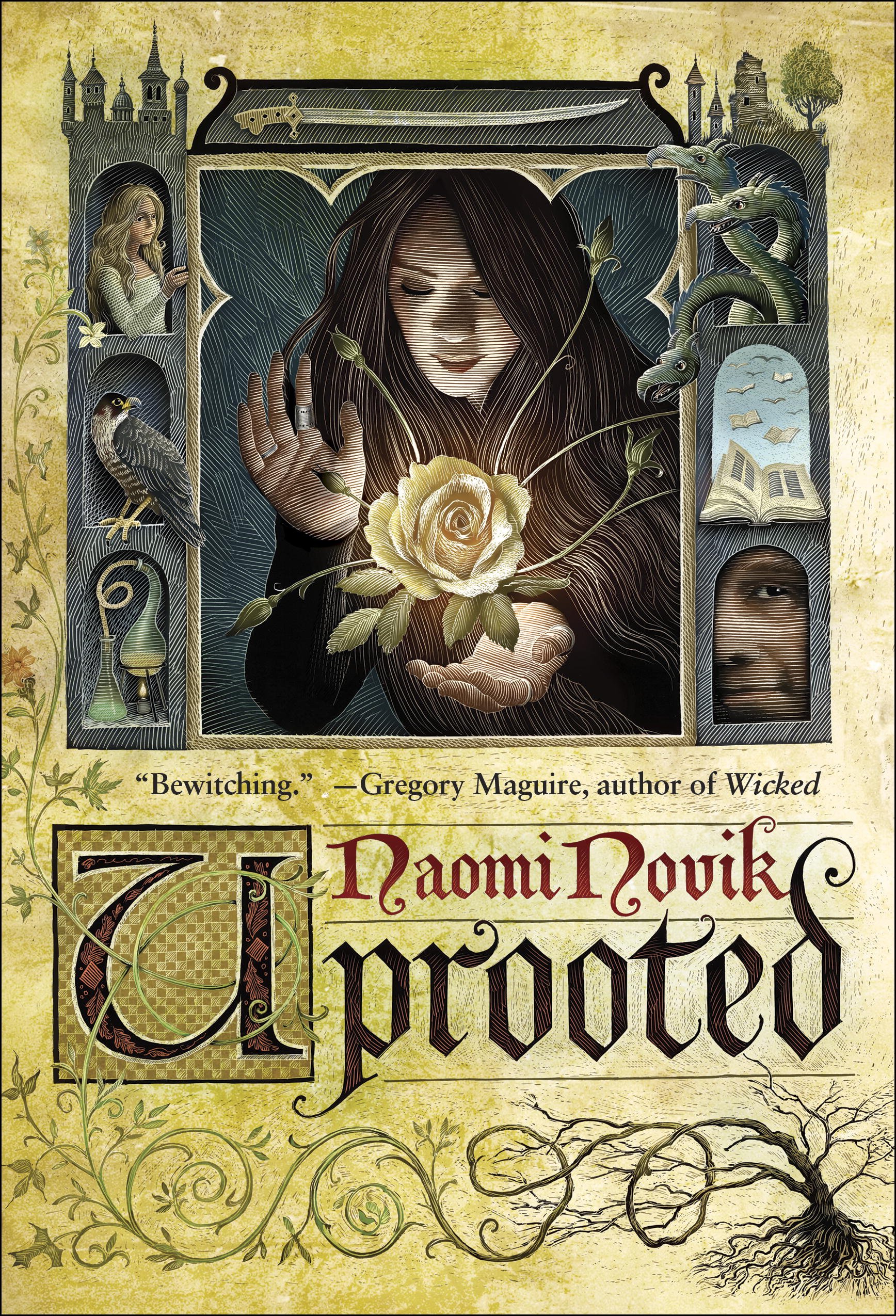
Uprooted by Naomi Novik rounds out my favorite fantasy only because it is last alphabetically.
One thing that struck me throughout the novel is a pervading sense of anger; it fueled much of the character interaction and pulled much of the plot along. Anger seems to be the only emotion, or a version of it such as disdain, the Dragon exhibits for much of the narrative. The prince, Marek, who visits the Dragon and later implores Agnieszka and the Dragon for their help, shows disdain and anger towards the Dragon. The other wizards introduced later in the novel seem to feel anger towards each other, while the Dragon condescends to interact with them with a great deal of spite. When Agnieszka interacts with people from her village in the middle-to-latter portion of the novel, they emanate an air of anger bordering on hatred to her. And yet, despite that anger driving many of these characters and the plot, Novik manages to overlay that anger with a sense of beauty and hopefulness; hope through the fierce determination of her character Agnieskza. Of course there are other emotions at play here, too. There’s a deep abiding love-of-friendship between Agnieszka and Kasia that provides an emotional backbone to the novel. There’s also sorrow and compassion and those come through in some of the minor characters.

Perhaps because I recently wrote about the books for SF Signal, I found many emotional and linguistic resonances with Patricia McKillip’s Riddle-Master trilogy. There’s a sense that the world in Uprooted echoes the folk tales of Europe, that it has a rich tradition sewn into the DNA of the world the characters inhabit, but we as readers meet these character at a time of Great Change, after all why else would we meet these characters?

Other 2015 fantasy books I enjoyed a great deal in 2015….
  • The Skull Throne by Peter V. Brett - "…pride may be one of the characteristics or traits that does in many of the characters and can be seen as the greatest flaw a person can have in this world. Rojer, Jardir, Jayan (among others) all exhibit a great deal of hubris and pride. Some of them overcome that and don’t let the hubris consume them, but when that hubris so strongly defines an individual character here, it tends to be a fatalistic flaw. Leesha was quite prideful in her journey through to The Skull Throne, but in this third volume, her pride seems to have been quelled and as a result, she is a stronger character. I have been enjoying The Demon Cycle through the first three books and even more after The Skull Throne; I love the world building and enjoy the characters, but is also rewarding to see a writer’s skill and prowess grow from one novel to the next."
  • Chapelwood by Cherie Priest - "Thirty years after Maplecroft, the second (and at this time final) novel begins. Lisbeth is alone, her sister Emma has passed, her lover Nance has disappeared, and Dr. Seabury finally lost his battles with sanity and also passed. Lisbeth is drawn to the strange occurrences in Birmigham, AL. Though I haven’t read every Cthulhu mythos tale, for my money,Maplecroft and Chapelwood are the epitome of modern entries of that subset of horror and dark fantasy. Although there are only two novels chronicling the Borden family’s conflict with creatures out of the Cthulhu mythos, I would not mind the title of this column being invalidated."
  • The Price of Valor by Django Wexler - "…on the whole, Django Wexler manages to reveal more layers of the plot of the antagonists and more about his characters. Some closure here, but dammit, the unresolved elements and giant hints of things to come have the next installment in The Shadow Campaigns quite high on my I NEED TO READ WHEN IT PUBLISHES list. With The Price of Valor, Django Wexler continues to prove that he’s got a great story to tell...an excellent installment in a thoroughly entertaining Military/Flintlock Fantasy saga.”
  • The Court of Fives by Kate Elliott – Court of Fives is one of those deceptively simple novels in which there’s a lot to be gleaned from the page if you know to look for it, and even more happening beyond the immediate action, as little details come together to build a very sound structure of a novel. …Jessamy is an extremely well-rounded character who, for all of her love for her family and inner strength, is flawed, occasionally allowing her pride to get the best of her.


Rob Favorite 2015 Science Fiction Novel(s)


The divide between Fantasy and Science Fiction was much more even this year, but much of the SF I read was backlist like CJ Cherryh. I think the SF book I enjoyed the most was The RED: First Light by Linda Nagata. Yeah, I know it is technically an older title, but a new edition was published this year through Saga Press:

Lieutenant James Shelley is in charge of a Linked Combat Squad (LCS), who has dubbed him King David because of his premonitions which have often saved some, or all of them, from defeat or death. In this near future (probably about Twenty Minutes into the Future) members of the military wear skull caps on their heads which connect them to a cloud network. The military answers more to defense contractors than the government. The skull caps worn by the squad members also, via the cloud and their network administrator (for lack of a better term), control their emotions to ensure a more cool and calculated demeanor in the field. Ironically enough, Shelly was a war protestor and in lieu of serving out a jail sentence, he agreed to join the military. He excelled and eventually Shelly’s premonitions become more powerful, but he sustains a very damaging combat injury in the first third of the novel. What provides Shelly with these premonitions is something he dubs “The Red;” but is it malevolent, benign, or benevolent or more likely, an unknowable wild card?
...
A big part of what I, and many people, enjoy about SFF is seeing familiar elements spun in a new way so I guess what I’m saying is that Nagata manages to bring a many familiar elements together (and few SF frameworks are as familiar or popular as Military SF) into something that manages to echo great stories that preceded it while still engaging in a powerfully refreshing fashion. In The Red, Nagata manages one of the most seamless, enjoyable, and enthralling meldings in SF of that familiar and “new spin.” I am excited to read the further exploits of James Shelley, The Red and wherever this story goes.


Since James S.A. Corey (AKA Daniel Abraham and Ty Franck) published another installment of The Expanse guess what makes my list again? Yup, the fifth installment; Nemesis Games (The TV show just launched!)

After returning from the planet Ilus at the far end of the Galaxy through the gate the protomolecule opened, Holden and crew go on shore leave in search for a bit of respite. Each has some affairs to settle or loose ends requiring tying up from prior to the series events. Naomi wants to reconnect with her son, Alex initially wants to make amends with his ex-wife, and Amos wants to settle up with a woman from his days as “Timmy” on the streets of Baltimore. Meanwhile, Holden is tasked by Fred Johnson, leader of the Outer Planets Alliance, with tracking down missing space vessels.

Each member is sort of going along on their own business when a major terrorist attack shatters the Earth. As such, we see the story through each of their personal lenses with all POV chapters from a member of the Rocinante. Each member of the crew is affected dramatically by their circumstances away from Rocinante, with Naomi a “guest” of her former lover, and Amos near one of the ground zeroes of the impact of the attack. Alex and Holden, have their own life-threatening issues to deal with after the attack, too. We’ve seen glimpses of the other characters in Holden’s presence, but never separated like this. At five books into the series, splitting the characters is a genius move to make the crew of theRocinante still seem fresh with plenty of room to breathe and develop. We knew them, sure, but we didn’t know them completely and only had glimpses or hints of their past. (At least in the novels.)

Next up is a book by an author who I first read last year, the fabulous Delilah Dawson. This is the first audio book on the list, Hit by Delilah Dawson:
It isn’t too much of a leap to think that banks own us, our debt, and everything we possess because of our debt to banks and credit cards. Take that idea one step (or leap) further – A single bank buys out all of America’s debt and America is the United States of America in name only. In Delilah S. Dawson’s dystopic tale Hit, Valor National (Bank) has done just that and owns all the debt. If you are overdue, they’ll come collecting just as they did on seventeen year-old Patricia (Patsy) Klein’s single mother (Patsy’s father left them years ago, and is only a faint memory for Patsy) with three options: pay all your debt now, die, or become an indentured servant for Valor National. In other words, become a bounty hunter for the bank and approach other people who owe Valor and offer them the same options. The indentured servitude lasts 5 days or until the 10 people on the list are killed, brought into service, or least likely, pay their debt.

The natural dystopic comparison is to The Hunger Games, if only because both novels feature a very head-strong, likable, engaging, young female protagonist. If anything, the America and world revealed in Hit could be seen almost as a precursor to the fractured and realigned national boundaries of Panem. There’s a certain South Park episode that served as partial inspiration to the novel/series/world, but the story takes off from the notion set forth in that episode with Dawson’s wonderful pacing and character development.

Planetfall by Emma Newman is a powerful and Important novel:
Let’s get this out of the way first: Planetfall is not an easy book to discuss without giving away too much about its plot and characters. So I won’t give away too many of the finer details of the plot—what can be said is that approximately 1,000 colonists left Earth, including the protagonist, Renata “Ren” Ghali, who followed Lee Suh-Mi, her lover and leader of this group, to the new planet in what can best be described as a pilgrimage of faith. Earth was not in the best of shape, but there isn’t much more elaboration than that in the plot or background details. When the colonists arrived on the new planet, Lee entered a pre-existing structure the colonists discovered and came to name God’s City. When Newman begins the novel 20 odd years later, Lee had yet to return from God’s City and she is revered as something close to a saint as the people await her return and still follow the spirit of her beliefs.

Planetfall is at once a fascinating character study through Ren’s first person narrative and a novel that examines how secrets, no matter how deeply buried they are, can be extremely damaging things…especially in a small colony in a seeming utopia. Ren spends much of her day as the colony’s printer, responsible for overseeing an advanced 3-D printer which is used to repair damaged items or create new items when necessary. Any items. Ren’s obsession with repairing things is a mask for trying to repair the damages left in the wake of Lee’s disappearance, and an attempt to bury her own guilt in the tragic events which transpired nearly two decades ago.

Other 2015 Science Fiction Novels I enjoyed a great deal in 2015….
  • Alive by Scott Sigler - "… With Alive, I feel like Scott upped his game. It isn’t always easy (at least for this relative and at the time very neophyte audiobook consumer) to get an idea of an author’s prose, listening to the book makes it a bit challenging to linger over the page and consume the prose with as much in-depth consideration. Even with that disclaimer, I think Scott’s prose here in Alive was a strength, and his use of the first person narrative was very engaging and helped me to finish reading the book in just a couple of days."
  • Zero World by Jason M. Hough - "I thought Zero World was a blast. One of my favorite Science Fictional tropes* is the Parallel Universe. Stories that feature protagonists/worlds and their mirror images which differ in only slight details, novels like The Talisman, the classic novel from Stephen King/Peter Straub, Michael Moorcock’s Eternal Champion cycle, or the many parallel worlds in comics, especially those of DC Comics’ Elseworlds. So you’ve got that element with Zero World and a protagonist that is like Leonard Shelby (from the film Memento) possessing the physical abilities of The Bionic Man and the tactical/combat/superspy knowledge of Jason Bourne or James Bond.."

Rob's Favorite 2015 Debut(s)

      The debut with the most hype and the one that came close to living up to it was Ken Liu’s The Grace of Kings, the first installment in his Epic Dandelion Dynasty:
      Set in the Dara archipelago (an imagined world with a Asian resonances), the Emperor Mapidéré has united the many islands under one banner. Immediately, in my mind, a flag arose. This could be seen as an endgame, for an epic fantasy novel/saga – the uniting of kingdoms by an ambitious ruler. But this is where Liu launches his story, at the apex of one ruler’s conquering goals as viewed by a trickster with lofty aspirations and an orphan seeking revenge. This trickster is a young boy who often gets into trouble, would rather frolic than read, but whose mother continually holds out hope that he’ll eventually “get it” and stop his tomfoolery. This is Kuni Garu, one of the primary protagonists of the novel. We see much of the action of the narrative through his point of view, we see him grow into manhood, become a husband, father, and unlikely leader of men. Kuni joins a street gang, has many adventures until he finally appoints himself Duke Garu and grows a legion of followers who pledge themselves to him. As Kuni climbs the social strata and makes a name for himself, he falls for a woman named Jia, the woman who becomes his first wife. … The Grace of Kings is one of those books that is a major part of the ongoing “conversation” of genre, as Coode Street podcasters Jonathan Strahan and Gary K. Wolfe often refer. (I –highly– recommend checking out the episode of their podcast featuring Ken Liu and Saga Press editor Joe Montias well as Ken and Joe on Rocket Talk with Justin Landon). One of those topics of the “ongoing conversation” is the treatment of women characters and gender in the genre. There’s been a fair amount of criticism about the lack of female characters in this novel, itself just the first part of a trilogy. (This raises the question, I suppose, of how to review one novel in a series, which is a large chapter in a much larger story. That topic could be an essay or podcast itself.) While I can understand that frustration – to a point – it seems to me in order to showcase an element that might be underrepresented, one must first illustrate that deficiency.
      C.A. Higgins’s, Lightless, impressed the hell out of me when I read it and I’m looking forward to my from this author
      The System is the governing body of the solar system, they have total control of the populace. One of their experimental military space vessels – the Ananke – is boarded by two hostile men. These men, Mattie and Ivanov, are known to be thieves (Space Pirates!) and are suspected to be allies of the galaxy’s most infamous terrorist. Ivanov is caught, Mattie escapes. But before he escapes, Mattie does something to the Ananke. At the center of Lightless, C.A. Higgins debut novel space is computer scientist Althea. … Higgins is an astrophysicist, having recently graduated from Cornell University. Impressively, she also wrote this novel whilst studying for her degree. While at the heart of the novel is a science fictional trope that has been part of the genre for many years, Higgins extrapolates the science of today well enough in the details to make it a plausible question to consider. Equally impressive is that, like a blanket over the hard science fictional core of the novel, is some deft characterization, plotting, and story pacing. Another element of the story that Higgins evoked very powerfully was claustrophobia – both in terms of the confined atmosphere of the space vessel and the urgency of the timing of everything. Althea is under a very imposing deadline to repair the computers of two space vessels and Ida is feeling a great deal of internal pressure from her own superiors to prove that Ivanov and Mattie are connected to the terrorist Mallt-y-Nos. Even if there isn’t a xemomorph hunting the crew of Ananke the way one hunted the crew of the Nostromo, Higgins captures that same claustrophobic, confined feeling just as well.


    Favorite Backlist / Book Not Published in 2015 Read in 2015

    As I said earlier, I started an audible subscription this year.  One of those audio standouts was Station Eleven by Emily St. John Mandel, the first audio book I snagged with my audible subscription and the bar was set very high.
    George R.R. Martin proclaimed when he stated that Station Eleven was his favorite book from 2014, it is a book that shouldn’t work. The structure is not linear, it veers all over the place and doesn’t make itself immediately clear how everything is connected. That perceived barrier is what makes this such a strong and powerful novel because Mandel so skillfully weaves these narratives and left me at each seeming halting of a specific narrative wanting so much more. So I continued with the “new” narrative in the hopes of coming to a connection point between the seemingly separate narratives only to be fully engrossed in that “new” narrative. Or, in other words, I was wrapped up in what was happening to Kirsten only for Mandel to switch over to a narrative featuring Leander’s first wife Miranda and found myself equally enwrapped in her story. … Station Eleven is also a story about the power of art and how humanity will continue to express and be mystified by art. This couldn’t be more evident with an actor dying on stage or another protagonist as a player in the Traveling Symphony. ….or where the novel gets its title, from a comic book / graphic novel titled Station Eleven depicting humanity in space as a result of a ravaged earth. We see both the creative process and energy that went into the creation of the comic book as well as its long-ranging effects as Kirsten carries a copy around as both a comfort read and remembrance of the World Before. Like the Traveling Symphony itself performing King Lear as Arthur died performing the same play, the graphic novel Station Eleven is a great mirror with which to compare the novel itself.
    I also loved the The Dresden Files installment from last year, Skin GameThe Martian by Andy Weir, and the second installment of Elizabeth Moon's Vatta's War sequence, Marque and Reprisal. She's publishing a new installment in that milieu this year so I'd like to read through the last three in the five book series. I didn’t do a formal review of these books but that is no indication of my lack of enjoyment. Both were great. Another audio book I thoroughly enjoyed was from an author I’ve been following and friendly with on twitter for a while, Miserere by Teresa Frohock.

    Lucian Negru, a Katharoi, is a disgraced (or fallen) exorcist in Woerld; one of four parallel worlds and specifically, Heaven’s primary “defensive line” between Earth and Hell. He is living on the proverbial leash of his twin sister Catarina, a dark sorceress looking to help the demon Mastema take over the known worlds. When she was at the gates of Hell years prior to the events of the novel, Lucian forsook his oaths as a man of god and to Rachel, the women he loved, in the hope that he could save his sister’s life and bring salvation to her soul. That didn’t quite work out completely, because although Catarina’s life was saved, her soul was tainted. For sixteen years, Catarina has continued to ask Lucian to open the Hellgates, despite his continued refusal. She begs him to constantly heal her wounds, which he does, but she mentally abuses him, and with some help, physically abuses him over those years leaving him a cripple with an unhealed leg. … Miserere is a novel of devotion, faith, god, demons, angels, and love. The novel utilizes Christian imagery and myth, but throughout the novel, it does not proselytize. Christian myth and biblical imagery provide the backdrop/world-building and it is handled beautifully through the characters, their actions, and the affect of the world(s) on the characters. One other thing I appreciated was the gender flip Frohock employed in the novel. When there is an abusive relationship between man and woman, the default dichotomy is for the man to be the abuser, the woman the victim. With Lucian and Catarina, Catarina is most definitely the abuser and Lucian the broken one who struggles to both remain in the relationship (for 16 years) and finally, with great difficulty and little outside assistance leaves the relationship. As the remainder of the narrative demonstrates, Lucian has a great deal of internal strength; he is saved as much by Rachel and Lindsay as he saves them both.
    MVP Author of 2015

    The criteria here is based solely on books published..since there a handful of authors who had high profile media adaptations release this year (ahem Andy Weir, James S.A. Corey). So, for me, here's what made this author my MVP author of 2015...

    I tried to narrow this down to one author, but found that a difficult task. So, I'm going to mention two and whether you want to call them co-MVPs or MVP and first runner up, that's up to you. MVP and runner-up seems OK. Then again, in 1979 the National League MVP was awarded to two baseball players. Either way, both authors deserve special mention. The first is based on how much I thoroughly enjoyed what I read from her, so let's do this.

    One author published five books this year, two of which I read. The two novels I read each launched a new series, she published a retrospective of her short fiction and a few short novels/novellas set in her existing worlds. This author was also a guest on many podcasts I listened to over the course of the year and was a wonderful voice, both from a fictional storytelling perspective and also from an Important Voice for the Genre standpoint.

    As I said above, Black Wolves was one of my favorite novels of the year, a novel that has me very eager to dive into her backlist. Elliott’s young adult debut, Court of Fives was a stunning novel, too. I recommended it to a cousin on facebook after she was looking for something new to read and she was blown away by it. I'd mentioned before (early last year and as far back as 2013) that I wanted to revisit Kate Elliott's Crown of Stars series and finally began the first volume, King's Dragon, in the waning days of 2015 and I'm loving it. I'm likely not going to post a "Anticipated Reading" post for 2016, but chances are I'm going to be reading quite a bit of Kate Elliott in 2016 and perhaps dive into either Jaran or Crossroads trilogy (Crossroads is set in the same world as Black Wolves). 

    A very strong runner-up/co-MVP is Chuck Wendig as he was nearly as impossible to ignore for all the right reasons. Chuck published a dark, near future cyber-thriller, Zer0es, a new installment in his Miriam Black series, finished out The Harvest, his young adult series, with The Heartland, self published the second Mookie Pearl novel, The Hellsblood Bride, after some build-up helped to launch a flagship comic book title (The Shield from Dark Circle Comics), and oh yeah, published Aftermath the flagship title in the lead up to Star Wars: The Force Awakens. I only read two of the books and the comic and enjoyed them a great deal. Chuck bore a majority of the brunt of the Sad Banthas © John Kovalic (Star Wars “fans” who are extremely vocal about their anger over everything they judge as “incorrect” in Star Wars since the Disney buy-out) and came out better for it.

    So that's my wrap-up of what I read in 2015.