Showing posts with label James Knapp. Show all posts

Friday, February 13, 2015

Friday Round Up! Bear, Bara, Moon @ SFFWorld and an Apocalyptic Mind Meld!

Been a while since I’ve done one of these Friday updates…oddly, I seem to begin these posts this way. I’ve had less time to do any blogging since my day job has been busier and the increased firewalls preventing me from doing any non-work related internetting.

So, on with it with the last few reviews I’ve posted to SFFWorld…

The first book review I posted in 2015 was for Elizabeth Bear’s fun and enchanting Karen Memory, a terrific steampunk / weird western / murder mystery:

That’s a great voice readers encounter immediately and throughout the novel, Bear remains powerfully consistent with that voice, not skipping a beat. As such, the copyeditor for this one should get special mention for ensuring the voice remained consistent over the course of the novel. Karen is a “seamstress,” which is code for sex worker and as such, Hôtels such as Madame Damnable’s were required to pay a sewing machine tax. Some may find it surprising that this was a real thing of Seattle’s past.
The other standout element is the wonderful cast of characters who, for the most part, are unapologetic, empathetic, and genuine. I thought Bear’s depiction of the budding relationship between Priya and Karen against the dark and fantastic backdrop proved a great optimistic balance. As for the cast of characters as a whole, they are diverse in a way that feels natural for the story. Karen Memory is a relatively short novel by today’s standards (352 pages), but Bear packs so much passion, energy, and uniqueness in the novel.


Earlier this week, my February Mind Meld was posted to SF Signal, in which I ask Bob Reiss, David Annadale, E.E. Knight, James Knapp, Jason Hough, Jaym Gates, Kristin Centorcelli, and Paul Weimer

Apocalyptic and Dystopic scenarios are immensely popular, ranging from stories of the Zombie Apocalypse, Alien Invasion, Superflu, Environmental Disaster, or the quite popular “Unexplained.”


Last week, my review of Dave Bara’s debut novel a rollicking Space Opera / Military Science fiction novel, Impulse:

The story is set far enough into the future that “Old Earth” is not the focal planet for humanity in the story, rather, Quantar is at the center of events. Like many Military Science Fiction novels,Impulse is told in the first person, in the case from the viewpoint of Peter Cochrane, a Lieutenant in the Quantar Royal Navy, who is assigned to investigate a disaster in space which claimed the lives of fellow military personnel, including his girlfriend. The Impulse; however, a Unified Space Navy ship is under foreign command and ends up on a moon/planet about which little is currently known. Peter initially received this news from his father (Grand Admiral of the Quantar Navy, and part of the ruling family of Quantar), though the assignment comes from his superior, Supreme Commander of the Unified Space Navy.There’s a deep history to this universe, with a long-vanished civilization leaving relics behind for humanity to discover. These Relics each have a code of sorts associated with them that if we are advanced enough, we can decipher it. While this is a fairly tried and true trope of the genre, I was reminded of Mark Van Name’s Jon and Lobo novels. Other elements reminded me of David Weber/John Ringo’s Empire of Man novels. The bulk of the knowledge of these Relics is protected by the Historians, advanced humans from Earth who don’t often take too active a role in humanity’s development and exploration. These characters reminded me a great deal of the Observers from the TV show Fringe.

My most recent review is the final novel in Elizabeth Moon’s Paladin’s Legacy series, Crown of Renewal:

The main thread of the novel deals with Dorrin Verrakai and how, as Duke, she adjust to the political and military power she possesses coming into conflict and with the magical power growing within her and in the land. She is quite symbolic of the various changes occurring in the world of the novel. When she was appointed Duke, she was the first female to be appointed such a role. Her family line provided conflict and trust issues over those whom she presided. Change is thrust upon her again when she is given the task of transporting a magical crown that speaks to her as if she is queen. Dorrin must make some difficult choices about her status as Duke and Heir, two roles that she cannot hold. Unfortunately, the choice she makes affects more than just herself.Crown of Renewal (and the five books which comprise The Paladin’s Legacy) proved once again that Elizabeth Moon provides me with novels I enjoy and find satisfying from character and (mostly) plot perspective. In other words, throughout, I found this to be a dependable Fantasy series that delivered an immersive and enjoyable reading experience. While some of the plot points and character movements went to places I may not have expected, my high expectations for a novel I could dive into and trust to tell me a good story were well met.

Friday, June 28, 2013

Recent Reviews & Interviews at SFFWorld: Ryan, Decker, Matheson & Pacific Rim

The SFFWorld Blog (and reinvigorated SFFWorld main site) have seen a flurry of new content posted over the past couple of weeks, some reviews from Mark and me, plus a new interview.

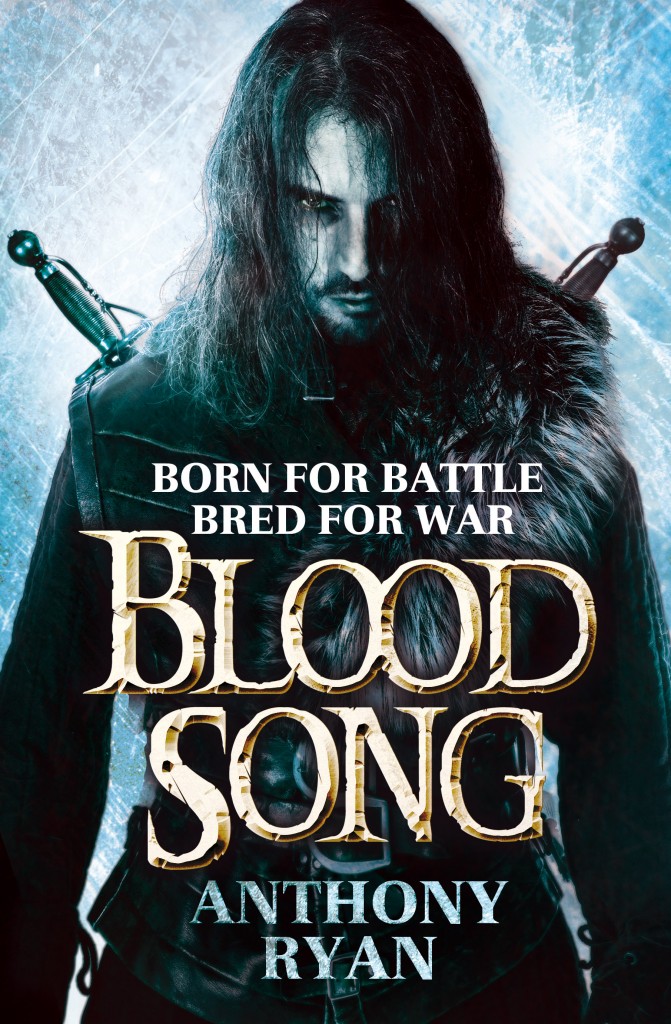
Earlier in the week, I posted my review to what is likely to be the most impressive debut fantasy novel of 2013, Anthony Ryan's Blood Song:

Much of the novel follows the growth of Vaelin from a blank slate of a young child to a hardened warrior trained by the Order in the art of war and combat. Vaelin distinguishes himself early, gaining the respect of his peers and making close ties with a handful of boys, much like (I assume) soldiers would bond during their military training. Vaelin comes to think of these peers as his brothers, Barkus, Caenis, Dentos, and Nortah. The bonds of trust and respect that develop between these young men are strengths of Ryan’s narrative on full display throughout the novel. One writer I’ve always felt who handles such bonds of friendship between youthful characters is Stephen King (The Body, Hearts in Atlantis, for example) and here, Ryan captures that bond just as powerfully.
...
Ryan’s style is somewhat relaxed and paced extremely well. I was lulled into the novel with Ryan’s almost conversational tone which kept me reading as the strength of the narrative’s power clung to me very strongly. The framing device, a chronicler hearing the legend of the man from the legend himself, utilized allows for an unreliability to set in as the novel progressed. Questions the historian Someren asks don’t exactly match with the narrative it seems Vaelin is telling in the framed sections of the novel. Unreliable narrators work best when this unreliability comes through subtly, and like Rothfuss and Gene Wolfe before him, Ryan pulls off this balance quite well.

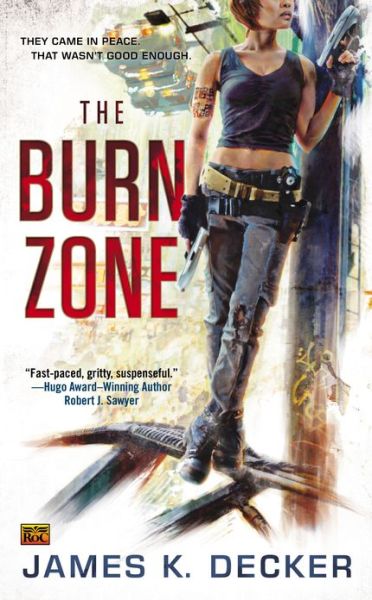
I read and loved James K. Decker's The Burn Zone earlier in the year and it will likely go down as a top SF read for me this year.  As such (and with a pending Author Roundtable with him, T.C. McCarthy and a yet unnamed author).  Here's the link to the interview:


For folks who are on the fence about reading The Burn Zone what would you tell them to push them over the edge to read the book?

As a science fiction fan, I feel like not enough science fiction attempts to go out a little bit on a limb. My editor informed me that The Burn Zone was totally different from anything they had in the works when release time came – I wasn’t sure if that was meant as a good thing or if they were nervous about it, but I am a science fiction fan, and I love works that make an effort to be different. There is violence in The Burn Zone to be sure, and yes, there are aircar chases and action sequences, but underneath all that is the story of real people with real world problems that matter. Come out and join me on the limb, it will totally hold us all.


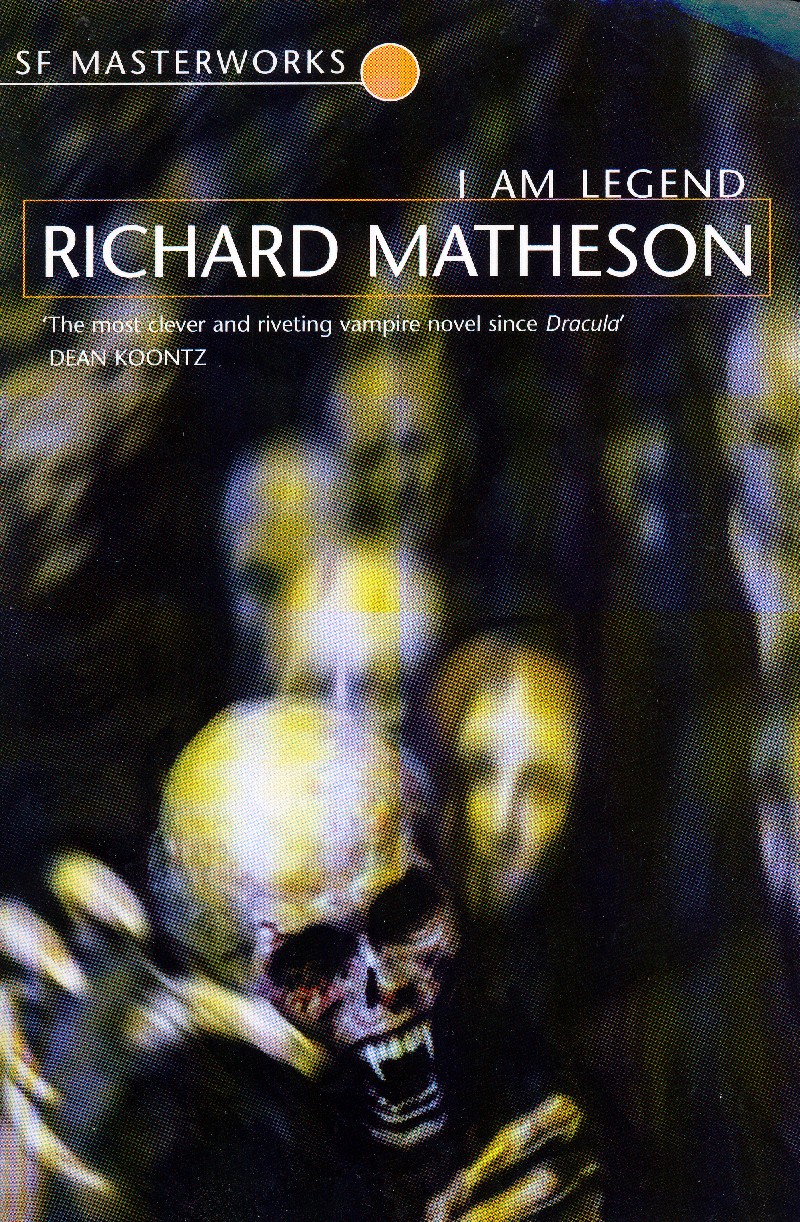
Mark posted a review of the classic (and IMHO, the best modern) vampire novel I am Legend by the late Richard Matheson:

The story is pretty straightforward. Starting in (a future) 1976, the story concerns itself with Robert Neville, the last surviving human in a world of vampires. Every night his barricaded house in Los Angeles is surrounded by vampires who wish to claim him and spend their time shouting at him to come out. His days are spent repairing the damage from the previous night, collecting provisions and trying to find a cure for the mysterious vampire illness that seems to have appeared almost overnight. As the book develops, Neville realises that he must find a cure if he is to survive.

Surprisingly to me, I hadn’t realised when I first read it that this was Matheson’s first published novel. Though he went on to write Hell House and The Incredible Shrinking Man, as well as scripts for The Twilight Zone and films, for a first book this is startlingly frank - a dark and angry novel. Though not perfect, for a debut novel it is stunning. The prose is stark, simple and yet effective. It is a masterwork of the minimal, one of those books that says more by saying less, bluntly and directly.


Mark also had a look at the behind-the-scenes / art book for the forthcoming film, Pacific Rim: Man, Machines, & Monsters:

This book shows that he clearly enjoyed the experience. The robots, monsters, cities, boats and other vehicles from the film are all shown here in various guises, in quite some detail. Although there’s the odd film picture, the book also shows a lot of obligatory behind the scenes photos of the film’s quite colossal production.

To the book itself, then. Presumably like the film, it is a lavish production – quality stock, lots of full-colour pictures throughout, and some lovely big versions that would look terrific framed. The attention to detail is very pleasing. The book has lots of little items stuck into the book throughout, that the inner fanboy/girl will love. There’s posters in an envelope at the back, Jaeger stickers, alien diagram pullouts, identity cards, blueprints of all the main robots, a page from Guillermo’s notebook. It’s the sort of thing you can imagine being paraded proudly in the school playground, although the reader may find them a little fiddly and annoying, even when they look great.

Sunday, January 13, 2013

Books in the Mail (W/E 2013-01-12)

Another week with just a few releases, but with the size of Mount Toberead, I am not complaining.


The Burn Zone by James K. Decker (Roc, Mass Market Paperback 02/05/2013) – James K. Decker is the open pseudonym of James K. Knapp, author of the Revivors, the first of which State of Decay, I reviewed and enjoyed a couple of years ago.

Plagued by overpopulation, disease, and starvation, humanity was headed for extinction—until an alien race called the haan arrived. And then the real trouble began.

It’s been a rough day for Sam Shao. As part of a program that requires humans to act as surrogates to haan infants, Sam has been genetically enhanced to bond with them. So when three soldiers invade her apartment and arrest her guardian for smuggling a dangerous weapon into the country, Sam can sense that something isn’t right. One of his abductors is a haan masquerading as a human, and the supposedly fragile haan seems to be anything but.

Racing through the city slums, trying to stay one step ahead of the mysterious haan soldier, Sam tries to find the man who, in her twenty years, has been the only father she’s ever known. Could he truly have done what he is accused of? Or did he witness something both human and haan would kill to keep hidden? The only thing certain is that the weapon is real—and lost now somewhere in a city of millions.

Fighting the clock, Sam finds an ally in Nix, a haan envoy devoted to coexisting with humans, or so it seems. But what she really needs are answers. Fast. Or else everything she knows—and everyone she loves—will burn..


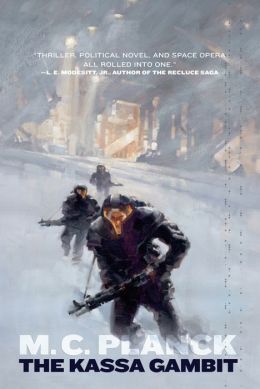
The Kassa Gambit by M.C. Planck (Tor, Hardcover 01/08/2013) – I recently reviewed this for Tor.com and thought it OK, but ultimately uneven.

Centuries after the ecological collapse of Earth, humanity has spread among the stars. Under the governance of the League, our endless need for resources has driven us to colonize hundreds of planets, all of them devoid of other sentient life. Humanity is apparently alone in the universe.

Then comes the sudden, brutal decimation of Kassa, a small farming planet, by a mysterious attacker. The few survivors send out a desperate plea for aid, which is answered by two unlikely rescuers. Prudence Falling is the young captain of a tramp freighter. She and her ragtag crew have been on the run and living job to job for years, eking out a living by making cargo runs that aren’t always entirely legal. Lt. Kyle Daspar is a police officer from the wealthy planet of Altair Prime, working undercover as a double agent against the League. He’s been undercover so long he can't be trusted by anyone—even himself.

While flying rescue missions to extract survivors from the surface of devastated Kassa, they discover what could be the most important artifact in the history of man: an alien spaceship, crashed and abandoned during the attack.

But something tells them there is more to the story. Together, they discover the cruel truth about the destruction of Kassa, and that an imminent alien invasion is the least of humanity’s concerns.


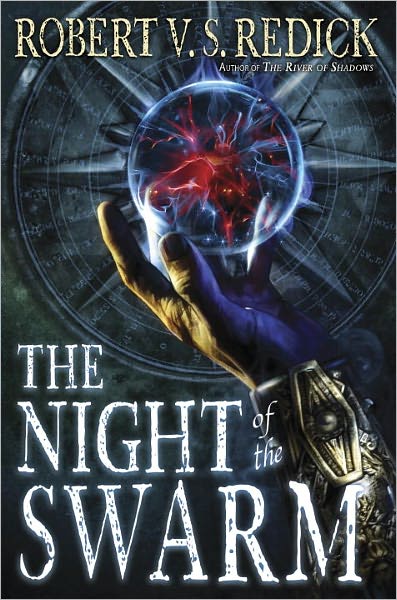
The Night of the Swarm (The Chathrand Voyage Book 3) by Robert V.S. Redick (Del Rey Trade Paperback 02/05/2013) – Now that this series is complete, I will be jumping into it. Those whose opinions I respect (particularly Liviu of Fantasy Book Critic) have been praising these books for quite some time.

Robert V. S. Redick brings his acclaimed fantasy series Chathrand Voyage to a triumphant close that merits comparison to the work of such masters as George R. R. Martin, Philip Pullman, and J.R.R. Tolkien himself. The evil sorcerer Arunis is dead, yet the danger has not ended. For as he fell, beheaded by the young warrior-woman Thasha Isiq, Arunis summoned the Swarm of Night, a demonic entity that feasts on death and grows like a plague. If the Swarm is not destroyed, the world of Alifros will become a vast graveyard. Now Thasha and her comrades-the tarboy Pazel Pathkendle and the mysterious wizard Ramachni-begin a quest that seems all but impossible. Yet there is hope: One person has the power to stand against the Swarm: the great mage Erithusmé. Long thought dead, Erithusmé lives, buried deep in Thasha's soul. But for the mage to live again, Thasha Isiq may have to die.

Wednesday, February 16, 2011

State of Decay by Knapp and assorted thoughts

Only one new review this week, a debut novel from 2010. I’m still playing catch-up with a lot of the 2010 releases. James Knapp’s State of Decay, a zombie/near future/thriller/mystery hybrid:


I can’t help but give credit to Knapp for what he’s trying to do here. In the current state of the genre, Zombies can be considered the new vampires, they inhabit some of the more popular video game franchises, some of the most popular comic books, popular movies, and thanks to the recent adaptation of The Walking Dead TV screens. Knapp is hitting upon a hot trope and seems to be having fun with it. He’s playing with that trope in interesting ways, though he isn’t exactly the first to show zombies being used as a form of slavery. His zombies, as I previously indicated, retain a portion of themselves. This is where the comparison to Blade Runner comes into play as one of the questions posed by the narrative and the characters is whether or not these reanimated corpses are humans and whether or not they have rights. It’s an interesting question to pose – just where does humanity end and death begin?

Also on the reading front, as my sidebar currently indicates, I’m in the midst of two books I’m really enjoying. The Age of Odin by James Lovegrove, which is a military sf set in the very near future with a woman president and a world where the Æsir, the Norse Gods, are looking to make their presence known in the world once again. Liviu at Fantasy Book Critic enjoyed the first two (Age of Ra and The Age of Zeus) in this connected trilogy and this one is a ton of fun, so I’ll probably go back and read the earlier installments.

The other book is of course, The Name of the Wind. This is my second reading of the book and I love it. I’d forgotten how inviting Rothfuss’s prose is and just how powerful his narrative pull is.