Showing posts with label Mark Yon Review. Show all posts

Friday, June 13, 2014

SFFWorld/Tor.com Round-up: Hulick, Aaron/Bach, Campbell and Hunt

Been a busy week for me on the intarwebs.  Or rather, things I'd been working on last week and a bit prior saw the light of day over the past week or so. I mentioned the SF Signal stuff yesterday, so today, I'll mention the SFFWorld and Tor.com stuff.

Wednesday, my review of Sworn in Steel, Douglas Hulick's second Tales of the Kin novel was posted to SFFWorld. This is a fun Sword & Sorcery series that I hope to be reading for a while.  Think one part Brust, one part Lynch, throw in a little Wendig and a dose of Goodfellas and you'll get an idea.  The second novel, Sworn in Steel, was just as good as the first:

The events of Among Thieves had major ramifications on Drothe and the criminal underworld of Ildrecca, where he made his home. One of those ramifications has seen his closest friend – Bronze Degan – disappear, though Drothe manages to learn where Degan went rather quickly and despite knowing Degan likely doesn’t want him to follow, Drothe tries to find his friend. This is problematic, because Drothe’s station has moved up in the world considerably as a result of the fallout of Among Thieves. By leaving Ildrecca to travel across the sea to this faraway nation of Djan he is leaving some very important responsibilities behind. Another Degan*, who only gives the name Wolf, compels Drothe to leave Ildrecca to find Bronze Degan after framing Drothe for the murder of one of Drothe’s rivals. Wolf sees Degan as a very important key in unraveling the truth of the Order of Degans. Drothe also manages to get involved with a troupe of actors who join him on his journey.
Also on Wednesday, a new piece I wrote for Tor.com went live. My fine editors (Bridget McGovern & Irene Gallo) at Tor.com have been doing their part to step-up for Hachette/Orbit authors because of the problems between Hachette & amazon.com. For my part, I put together this overview/review spotlight on Rachel Aaron/Rachel Bach, Aaron and Bach: A Tale of Two Rachels:


Rachel Aaron is an Orbit author, through and through, under both her real name and the pseudonym Rachel Bach. She is a writer who was cultivated by Orbit and whose audience grew through some smart publishing decisions in the early days of Orbit’s US imprint. To wit, Orbit US launched in 2007 and her debut, The Spirit Thief, published in October 2010.
Then there’s Rachel’s Paradox series of novels—comprised of Fortune’s Pawn, Honor’s Knight, and Heaven’s Queen—published under the pen name Rachel Bach. Aaron was very open about the pseudonym being used to differentiate her SF from her Fantasy. This isn’t to say there aren’t parallels between what Rachel is doing in her Bach and Aaron books, just a little bit more of some stuff in Bach (more swearing, more sex) and a different setting (secondary fantasy world v. Space Opera). If the Eli books are PG-13, then the Paradox books are more of an R rating.

Over at SFFWorld, Mark Chitty took a look at the latest Lost Fleet: Beyond the Frontier novel, Steadfast:


After the events of Guardian, Geary and his fleet are touring Earth before making preparations to leave Sol with the alien Dancers. But when two of his lieutenants go missing the fleet track them down only to be faced with a problem none of them expected: having to make a rescue from the strictly off-limits moon of Europa. Back in Alliance space, Geary is ordered to the edges of Alliance territory to settle refugee issues from a Syndic system. Once there he discovers that information that the Alliance has been presenting isn’t quite what it seems, and that’s only the start of his troubles…

Steadfast was both the novel I was expecting, and the novel I wasn’t. Let me tackle the first point. Quite simply, Steadfast is a Lost Fleet novel.

Lastly, Mark Yon reviewed In Dark Service, the start of a new series from Stephen Hunt (of SF Crowsnest):


It is good to read of a world that is a bit more than the usual setting, and I liked the point that one of the key features of this novel is the planet itself. The sheer size of Pellas reminded me of Dune’s Arrakis or even Jack Vance’s Big Planet in its scale. By building a world too big to traverse in your lifetime, this also creates an enormous blank canvas upon which the cast (and the writer) can play. As in the best planetary romances, Pellas is filled with different places and settings, groups and societies, all a little beyond the usual. There’s glimpses of an intriguing backstory too that suggests that Pellas has a long history. I am hoping that much of this will develop further as the tale expands.

Friday, May 30, 2014

Friday Round-Up of SFFWorld reviews: de Pierres, Bach, and Abercrombie

Here's a collection of SFF linkery I (or my various internet genre colleagues) have posted this week.

Tuesday, Mark Chitty posted his review of a book I enjoyed earlier in the year (my review for Tor.com), Marianne de Pierres's Peacemaker:


My first impression of Peacemaker was, quite simply, cool. The setting – a Wild West style landscape set in the future – cried out to me as somewhere that could tell some very interesting stories. While the sci-fi side of the coin is perhaps not quite as prevalent as I would have hoped, it really didn’t matter. There were touches here and there to remind you that this was the future, but it was the western elements that really enriched the story.
...
There are also mystic elements to Peacemaker, particularly in Virgin’s spirit pet, Aquila. When she turns up it sets many aspects of the story into motion, and Virgin’s understanding of why and how she is there is never firm. Something that is clear from the outset is that Sixkiller is a font of knowledge, but he rarely offers opinions, and Virgin doesn’t trust him to delve and ask questions


On Wednesday, my review of Heaven's Queen, the concluding (for now, I hope) volume of Rachel Bach's highly charged space-opera series Paradox:


Rachel Bach has crafted a stable foundation over two books in the Paradox series and has left readers like myself hoping for a payoff that both works with that foundation, but also surprises. When we last left Devi, she was an outlaw, having run off from her mercenary group with just her former lover Rupert Charkov by her side. Their relationship is not quite what it once was, Devi now knowing that Rupert wasn’t all that he said he was, she (understandably) finds it difficult to fully trust him at first.. More importantly, he was withholding some very important information from her. This adds more tension to their already strained relationship, but through everything that has affected the two lovers, their true feelings for each other is the core strength of their relationship. Devi, despite her anger and frustration, can’t bury her feelings for Rupert. On the other hand, Rupert continually admits his devotion to her, and almost puppy-dog like fashion.
...
Perhaps what I appreciated most was the candor of the dialogue between Brian Caldswell and Devi leading up to the climax of the novel. Their conversations came across as a fairly level-headed disagreement between two characters who both felt extremely passionate about their opposing viewpoints. Both characters even acknowledged the validity of the other’s argument.


Today, Mark Yon (aka Hobbit) posted a review of Half a King,  Joe Abercrombie's foray into "young adult" or books for younger readers, or whatever you call books that are less squelchy and cursey than his usual fare:


...a Viking-esque, young adult tale that is less gory, less sweary and yet all the more enjoyable for it. It has an Abercrombie tone, it must be said, although I’m still trying to work out what exactly I mean by that, but the writing is as tight and as dexterous as ever.
The forty chapters, generally no more than half a dozen pages each, give the novel an episodic format, but not too fragmented. The characters and their values are identifiable, and, for the most part, likeable.
Our hero, Prince Yarvi, is an outsider, initially put into a position unwanted and yet necessary by circumstances outside his control. Against opposition, he must prove his worth and show that he is capable of dealing with the many problems brought to him. ‘A king must lead’, it is pointed out early in the book.
The twist in the story is that he must do this all the while with a physical disability – he is ‘Half a King’ because he has only one fully formed and functional hand. Consequently seen by many, including his father, as a weakling, (and to my mind rather like Miles Vorkosigan before him), Yarvi has personal demons and practical issues to deal with as well as his unwanted new commitments.

Friday, May 23, 2014

Friday SFFWorld and SFSignal Round-up: Boyett, McClellan, Bywater, Hines plus more!

Here's my semi-regular round-up of reviews and assorted linkery from the past week or so.  Last week, my Completist column for SF Signal went live, this time featuring a two-book series that might be considered cult favorites, The Change books by Stephen R. Boyett:


In the Changed world of the novel, no creature is more magical than a unicorn and nothing holds as much magical power as the horn of a unicorn. It is for this reason that Pete and Ariel must constantly be on guard and aware of their surroundings even more than usual in this dangerous new world. When they come int the area of Atlanta, this danger confronts them head-on as an imposing man on a Griffin who, on behalf of a powerful Necromancer in New York, demands Ariel’s horn. Fortunately, Pete had recently befriended a warrior named Malachai Lee who helps to fend off the Griffin and its rider. Malachai is a sword master of the newly changed world and takes Pete under his wing. With the real threat of a bounty on Ariel, Malachai sets out for New York to confront the Necromancer, demanding Pete and Ariel not follow him.
...
Even though Elegy Beach and Ariel are told in the same type of narrative voice, Fred is a much different narrator than his father. That said, Boyett’s voice in Ariel was crisp and honest, and much the same can be found here. The framework of the two novels is similar; both are essentially quest fantasies wherein the heroes must travel to the enemy’s stronghold and bring him down to save the world.

This week, I posted a new review to SFFWorld for the first time in a few weeks. The book under review? The Crimson Campaign, the second installment of Brian McClellan's Powder Mage Trilogy, which is evolving into a premier Epic/Military Fantasy series.


War is still raging between the Adro and Kez, caught in the middle are Tamas, Admat, Taniel Two-Shot and one-time seamstress Nila, among others. The Crimson Campaign is the second installment of Brian McClellan’s Powder Mage Trilogy and as excellent a debut as was A Promise in Blood, he elevated his game with this second novel.
...
Where A Promise of Blood gave a broad stroke of the military, The Crimson Campaign delves much more into the importance of stability in the military. McClellan also shows how short-sighted leadership can cost a great deal in the long run. Although the gods are a part of the story, these gods are backdrop and merely a part of the story rather than the complete focus. People in the story don’t universally believe the gods have returned, despite a few of them (Taniel, Tamas, Ka-Poel) conversing with the Gods. Rather, they are just one more complication in the larger global conflict; the gods are not the be-all end-all of the story. As such, one can consider The Crimson Campaign a slide from Epic Fantasy along lines of his mentor Brandon Sanderson and into a story more grounded as a Military Fantasy, with a stronger resonance to Glen Cook’s landmark Black Company novels as the story has progressed through two volumes and there’s still a vibe of Abercrombie in the feel of the story at times. These are all good things.


Also at SFFWorld is a review from Mark Yon of Stephen Bywater's debut novel The Devil's Ark:


Set mainly in the 1920’s, the story tells of Harry Ward, a photographer working in Iraq/Mesopotamia. Still affected by his fighting and his injuries there in The Great War, he takes on what should be a relatively simple job – to take photographs of an archaeological dig just outside Mosul.

...

Whilst the plot may not be particularly new, The Devil’s Ark is a great fun read. Sometimes you can be happy knowing what sort of thing to expect in a read and here in The Devil’s Ark the reader is not disappointed. Like a good Hammer Horror movie or a Weird Tales magazine story, the fun here is not in the actual events as they happen but in the telling.

This is a good debut. Stephen manages to set up the tale well, evoking images of an ancient Empire, lying redolent in desert heat, whilst an even older evil is awakened.


Some great podcasts have dropped this week, too:


Friday, March 07, 2014

Review Round-up W/E 2014-03-07 - Harris, Hines & Patrick

The last half of that title sounds like a law firm, doesn't it? Any-who....here's a recap of the week (or so) that was for book reviews/interviews at some of the internet places where you are most likely to find me...

A little over a week ago, we (specifically Mark Yon) interviewed Den Patrick, author of the forthcoming novel, The Boy with the Porcelain Blade:

Has Boy with the Porcelain Blade always been planned as the first in a series? 
Den: Very much so. I wasn’t even sure there would be a second novel at first. As I wrote Porcelain I decided what would happen in book two of The Erebus Sequence, and that it would have a different protagonist. Book three has two female protagonists.

At one point I understand the book was being called The Boy with the Porcelain Ears? Is that true? 
It is. The feeling at my publisher was that ‘Ears’ felt too weird and literary. I’m perfectly fine with people thinking I’m weird. I’m weird for a living, but we didn’t want to chase off fans of traditional fantasy. The novices are given ceramic blades in Landfall, earning steel blades upon their eighteenth birthday, so the title change wasn’t too much of a stretch. Much of the novel is about childhood and coming of age, which is a fragile time where mistakes are made and things get broken.


I reviewed Joanne Harris's wonderful mythpunk novel, The Gospel of Loki for Tor.com, which tells the Norse mythology from Loki's Humble point of view:


Harris captures the essence of what we as the reader would hope the trickster god would sound like. He is charming and forthcoming (to an extent), and honest in the fact that he admits he is telling this story from his point-of-view as the Humble Narrator. While he seems as if he is coming across honest and genuine, there’s also a sense that Loki isn’t telling the full story.
...
One thing Harris’s novel brings to light from the classical Norse myths, and an element that has taken a back seat (especially with the popularity of the Marvel Cinematic universe, which features Loki and the Norse pantheon) is that Loki is not the only being whose morality is grey and who is not fully honest. Though not as much of a trickster as Loki, Odin is certainly not completely forthcoming; he hides the truth even if he doesn’t lie. Much of Loki’s story comes across as a long-con to extract revenge upon the Asgardians for disliking him, demeaning him, treating him like a cur, and blaming him for all the bad things which happen over the course of the story. While he may be responsible for some of the things, they blame him with no evidence, just because he is not one of them.

Most recently, Mark Yon, Mark Chitty (the new guy at SFFWorld, but who has been part of the online community for a few years), Nila White and I did a round-table review of Jim Hines's Libriomancer, the launch of his Magic ex Libris series:


Mark Y: For me most of all it was the clear love of books throughout that won me over. Libriomancer is a book that makes you want to pick up other books, or it did me, anyway. Anybody else feel the same way?
Nila W: Hmmm, not really. It seemed more of an action-adventure story for me, rather than a homage to all the books he mentioned. Though I was impressed at how well all the story elements tied together with book history.
MarkC: To be honest, it made me feel like I haven’t read enough books. Hines clearly loves books, and he mentions so many throughout the novel that I kept on thinking that my reading history is woefully inadequate to get all the in-jokes. But it did make me want to expand my reading.
Rob B: Like Jo Walton’s Among Others, Libromancer made me want to read more, especially the books Jim mentioned in the story and more of Jim’s books. In short, I found it to be a great advertisement for the joy of reading the fantastic.

Friday, February 28, 2014

SFFWorld & SF Signal - Last Week of February (Butler, D'Lacey, Hamilton, Ottesen)

The great Hobbit of SFFWorld, Mark Yon, turned 50 this past week and 'celebrated' with a list of what he deems "50 Books to Read before You Die." Mark also looks at Peter Hamilton's first novel for younger readers, The Queen of Dreams:

The plot is briefly summarised as follows: Agatha (Taggie) and Jemima Paganuzzi are two young sisters who go on holiday to their divorced father’s farm, Orchard Cottage, for the summer vacation. As they are settling in, the appearance of a white bespectacled squirrel seems a little unusual. Things turn stranger when they find the squirrel talks and then their dad is kidnapped down the garden well by some evil creatures doing another’s bidding… and it becomes clear that Taggie, Jemima and Felix (the aforementioned squirrel) are the ones to rescue him…

However, if I was, say, a 7-12-year old girl, I suspect they would love it. The energy and frenetic pace keep the pages turning, even when the tale veers into the decidedly twee, (and I’m thinking of, as an example, the point where there is the enrolment of a certain Princess Elizabeth Windsor in 1940’s Blitz-hit London.) Generally though there’s enough charm and verve to carry the story forward over the odd bump.


I posted my review of the second half of Joseph D'Lacey's Black Dawn duology, The Book of the Crowman:

The Crowman as a figure has increased in prominence. In Black Dawn he was a whisper, a myth, but here in The Book of the Crowman, the figure is said to have been seen by other characters. He is a lightning rod, hunted by the Ward, elevated to a savoir figure by the Green Men (the rag-tag groups who oppose the structured order of the Ward). Gordon’s sole purpose is to find the Crowman by any means.
...
As the story/novel draw to close, the environmental theme of a Mother Earth is still strong, but more Judeo-Christian overtones vie for control of the story. These overtones were hinted at during the lead up to the story’s climax, but the theme thundered full force during a very graphic scene at the end. The allegory and resonant nature of the closing elements go from hints to being actually played out by the characters. The graphic nature of that pivotal scene is much more in-your-face and visceral than the earlier horrors hinted at in the novel. Considering much of D’Lacey’s previous fiction is very much in the horror genre, this shouldn’t be much of a surprise. For me, this shift worked in the larger context and themes I felt from of the Black Dawn, but I can see this element being a divisive point for readers.

Yesterday, the latest installment of my Completest column was posted to SF Signal, and features Lilith's Brood / Xenogenesis by the late, great Octavia E. Butler:


A big theme here, obviously, is that we need to look outside of ourselves to survive. Related to that, is the theme of The Other: coming to accept the Other and the consequences of rejecting the Other. There is also an implied resonance with Lilith’s initial situation and slavery; she has no choice in being taken from her land. In being the mother to her “owner’s” children, she gains a family and secures safety for that family. This conflicts with her feelings for the remainder of humanity on the space vessel as she tries to help some of them escape. The race conflict, is of course, writ large on the conflict between humans and Oankali.

Butler plays with symbolism in the names, too. Lilith, of course has many ancient and biblical connotations. Dawn, as the title of the first novel in the series, hints at things anew on the horizon, Adulthood Rites to the maturation cycle, and Imago is the final stage of an insect’s metamorphosis which is appropriate for the title for the final novel in the series.


Nila White reviews Golak by Josefine Ottesen (Translation by Martin Aitken):

The story begins with an attack on their village. The golaks, the result of terrible genetic experiments, approach the village walls pleading for food and help. The villagers, along with Jonah and his brother, attack the golaks, driving them off.

In the process, Jonah kills two of the golaks who look a lot like a woman and child instead of the monsters he expected. After the ordeal, once everyone is safe behind the village walls, they realize Jonah’s younger sister, outside the walls grazing her cow, has been taken by the fleeing golaks.

A search party is organized, including Jonah, his estranged brother, and another village boy who is slated to marry Jonah’s sister. They scour the nearby woods, but do not find her. Jonah is convinced if they just keep at the golak’s trail, they’ll find her. Jonah loves his sister and will do anything to save her, but the elders in the search party determine it is too late. The girl is lost. They order that everyone turn back before it gets too dark.

Friday, February 21, 2014

SFFWorld Weekly Round-Up: Harris, Bach, McAuley, D'Lacey

Lots of good content (reviews, author guest posts) were posted to SFFWorld this week, here's the rundown...

Mark reviewed Joanne Harris's The Gospel of Loki over the weekend.  Mark is one of many folks signing the praises of the author's first novel for adult readers: 

Joanne writes this story with panache and skill, infusing it with humour and a wry smile throughout. As I’ve said before in these reviews, humour’s very difficult to pitch right, but this one worked for me. It’s clever and literate, yet surprisingly still accessible. Through Joanne’s writing Loki becomes something tangible, at times liked, at others strangely melancholic.


This is not easy. The difficulty in telling the traditional tale (for me, anyway) is that there are aspects of the Norse pantheon that are usually a bit hard to swallow, never mind the fact that some of the names have always been a bit of a personal difficulty, frankly. Just trying to get your reading head around terms such as Yggdrasil has always seemed to be more effort than its worth. Here Joanne/Loki cleverly sidesteps this difficulty for me by mentioning some of the more imaginative (some would say outlandish) parts of the traditional tale, but then explains them away as mere exaggerations, the sort of tall tale often bragged about over beer.

On Tuesday, I posted my review of Rachel Bach's second Paradox novel, Honor's Knight. Rachel Aaron/Bach is becoming a go-to author for me, as I connect with her work very well. This particular book was a great cure for a reading lull I hit. Some thoughts:


Bach ratchets up the politics in Honor’s Knight and dials back the romantic element a bit. There’s also an ongoing discussion in the novel about the price of security and safety, in that can the fate of humanity be measured against the life of innocent girls who lose their identity and humanity? A difficult question to answer, and sometimes the easiest answers prove to be the incorrect answer in the long run. In other words, war breeds difficult moral choices, which leads to drastic consequences. The black ink-like substance afflicting Devi also happens to be like kryptonite to the phantoms, but Devi has little control over it and when it comes out on her skin.

There’s more action in the novel and Bach opens up the universe to a greater degree, bringing the phantoms more into the folds as the most alien creatures thus far encountered. At times described like bright firefly like creatures and other times, the larger creatures seem like something out of a Lovecraftian nightmare. In fact, what comes to mind are the Drej, the blue alien creatures from the animated film Titan A.E. (An animated film with the classic Don Bluth look and feel that deserved a much better fate at the box office than it received.)


Yesterday, we had a guest post from Paul McAuley on revisiting and touching up his popular Confluence trilogy in preparation for an omnibus publication of the series:

The three novels, published in 1996, 1997 and 1998, were caught up in corporate takeovers in the UK and the US; when Gollancz agreed to republish them in a fat omnibus, the original files used to set the books were long gone. So I resurrected my old WordPerfect 5.0 files and read through them, and then went over them again to remove a few niggling inconsistencies in the narrative and to give the prose a further polish. My younger self didn’t need my help move a story through its twists and turns. He’d learnt from Robert Louis Stevenson how landscape can shape and reveal the actions of the characters, and to keep action scenes short and sharp. He’d crammed plenty of eyekicks and estrangement into the narrative. And Yama’s story, his discovery of the costs and obligations of escaping from his mundane fate and becoming a hero, and the sacrifices he must make to find a way of saving his world, was fixed by the course of the river he follows.


So in its omnibus incarnation, the story and almost all of the narrative of the trilogy remains the same. Revision was mostly a question of tightening the focus of sentences and paragraphs, and sharpening certain passages

Lastly, we published a guest post from Joseph D'Lacey wherein he attempts to answer the question I threw at him:


My ‘visible’ work categorises me as a Horror or, more specifically, Eco-Horror writer. But, like most authors, what I have ‘on display’ represents a fraction of the whole. There’s also the almost published, the limitedly published and, of course, the unpublishable – tons of that!

So, when a question comes up about exploring Horror elements in a Post Apocalyptic world, from my particular, and probably quite odd, writerly point of view, there’s no simple answer.

It’s partly because I write in such a naïve and uncalculated way. I’m instinctive (haphazard, an overwriter, rarely plan anything), lazy (avoid research, reality and work of any kind – especially writing), whimsical (whimsical, basically) and my work is organic (I write the bits I feel able to write first and the bits I feel unable to write just before the deadline).

Thursday, January 16, 2014

Shadowbridge at SF Signal and Breach Zone and The Martian at SFFWorld

Some new things from me and Mark on the intarwebs....

Last week, my most recent Completist column went up at SF Signal, featuring Gregory Frost's Shadowbridge duology

http://www.sfsignal.com/archives/2014/01/the-completist-shadowbridge-by-gregory-frost/


Stories within stories are one of the greatest tricks in fiction and have been around ever since people have been telling stories. Gregory Frost’s Shadowbridge is a fine example of this storytelling method used to great effect. The protagonist is Leodora a storyteller, a shadow-puppeteer who hunts for the stories she tells. In many ways, Leodora is a traditional heroine – she’s an orphan, is mistreated by her caretakers, and eventually runs away. The running away occurs about halfway through the book, but I don’t think this would be a spoiler by any means. Her reputation has grown to become the greatest shadow-puppeteer since Bardsham, who himself has an air of mythology. While the story has the feel of a traditional fairy tale, Frost makes it clear this is no sanitized kiddy tale as the story progresses.

On Tuesday, I posted my review of Myke Cole's third Shadow OPS novel, Breach Zone. This series is great and I can see Breach Zone making to the end of 2014 as one of my favorite books of the year.

http://www.sffworld.com/2014/01/breach-zone-shadow-ops-3-myke-cole/

Parallels are drawn between Harlequin’s ‘current’ adjustment situation with his past, when he was more of a rookie in the Supernatural Operations Corps and was liaising with the corporation who developed the Limbic Dampener, the drug that allows for greater control of an individual magic. When he and his colleague Crucible visit Channel Corp, they meet with the company’s founder, a dark haired, beautiful woman named Grace. There’s an immediate attraction between Grace and Harlequin and the two soon become lovers. What these “interlude” sections illustrate is multi-layered and compliments the ‘current’ time very well. The seasoned Harlequin and the inexperienced Harlequin both had questions about what they were instructed to do by their higher ups and as a result, things don’t go smoothly for some people involved.
...
Breach Zone works on many levels; one of which is overriding themes of character evolution in the face of conflict and a globally changing environment. Each of the four primary characters – Britton, Bookbinder, Scylla, and Harlequin are not the same characters they were at the novel’s beginning and more drastically, at their introduction in Control Point. That’s an easy line to map out, characters change, but the true mark of the writer’s skill is illustrating in a believable fashion how characters change and evolve. On both the book level of Breach Zone and the trilogy level of the Shadow OPS series, Cole has exhibited great skill in making me believe in these characters: their motivations, their reactions to events that affect them, and their ultimate evolution because of these things.

Lastly, Mark/Hobbit posted his review of Andy Weir's The Martian this past weekend:

http://www.sffworld.com/2014/01/martian-andy-weir/

It starts off a little wobbly, if I’m honest. The first 50 pages or so are just log entries from Witney as he explains what he is trying to do and how he is going to solve the problems in order to survive. This part does get a little bogged down in the science and the maths, though it does show that his thinking is sound, logical and intelligent.
...
The tension of the tale is escalated when a rescue mission, or at least a survival package, is hastily put together. But Mark has over 500 days to survive until the support arrives. And for all his ingenuity, courage and endurance, there is danger every day. From ensuring his supplies of air, food and water to dealing with sandstorms, decompression, faulty equipment and a total lack of communication with other people, Mark Watney seems to generally manage. Considering the difficult situation Watney is in, his humour throughout is a nice counterbalance to the screamingly-bad events that happen just when you think he’s turned a corner. Watney himself comes across as a likeable and, most of all, believable character, with enough wit, humour and intelligence to survive.

Wednesday, January 08, 2014

New SF Reviews at SFFWorld - Howard and Heinlein

Mark and I kick off another year of reviews at SFFWorld with two Science Fiction novels.  Mark looks at a classic while I look at a brand-spanking-new novel, both aimed at younger readers.

Strange Chemistry has been publishing some excellent novels since launching in September 2012.  While I haven't read every book published under the imprint under the deft guidance of Amanda Rutter, the books I have read have worked extremely well for me.  Such is the case with Amalie Howard's The Almost Girl (which the more the title rolls around in my head, the more it sounds like an episode of Doctor Who), the first of a duology.

http://www.sffworld.com/2014/01/almost-girl-amalie-howard/
In The Almost Girl, Howard never lets the plot or her characters settle into a rut. Something is always pulling the narrative forward with urgency, whether an action scene when Riven is battling the zombie-cyborg Vectors, or if she examining her feelings about Caden. The parallel worlds, zombie-soldiers, genetic manipulation gave a great science fictional feel to the world of Neopses. It isn’t clear just how similar our world is to Neopses, but it seems like either a future version of our world or perhaps a world like ours with a divergent point in its past. Regardless, the two worlds contrast each other effectively.

Howard’s characterization of Riven as a hardened soldier came across well, and even more so, the emotions she struggled with about her sister Shae. As the novel deals with two parallel worlds, Howard cleanly divides the novel between the two, with the first half taking place on Earth and the second half taking place mostly on Neopses. In some ways, the locales of Neopses where the action takes places had the feel of a mash-up between The Cursed Earth (of Judge Dredd fame) and Coruscant (of Star Wars) that may have lost some of its lustre. Neopses seems to be a world, as we learn through some of its inhabitants, that is trying to cling to any of its lost greatness.

Mark continues his re-read of the Heinlein classics reissued in the Virginia Edition with The Rolling Stones:

http://www.sffworld.com/2014/01/1281/
Reading Heinlein’s books in (mainly) chronological order for the first time, I am now picking up more of Heinlein’s evolution as a writer. At this point he has become more confident and has begun to develop and reinforce what many would consider ‘the Heinlein voice’. His dialogue has become lively and energetic. His characters have now started to settle into what would become a Heinlein archetype – bright and intelligent, which at times shows that ‘hectoring and lecturing’ that would be apparent in his later work.

The Rolling Stones is a story like Between Planets that takes place on a wider canvas – this time, it’s Luna, Mars, the Asteroid Belt, around Saturn – but whereas previous tales have focused around one key character, this time the plot is predominantly about a family.

...

For all my gripes, we have here characters that Heinlein will keep returning to in the future. He has used similar archetypes in the past, too – the family of Jim Marlow on Red Planet isn’t that different – but here, the templates are given full rein.

Wednesday, January 01, 2014

SFFWorld's Best of 2013 in 3 Parts

Over the past week, Mark has posted three articles to SFFWorld rounding up our thoughts about the best books and movies that came across our desks at SFFWorld. 


Wednesday, December 11, 2013

Rouaud's The Path of Anger, Scwab's Vicious, and Wallace's The Wolves of Paris

We've got a few new reviews at SFFWorld this week. Heck, ever since Dag revamped the Web site it  has been something of a hotbed for genre content like reviews and interviews.  One of the ongoing "series" at the site is "Authors review Authors." At the title implies, small press/self published authors pair up and review each other's work.

Aside from those regular updates, Mark, Nila, and I have new reviews.

Over the weekend, Mark posted his review of The Path of Anger by Antoine Rouaud, the first installment of The Book and the Sword:

http://www.sffworld.com/2013/12/path-anger-antoine-rouaud/
I must admit my first impression was that this debut Fantasy novel was a book catering to the ‘I know-what-I-like’ reader. Admittedly the cover is very cool, but as we’re looking at a world of knights, Emperors and assassins, I was rather concerned that I’d think I’d read it all before.

How wrong I was.
...

The world is deliberately medieval-esque. It’s rather like the French Revolution of the 1790’s transposed to a more traditional medieval fantasy world. There is magic here, known as the animus, which people can tap into, although at a physical cost.

The world of Masalia is a world in transition: a place where we look at the formation of a Republic and the collapse of an Empire. It raises interesting questions, in the same way that the Star Wars trilogy does: when the Empire’s ended, the bad guys have been beaten: what happens next? The reader, and the people within this world, may not like all that they see.

Yesterday, I posted a book that will be on my list of best 2013 books. Vicious by V.E. Schwab is her fist novel for the adult market and is one of the best super-hero/super-villain deconstructions stories I've encountered:


http://www.sffworld.com/2013/12/vicious-v-e-schwab/ Through a non-linear narrative, we learn in the “present” of the novel, Victor has just broken out of prison after serving for 10 years. Initially, his reason for incarceration is not given, but hints leading up to the revelation paint a good picture. The two friends were successful in their attempts to gain super powers, but as a result their friendship is forever fractured.

The first half of the narrative was told mostly from Victor’s point of view, and Eli’s point of view entered into the second half of the narrative, even if it was still mostly from Victor’s POV, with some chapters throughout from the POV of Sarah and Sydney, sisters, one of whom winds up as Victor’s ‘sidekick’ and the other a romantic interest for Eli. Schwab jumped around in time, focusing on the days surrounding the time Eli and Victor conducted their experiments in the hopes of becoming EOs and the days and weeks leading up to their final confrontation. The shortened chapters with intertwined timelines did a fantastic job of building suspense on multiple levels. It seemed a natural way for the story to be told, and I suspect it was one of those tricks that took a great deal of effort to get correct, but felt effortless due to Schwab’s incredible storytelling powers.


Today, Nila reviews Michael Wallace's The Wolves of Paris:

http://www.sffworld.com/2013/12/wolves-paris-michael-wallace/
The Wolves of Paris is a short, fun read of murder, mayhem, and werewolves in 15th century Paris. Told primarily through three main characters; two brothers at odds with each other, and the woman they both love; The Wolves of Paris starts out funny. Not laugh-out-loud funny, but pretty darn close.

Two gate guards, an older, half-blind fellow and his younger compatriot, are freezing as night descends over Paris. The two collect tolls but their minds are decidedly in the gutter, awaiting the appearance of Lade d’Lisle’s bottom as she extends it over the Seine to relieve herself.
...
Michael Wallace writes a dashing tale of suspense, religion, intrigue, with a bit of romance thrown in for good measure. He colors his world with quick and accurate descriptions that keep the story moving briskly while filling out the histories and customs of the land. His characters are well-drawn and likeable, and the situations they find themselves in are touched with equal amounts of horror and humor.

Friday, December 06, 2013

SFFWorld/SF Signal Weekly-ish Wrap Up: David Anthony Durham and Elizabeth Moon

Earlier this week, Tuesday to be specific, I posted my first review to SFFWorld in a few weeks, David Anthony Durham's The Other Lands. This is the second installment of his superb Acacia Trilogy and after finishing the third and final book recently, stands quite high in my echelon of Fantasy series.


http://www.sffworld.com/2013/12/lands-acacia-book-2-david-anthony-durham/ A prologue illustrates the horrors of the Quota – the pogrom in which children are stolen and used either as slaves and/or their life force is sapped to power the boats, machines, and indeed the lives of the Lothan Aklun, one of the nations in the world. This prologue shows a glimpse of the despair and horrors of slave life and how in an instant, a brother and sister can be torn apart.

...

In each of the first two novels in this series, the incoming leader has goals of ridding the world of the Quota, of slaves, before ascending the throne. A throne, mind you, that both times was gained through violence and the death of the previous throne’s sitter. Hanish Mein wanted to abolish the Quota, but realized how powerful a tool it was to making the world turn. Removing such a foundation proves more difficult than idealistic minds anticipate. Haunting the novel is the specter of Aliver, Corinn’s older brother who was the rightful king of Acacia. His proclamation to rid the Known World of slavery and the mist (an addictive drug used by the ruling class to keep the great unwashed populace in check) is seen by his now ruling sister as a childish dream. While the mist’s hold over the populace was broken thanks to the sorcerous events of the first novel, the Quota is still an unchangeable thing. Corinn seems to embrace the Quota and goes to great lengths to create a new tool to control the populace in the same fashion the mist was used in the past. Rather than an addictive mist, she charges her alchemists to create a wine – the Vintage – which will bring all the people who consume it fully under her sway.


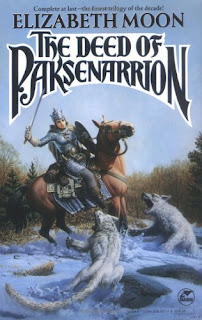
Over at SF Signal, my latest completest column is up and features the seminal Military Fantasy trilogy by Elizabeth Moon - The Deed of Paksenarrion.


http://t.co/MDiPNBMafJ One of the strongest elements of this trilogy was how that Moon chose to tell the story of Paks, not as the Hidden Heir Chosen to Rule, but rather she who finds the Hidden Heir Chosen to Rule. I liked nearly everything about the three books contained in the big grey/blue book published by Baen. What’s more impressive is that these three books are the first three published by Elizabeth Moon. I think she developed the character of Paks very well throughout the novels and the world came across as quite real, especially because of the solid and believable groundwork she laid down in the first novel Sheepfarmer’s Daughter. If you want readers to believe in the fantastic elements (elves, magic, etc.) the real elements must be authentic and true, it seems Elizabeth Moon takes that statement to heart. I’ve also seen the criticism leveled ad Paks that she’s too perfect, but a lot of her gains and successes are through hard-earned work and some suffering, she gives up part of herself in service to her goals and what she hopes to achieve, especially by trilogy’s end so it isn’t as if she just picks up a magical sword and becomes the greatest sword-wielder the world has ever seen.


Also at SFFWorld, Mark reviewed the latest massive tome edited by Ann and Jeff Vandermeer, The Time Traveler's Almanac.

http://www.sffworld.com/2013/11/time-travellers-almanac-edited-ann-jeff-vandermeer/
It is difficult to summarize such a tome, and it would perhaps be wrong of me to try. However, like the previous Vandermeer collection, I found old personal favourites (Ray Bradbury, HG Wells, Asimov, Kuttner and Moore, Connie Willis) as well as ones totally new to me (Vandana Singh, Dean Francis Alfar, Rosaleen Love, Karen Haber, Rjurik Davidson). I found stories from authors I liked, but hadn’t read (George RR Martin, Kristine Kathryn Rusch, Adrian Tchaikovsky, Kim Newman, Eric Frank Russell) and stories I know others will like but left me cold (Ursula K leGuin, Adam Roberts). There are some old ones (Edward Page Mitchell’s The Clock that went Backward, 1881, regarded here as one of the earliest time-travel tales, Max Beerbohn’s Enoch Soames, 1916, EF Benson’s In the Tube 1923), and some relatively new ones (John Chu’s Thirty Seconds from Now, 2011, Adrian Tchaikovsky’s The Mouse Ran Down, 2012). There were some that I forgot nearly as soon as I had finished reading them, even some I disliked. But that is the nature of such an eclectic assemblage: if you don’t like one, there’ll be another along in a minute that you probably will.

Friday, November 08, 2013

SFFWorld Round-up: Bach, Dalglish, Robertson, Paolini, and Wexler

Another round up of what's been posted to SFFWorld in today's blog post....

Last week, I posted my review of a contender for my favorite Science Fiction novel of the year, Fortune's Pawn, the first Paradox novel by Rachel Bach:


Devi meets and interacts with the motley crew of the Glorious Fool, – Captain Caldswell, who runs the ship with near military precision; Rupert who is “just a cook” (not); the bird like aeon pilot Basil who literally navigates from a nest; the tall lizard-like xith’cal doctor Hyrek (right, a doctor from a race which enjoys the taste of human flesh); the captain’s daughter Ren who is protected by Rupert; Cotter, the other security mercenary who joined the ship with Devi; and Mabel, the ship’s engineer who has the longest relationship with Captain Brian Caldswell; and Nova, who oversees the ships diagnostics. . Amidst this backdrop, the Glorious Fool is a trading vessel, not unlike the Serenity of Joss Whedon’s Firefly. Of course, we’d have very little story if the vessel were a simple trader. The character with whom Devi has the closest relationship as the novel progresses is Rupert; he is the love interest. He is the unconquerable man who doesn’t give into Devi’s charms immediately; Rupert is initially something of a stonewall. If anything, he may be a little too perfect. The romance between the two takes up a significant portion o

f the narrative energy.
...
I was a fan of the Eli Monpress novels written under the author’s real name Rachel Aaron, so when I learned she was shifting to space-based science fiction (so far, these books seem an equal mix military science fiction, space opera, and adventure SF), I was excited. That excitement was fulfilled. In the Eli Monpress novels, Aaron played with some genre conventions, but here writing as Bach she does much more upending of the genre tropes. For starters, the protagonist is a woman where a majority of protagonists in military SF have been male. That said, Devi is as aggressive on every level of her character as any male protagonist who preceded her in the genre. She goes after the men she wants, goes after the targets at which she aims, and tackles just about every obstacle in her way. She names her weapons and her power armor. Point being, she’s larger than life and in your face and I felt as if I got along well with her voice.

Mark had a look at self-published sensation turned newest Orbit fantasy author, David Dalglish and his fantasy novel, A Dance of Cloaks:


As a debut book in the series, A Dance of Cloaks is a ting-out-the-stall’ kind of book, where the reader is introduced to characters and places that it is clear will all be developed later, and undoubtedly with paths that will cross at some point. There are quite a few different characters to follow here, some major, others minor, but who may become more important later. Of the families, much of the plot deals with the life-changing events around two main characters. In the Trifect group, Alyssa Gemcroft, is the main heroine, the heir to the Gemcroft family fortune, used as a political device by her father Maynard, available for marriage to the right suitor. As you might expect, she rejects this.

...
Whilst the characters are nothing really new, and the plot admittedly rather generic, this is a book that revels in, and can be enjoyed for, its familiarity. With such a book, a reader does not need to spend time wrestling with deep concepts or revelatory stylistic touches. Readers can be assured that what they expect is what they get, to enjoy the plot developments as they happen, feel engaged with a story that uses straightforward language and enjoy a tale that basically is done well. Its purpose is to entertain.

Most recently, I reviewed Freya Robertson's debut novel, Heartwood. Robertson also recently provided SFFWorld with a guest post. Here's the cover, link, and review snapshot:


Robertson introduces many of the players at this gathering including the Holy Knights of the Heartwood, elite defenders of the Arbor as well as the many nations gathering to meet for a potential halt to hostilities. The protagonist, at least for the first third of the novel, seems to be Chonrad, a man who tried but was unsuccessful at becoming a Holy Knight and is sent to represent his nation at the Congressus. The Knights are led by Procella, a woman with whom Chonrad feels a great connection. Other knights include Beata, another female knight and Dean at Heartwood; twins Gravis and Gavius. Additionally, members of other nations, such as Fionnghuala of the Hanairean and Grimbeard, of the Wulfian where war rules all and men just take women are introduced.

...
What started as a novel with great potential conflict and interesting, if familiar, world and story fell under the weight of info-dumps and backstory. I liked the characters, I liked the world, but after the ample world-building in the first third of the novel, I felt ready for the story, particularly since it seemed to be pointed in the direction of multiple quests, to move at a more brisk pace. With each of the quests the characters were split up to undertake, we learned more about the characters. Too many weighty details are revealed about the characters by the characters themselves as inner monologue to allow for narrative the move along at a good pace.

We've also got some new interviews, including:


Friday, August 09, 2013

SFFWorld Round-up (2013-08-09): AJ Smith, Joe Hill, Michael J. Sullivan

Another round-up of the week's postings at the SFFWorld blog.  New additions from Mark and I, plus some interviews Dag (the esteemed site owner of SFFWorld and man in the shadows) at the main SFFWorld site.

First up, Mark just posted his review of AJ Smith's debut novel, The Black Guard, which is the first installment of his Long War sequence:


It must be said that are many similar debuts out there at the moment. In my opinion, The Black Guard is one of the better ones. What works here for me more than other recent debuts I’ve read is the characterisation. Generally the characters are recognisable and yet different enough to be entertaining. The reader will identify with the good guys and hiss mightily at the bad, though there’s a nice touch of greyness in there too. In particular, their dialogue is appropriate to the setting and worked for me, a problem I’ve had with many recent debuts. One warning: there is profanity and rather bloody mayhem here (it’s not really a Young Adult tale) but it was refreshing to find that, unlike some ‘Grimdark’ books of late, it doesn’t reduce the overall impact by overdoing the violence or the expletives.

...

Before I get too carried away, it must be said that the book isn’t entirely perfect. We could quibble about the huge dollops of set-up dialogue in conversations at the beginning of the novel, a slight lag in pace in the middle of the novel and the occasional over-the-top Conan-esque moment, but generally what happens works well and keeps the reader’s attention over a 600+ page book.

My big review of the week is (so far, and likely to remain) my favorite novel published in 2013.  The novel is the third from Joe Hill and is a masterpiece of horror / dark fantasy, NOS4A2:


For my tastes, a villain is much more terrifying if he is calm and calculated rather than a slavering creature who shouts. On this count, Joe Hill’s creation of Charles Talent Manx is one of the creepiest individuals in modern Horror literature. In interviews with Joe Hill (particularly this great one which first aired on The Geek’s Guide to the Galaxy podcast), he’s mentioned getting Manx’s voice right was a challenge. The hard work paid off because the character, conversely, seems effortless and a fully-formed creation. The man speaks as if he is of a different era, does not use contractions (is not v. isn’t; do not v. don’t) and abhors curse words, is quite concerned about what is proper, and loves Christmas. Well, concerned about what is proper aside from abducting kids, turning them into monsters, and feeding off their life force. In other words, Charles Talent Manx is a prime example of the Affably Evil character.

...

The structure of this novel is quite powerful and epic. We are introduced to Manx (the villain), we then meet Vic. They have an encounter that leaves them both scarred, which is only a precursor to their return match-up. In many ways, this reminded me of an Epic or Heroic Fantasy where the hero gets a measure of their enemy and defeats that enemy at great cost with a knowledge that a final encounter looms. Throughout the novel, this tension (added by the build-up to the Christmasland reveal) is so thick and absorbing that not reading NOS4A2 was a painful thing for me.


Lastly, Michael J. Sullivan provided a guest post to the SFFWorld blog, in which he discusses the notion of bringing secondary characters more fully into the spotlight:

Dag also posted his interview with author Douglas E. Richards.


Wednesday, July 17, 2013

SFFWorld Review Round-up: Baxter & Pratchett, Hough, Kemp, Jemisin, Martin, Willis

Some new reviews  have been posted over at SFFWorld and the SFFWorld Blog over the past coiuple of weeks. Reviews from both Mark and myself, as well as Nila White.  Here goes...

Visitors to the SFFWorld forums who know Mark are probably aware he's a big fan of Connie Willis.  His take on the collection The Best of Connie Willis (SFFWorld / SFFWorld Blog):


There are 10 stories, the 2006 Worldcon Guest of Honor Speech and her Grand Master speeches (both given and as an alternative version) included. As the editor of the book points out, Connie is nearly as well known for her presence on the US convention circuit as she is for her writing, so her speeches are nearly as entertaining.

What may also make this a must-buy for those who know the stories is both the Introduction by Connie and an Afterword by Connie for each of the ten tales. Like the speeches, they are, as you might expect, emotional, filled with warmth, wit and great self-deprecation, as well as clearly showing a deep everlasting love for the genre. Connie’s Introduction to her stories and how she came to read (and write) SF is about as eloquent an homage to older writers as you can get. The Afterwords end each of the tales nicely.


Yesterday (7/16), I reviewed the debut novel from Jason M. Hough, The Darwin Elevator, which also launches his Dire Earth Cycle of novels:

Hough does a lot of things well in his debut effort, The Darwin Elevator, which also launches The Dire Earth Cycle of novels. There’s a convincing sense of despair and desolation as conveyed through the characters who live in the world. Hough also imparts a plausible sense of fear about the Elevator and the characters concern over its source/origin. The elevator itself is more than just a MacGuffin, the mystery behind it, as well as potentially more events or contact with the builders is theme laced throughout the narrative. Neil Platz is the Donald Trump/Lex Luthor (with a slightly more altruistic bent, but still the Magnificent Bastard) like character who pulls many strings in Darwin and the civilized world. He was able to build his power and influence because he just so happened to have built power, water, and energy supply stations near the center of the civilized world which is now Darwin. Timing is everything and knowledge is power seem to embody Platz.
...
Unfortunately, the inconsistent pace of the novel brushes over some of the characterization, especially regarding Skyler’s crew and the snarling Russell Blackfield (surprise, he’s an antagonist). Danger is inherit in an apocalyptic landscape with an alien technology people fear, don’t understand completely and whose origins are in question.


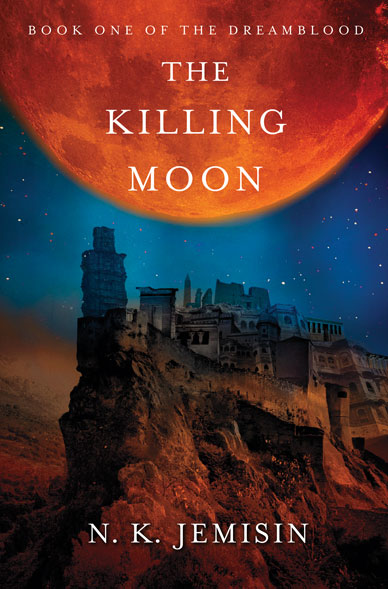
Over the past weekend, Nila had a look at the first installment of N.K. Jemisin's Dreamblood duology, The Killing Moon:

The Killing Moon is more about a time and place of Jemisin’s making than it is about any of these characters, but they will make you rejoice and weep as you follow them into the dream world and struggle to overcome the corruption that seeps through the fabric of their lives and their religion. This is the book’s greatest strength: its richly layered world and its incredible characters.
...
Based on both Egyptian mythology and Nairobi traditions, I actually found the book to be too short. I wanted to spend more time with the characters in the places they found themselves, from the streets of the outer city of Gujaareen, to the desert oasis, and further afar into Kinsua. I found the cultures Jemisin created in the two city-states. as well as the religious Hetawa. to be both an interesting interpretation of African mythology as well as a relief from our own cultural hang ups concerning sex and gender. Not that the cultures in this book are perfect in that regard, but different from our own western sensibilities - and I liked it. I wanted more ‘meat’ to this story and would have been glad if the book was twice as long.


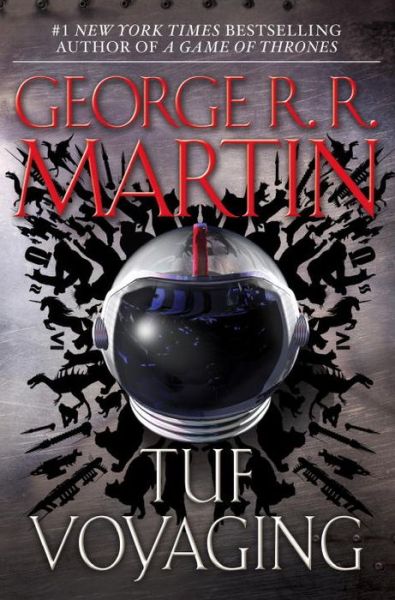
A little over a week ago, I dove into a long out of print fix up novel/collection from George R.R. Martin, Tuf Voyaging:
Seven stories are included in this fix-up novel/book and are presented in chronological order of the events of Haviland Tuf and his acquisition of the Ark rather than publication order.
...
Martin has long professed his admiration for Jack Vance’s writing and these stories can very much be seen as homage to Vance or his style. The balance of humor and fantastical situations were hallmarks of Vance’s work. In particular, one might imagine Tuf himself interacting with Cudgel the Clevor or Rhialto the Marvelous. Undoubtedly, Tuf’s deadpan style and pure logic work in direct contrast to every personality he encounters. Nobody trusts Tuf, he is distressed by this lack of trust when he always attempts to present himself as, if not altruistically as possible, as logically as possible. Humanity has evolved to a state on many of the planets he visits that logic is far from even the tenth lens to view their respective world.


Last week Mark posted his review of The Long Earth, the collaboration between Stephen Baxter and Terry Pratchett (SFFWorld / SFFWorld Blog):

Much of the actual bones of the tale appear to be themes of Baxter’s, as there are resonances of his writing style, so reminiscent of Arthur C Clarke, throughout. There is an imaginative extrapolation of the ‘what-if’ here. The consequences of people migrating to these new worlds, the changes in society, trade, commerce and even religious belief are all examined here, and have that overarching tone of some of Baxter’s other books, such as Evolution. The characters also seem to fit the Baxter/Clarke template, in that they are not particularly deep or complex, but they are understandable and accessible. In terms of worlds, the writers clearly had a lot of fun explaining extinct animals and sapient civilisations. There’s a definite Arthur C Clarke/Olaf Stapledon feel of epic-ness to that aspect of the plot, which I am assuming comes mainly from Stephen Baxter.

If Stephen brings the imagination usually demanded by SF readers, what we seem to get, with added Pratchett, is a warmth and a less clinical, more human dimension that will appeal to those readers less SF-inclined. Readers should not be misled, however - this does not make a laugh-out-loud, comfortable Discworld-kind of novel – but there is, in places, a wry grin, and even at times a little acidic statement (something Terry can do very well.) In tone, this is more like Nation than Discworld. It is clear from the start, though, that when the power for the stepper is a potato, it’s obvious that there’s going to be a certain amount of humour involved. How a potato can change the world… 

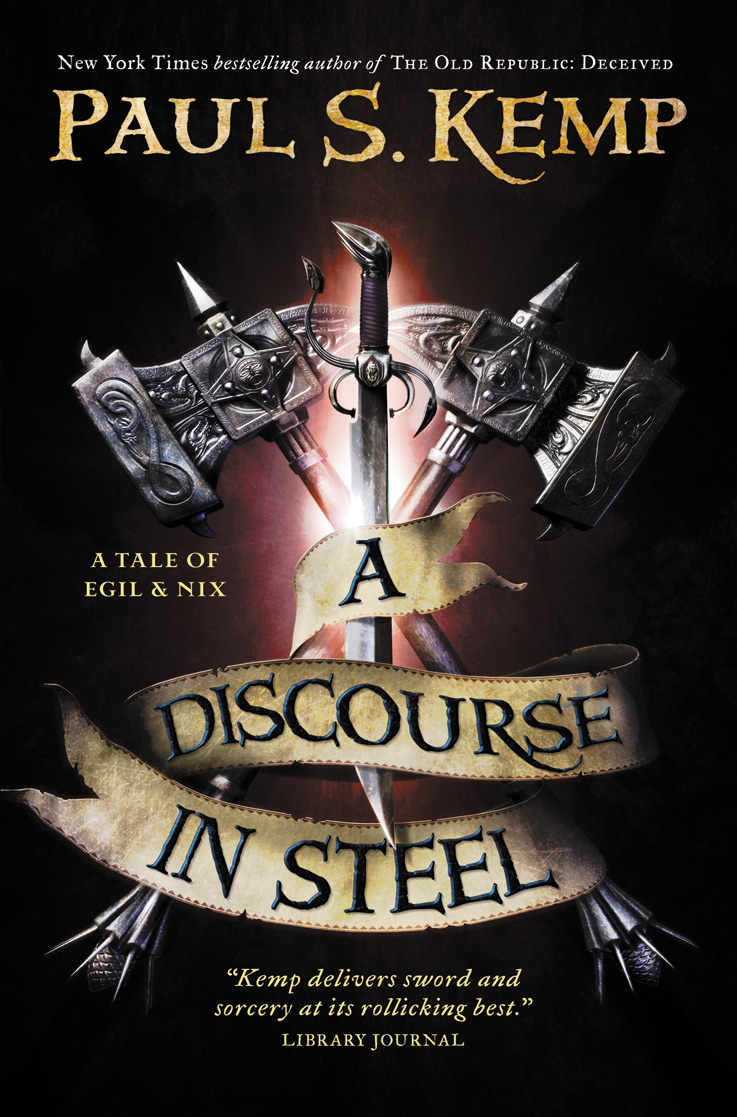
A few weeks ago, I posted my review of Paul S. Kemp's second Egil & Nix novel, A Discourse in Steel (SFFWorld / SFFWorld Blog):


I said in my review of The Hammer and the Blade that Kemp is evoking Fritz Leiber, that evocation/homage continues here in A Discourse in Steel quite nicely. The protagonists Egil and Nix are fully realized characters who breathe and banter in my head like old friends. Kemp’s writing/storytelling with this duo puts you in the room, the tunnel, or dungeon with them; essentially, it feels as if you become part of their group. Sword and sorcery can be considered the fantasy equivalent of the buddy movie and Egil and Nix, along with Scott Lynch’s Locke and Jean, are perhaps the most entertaining buddies in the genre. Egil and Nix are a bit more experienced, which adds another layer to their dynamic and the depth of their history. At times I’d almost expect one of them to echo Murtaugh in saying I’m too old for this shite. That age and history comes into play as the Blackalley plays against a person’s fears, sorrow and loss. This affects Egil very profoundly as the regret over his lost wife and child continually come back to him as the duo progress through the narrative.