Showing posts with label Dan Bieger's Review. Show all posts

Wednesday, March 07, 2012

Heir of Novron and The Rook Reviews

Another mid-week post announcing the newest, latest, and greatest reviews at SFFWorld. This week’s reviews are brought to you by Dan and me. .

I finished off Michael J. Sullivan’s Riyria Revelations saga with the third and final omnibus Heir of Novron. As with reviews of most concluding volumes, I give a brief assessment of the series towards the end of my review. Here’s the cover and excerpt:


The princess is imprisoned, the heroes are separated, and the manipulator is about to take the reigns of the burgeoning empire fully within his grasp. This is what’s at stake upon the beginning of Wintertide, the fifth book in Michael J. Sullivan’s Riyria Revelations and the first half of Heir of Novron, the third and final omnibus.

Said manipulator is Saldur, who forced events to place Modina on the throne of the Empire as the Heir of Novron, in the hopes of playing her like a puppet to do as he wishes. Modina is starting to realize she can be her own person after living in shock of the events leading to her being placed on the throne, that is, the death of her father, destruction of much of her village, and that she killed a dragon-like monster. Her assistant, Amilia, was hand-picked by Saldur to prepare the listless Empress to do his bidding, but little did Saldur suspect the two puppets he thought he was controlling would turn into young women who could think for themselves. Compounding the difficulties in Aquesta is the impending invasion of the Elves who after years of seclusion, wish to return and claim the Empire as their own.


One thing that Sullivan has played with throughout the series is the idea of Prophecy (yes, with a capital “P”). In this respect, he’s treading ground (successfully, for my mileage) that Tad Williams treads in his Memory, Sorrow and Thorn (a trilogy that should be read by every fantasy fan and one that predates A Song of Ice and Fire for more adult, and darker turns on Epic Fantasy). Like Williams, Sullivan is splaying with readers expectations of how to use Prophecy and characters expectations on how to read certain prophecies. In other words, just because the Prophecy is written and “known” doesn’t mean that you really know its true meaning. I particularly enjoyed how Sullivan played with the dwarf Magnus – his character arc moved along at a nice pace as Sullivan revealed more about his past and how he came to interact with Royce and Hadrian. The character who turned out to be the most annoying (by design, no doubt) was Degan Gaunt. In the early volumes, he was the charismatic leader of the resistance, and by the end of the series, he turned into a whiny, complaining, self-centered ass.


Dan is aback this week with another review, Daniel O'Malley’s debut novel The Rook which is also the first in a series

Up to now Thomas has been a shy retiring accountant, fearful of using her talent, but thoroughly engrossed in the administration of the Court. The Court, consisting of a Lord and Lady, two Bishops, two Chevaliers, and two Rooks plus all the supporting staff of Pawns and Retainers required to fulfill its mission, is a centuries-old organization charged with protecting Britain from supernatural calamity. Over time, the Court has meshed with the mundane government while maintaining its secrecy. The trouble is there is a traitor among the Court. The story is her journey to find and expose the traitor.


Over and above the traitor's threat, she discovers another organization, the Grafters, is also planning an invasion of the Isles. Likewise a supernatural threat, the Grafters use biology and science to create their monsters whereas the Court uses natural talent. A long time ago, centuries, the Grafters attempted an invasion of Britain but were soundly defeated on the the Isle of Wight. The Grafters haven't forgotten. They intend to even the score.

Wednesday, February 22, 2012

Sixty One Nails, Interview, and After the Golden Age

We’ve got some more reviews up at SFFWorld, this time from some of the irregulars.

Nila White is one of the new contributor/moderators at SFFWorld, but she’s been doing a bang up job of everything. This time ‘round she did double duty with Mike Shevdon (also a member of the SFFWorld forums) reviewing his first novel, Sixty One Nails from Angry Robot books and conducting an e-mail interview with him.


Sixty-One Nails is Mike Shevdon’s first book. But it doesn’t feel like it. The characters are well defined, the plot engaging, and the story arc brings a satisfactory conclusion to the first book in a series that I predict will become one of my favorites.


This is a fast paced book that, if it grabs you, will leave you sleepless till you finish. It is hard to put the book down when so much is happening to the character. Because Niall is being chased for pretty much the entire book, the reader is imbued with that same sense and is impelled to finish the story. Another aspect of the book I enjoyed was the descriptions of the use of magic and the magical beings. Though these creatures are familiar to many who know English folk-lore, i.e. wraiths, fairies, leprechauns, etc, they are painted in darker hues and given a history and problems just as real as our own. This made their story just as interesting to read about as the main character’s. I was also impressed with the descriptions of Niall’s power over the ‘void’, the spaces between things, and how, when the character draws upon that power, it changes his physical appearance. Don’t ask me why, but I was reminded of Dr. Manhattan from the Watchmen.…


Again, here’s that interview with Mike, go have a look, won’t you?

Dan has written a handful of reviews for SFFWorld in the past, his latest review is of Carrie Vaughn’s After the Golden Age:


Celia West is the daughter of the leaders of a superhero crime fighting team, a fact that did not bring her much pleasure growing up. She loves her parents but can't stand being around them for great lengths of time.

This is a comic book without pictures – that is basic to the encounter - and it works very well. Knowing too much about the heroes and villains will detract from the enjoyment of the tale but know that the interrelationship between the characters is played flawlessly. Celia's character makes sense; her love life makes sense, and the progress toward conclusion makes sense.

Wednesday, April 14, 2010

Buchanan, Moorcock, McAuley, and Roberson reviewed at SFFWorld

Four big reviews at SFFWorld this past week, all from the most recent usual suspects (Art, Mark, Dan, and me).

Art reviewed the second in Tor’s attractive reissues of Moorcock’s seminal Hawkmoon saga, The Mad God's Amulet:

The Mad God's Amulet picks up where The Jewel in the Skull left off, with Hawkmoon and his hirsute companion Oladahn in the Middle East, Hawkmoon having rid himself of the jewel's curse and eager to return to France, Kamarg, and his betrothed Yisselda. Traveling through the desert, they come upon the ruins of an ancient city called Soryandum, but before Hawkmoon and Oladahn have a chance to investigate it, they are captured by a Granbretan regiment l ed by the Frenchman Huillam D'Averc. Mysterious wraithlike beings, the original occupants of the city, offer to help Hawkmoon and Oladahn escape from the Granbretans if they will obtain for them an artifact that will allow the beings to save Soryandum from being razed by Granbretan. What follows is a series of adventures as Hawkmoon and Oladahn make their way back to Kamarg through Granbretan-occupied lands, are waylaid by pirates and the cult of the Mad God, and search for Yisselda, whom the Granbretans finally succeeded in kidnapping. Along the way they are first pursued and then joined by D'Averc, whose skill with the blade, urbanity and fluid loyalty make him one of the most entertaining characters in the series.
Mark reviewed a book that’s been buzzing about the intarwebs recently Farlander by Col Buchanan:

Pleasingly though, there was a point in the book about halfway through where things changed. The murder of Rianna by Kirkus, leads to a vendetta killing being instigated, as she was under protection of the Roshun. Ash and Nico, with Nico’s co-trainee friend Aleas and Ash’s uneasy colleague Barachas volunteer to take on the dangerous mission and avenge her death for the Roshun. The book, like Joe Abercrombie’s Best Served Cold, becomes focused as a tale of revenge.

Now with this impetus, the book kicked up a gear. Characters started to have meaning, the dialogue became less excruciating and the action scenes kept things moving along, as long as I didn’t think about things too much. (A lot of the problems in the book could’ve been solved by using airships, it seems to me, for one.)


Dan reviewed Gardens of the Sun the conclusion to Paul McAuley's duology which began with The Quiet War:

The folk in the Outer Worlds tend to work at the far ends of a liberal spectrum while the folk on Earth work at the far end of a conservative spectrum. The Outer Worlds’ experiments have led to life spans ranging to two hundred years and cuts to their bodies to make them individually unique. A cut can be anything from the nip-and-tuck that we are familiar with to a radical gene modification.

In order to make the distances manageable, Sri Hong-Owen’s labs, in The Quiet War, came up with a fusion motor that drives space ships at really fast speeds enabling the players to get to any place in the Solar System quick.

I’ve enjoyed the novels I’ve read Chris Roberson thus far as well as the small sampling of Warhammer 40,000 fiction I’ve read. Logic would dictate that I’d enjoy Roberson writing Warhammer 40,000. This truth is born out in my review of Sons of Dorn:

Though not told in the first person, Roberson emulates Starship Troopers in that Sons of Dorn follows the three recruits and former enemies through the training, through indoctrination, though the Pain Glove, through the history to their graduation as Space Marines the Adeptus Astartes. In this respect, the storyline is familiar, but it allows Roberson to flesh out the mythology of the Astartes, while also fleshing out the three recruits.

Along with the indoctrination of the three recruits, the novel also follows the story of Taelos, the captain and primary authority figure throughout the novel. His story is something of a redemption story, but nicely parallels the growth of s’Tonan, Zan, and du Queste.

Tuesday, March 16, 2010

Oath of Fealty, Eclipse, and Hawkmoon at SFfWorld

We’ve been cranking out the reviews lately at SFFWorld, with another three this past week, one from me, one from Dan, and one from Art.

Elizabeth Moon should be a familiar name to readers of Fantasy and Science Fiction. For me, Oath of Fealty is the first book of hers that I’ve read, but based on that experience, it likely won’t be my last. Mrs. Moon launched her career with The Deed of Paksennarion trilogy and this is her return to the milieu after a two decade absence:


Through her characters, Moon makes the world breathe and come alive. The magic is handled particularly well in that it isn’t thrown around as simply another tool or a means to an end. It is treated with respect and in many cases, fear. This is particularly true in the case of Dorrin and her connection to magic. Here, Moon provides a good balance between curiosity and fear – fear of abusing the power, fear of becoming seduced by it, and fear of becoming like the people of her clan who banished her.

While I can’t compare Oath of Fealty to the earlier books set in this world in any way, I can say the book was well written and really had me hooked once Dorrin fully asserted herself as Duke. It was an exhilarating scene and the sense of nervousness Dorren felt was counterbalanced by her own assertiveness when she finally made her power as Duke known to those who challenged it. While this occurred towards the middle of the book, it carried on very nicely through to the end of the novel.

Dan continued his trek through the Strahan-edited annual anthology series with Eclipse Three:


Strahan spends his introduction discussing book covers so we must rely on the back cover blurb to determine this volume contains stories where strange and wonderful things happen – where reality is eclipsed by something magical and new.

Don’t Mention Madagascar, Pat Cadigan
This is what happens when a very determined young woman discovers a photograph of the Rolling Stones as they were in the 1960s, except that the young woman’s mother and aunt are in the picture. The difficulty is that the two women in the picture are as aged as they should be in 2009 and both have been absent from this world for a few years now. The detective work is both lucky and solid as two friends try to run down the reality or lack thereof in the photograph. What they find is magical and new and not quite what they expected.


Art (aka Banger) returns to the reviewing game with a look at a classic Moorcock novel reissued by Tor, The Jewel in The Skull (Hawkmoon):


The setting here, an ancient, alternate universe Europe, is reminiscent of Conan the Barbarian's Hyborian world, as are its characters: heroic and brutal, intelligent and savage, clear of conscience and ruthless in its execution. This is the world of Baron Meliadus, ambitious general of the Granbretan Empire; Count Brass, wise and clever Lord Guardian of Karmag, one of the few free cities left in Europe; and of Dorian Hawkmoon, captured rebel leader of the people of Köln, recently annexed to the Granbretan Empire. Eager to conquer Karmag, Meliadus makes a deal with Hawkmoon: if he kidnaps Brass's daughter, the beautiful Yisselda, and brings her back to the Granbretan capital of Londra, Meliadus will restore Hawkmoon as Duke of Köln – subject to the overlordship of Granbretan, of course. To ensure that Hawkmoon keeps up his part of the deal, Meliadus implants in Hawkmoon's forehead a jewel that allows Granbretan to see whatever Hawkmoon sees, and, should they see betrayal, enables them to destroy his mind in an instant, no matter where he is.

Thursday, March 11, 2010

Wolves, Ecplipses & Lightning - Three Reviews @ SFFWorld

Lest my review be the only posted at SFFWorld this week, Mark and Dan put up some nice reviews as well

First off, is Mark’s review of Wolfsangel by M.D. Lachlan:


It’s quite refreshing to read a book that dips into other pantheons from the usual. There are elements here that you will recognise from Norse mythology, if you know it: for others it will be a pleasant surprise. There’s a wealth of background available for a writer to dip into, and it’s clearly something M.D. expects to use in future books in the series. The ending is not too surprising, though fairly self contained, if you want it to be.

Consequently, despite being a little spoiled for me, as a Fantasy debut this is a fine novel and one for me that punched above its weight. Consequently, I suspect it will do very well. As is often the case with a good read, despite the fact that I knew what was going to happen in the end, I finished the book caring about the characters and wanting to know what happens next. That is a good sign.

Dan reviewed Eclipse Two edited by Jonathan Strahan the second in Strahan’s annual original anthology series:


Strahan describes this volume as a collection of stories, tales built around a good idea that is complete; one that opens, builds and then delivers some kind of pay-off at its conclusion. It is not structure he’s after but whether there is a story to be told and the authors get it done by the time they’re finished. He wants a story that is immersive, that sweeps him away into that world for as long as it lasts, or makes him think differently about something. So, let’s see what that means:

Mark also reviewed Red Lightning by John Varley, sequel to his earlier reviewed John Varley novel Red Thunder:

As I had hoped, this is an interesting novel with many of the pleasing attributes of the first. It is, in simple terms, Red Thunder: the Next Generation. The tale here moves on from Manny, Kelly, Dak and Travis to the teenage prodigy of Manny and Kelly. Now living on Mars and helping run Manny and Kelly’s Red Thunder Hotel, the tale is told in the first person by their son, Ramon (Ray) Garcia-Strickland.

As a reader, it felt good to revisit and continue on from Red Thunder. More pleasingly (for me) Jubal is less important than previously, though he is still an important character. This means that we get less of his irritating Cajun accent, which really didn’t work for me in the previous novel, as I spent more time trying to decipher his speech in writing than enjoying the plot.

Tuesday, February 16, 2010

Swords, Space Opera, Necromancer, and Vampires - 4 SFFWorld reviews

A bunch of new reviews have been popping up at SFFWorld over the past week. Mark churned out three, while Dan cranked out one.

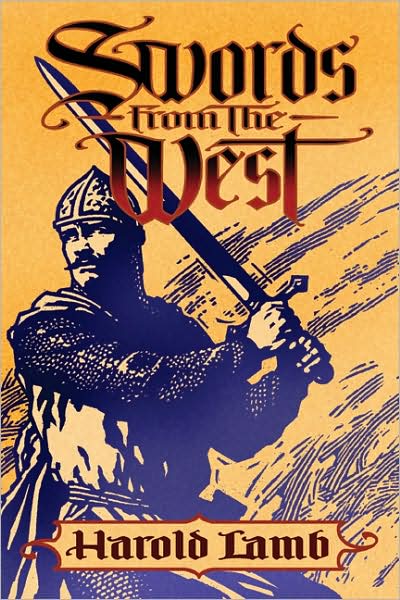
Mark had a chance to look at a very under-appreciated practitioner of classic Sword & Sorcery, Harold Lamb. Mark reviewed Swords from the West:

Harold wrote at a time when the pulp magazines were aplenty. His tales of heroes and enemies, of valour and derring-do are of that time (and the tales here date from 1921 to 1953.) Though he was known at the time for his screenplay writing and his historical biographies, like Tolkien before him, he wrote other things as a hobby. These adventure tales were written for fun as well as publication.

But, what fun! There are seventeen tales of the Crusades and the Indian Raj here, most of them not seen since their first publication in Adventure magazine. We meet Nial O’Gordon, young crusader on a life-changing journey to Constantinople, and Sir Robert of Antioch fighting Mongol masses. As you might expect in tales of the Crusades, we meet men who epitomise the conflict, such as Hugh of Dol, a Christian minstrel, and his opponents, the Turks. King Richard the Lionheart also appears on his quest. We also meet Michael Bearn, fighting for vengeance after being betrayed by an Arabian sultan. In the India of the nineteenth century we have Captain John Malcolm and Rawul Singh defending the British Empire against the Afghan Ali Khan and his co-conspirator Gom Gion.


Dan reviewed The Quiet War by Paul J. McAuley:

Some times, when presented with a political saga of epic proportions, I can get confused about who it is we are supposed to root for. In The Quiet War there is a big cast of characters but, as you would expect, some are merely props to move the action forward. What I soon discovered, the tale belongs to four major players.
.
.
.
A lesser character but one with the important role of villain is Loc Ifrahim who begins the tale as minor diplomat attached to the embassy on Callisto. His family ties to the dominant Brazilian family cause him to be around at crucial points of the story. Loc’s major character flaw is ambition, an ambition that everyone recognizes. His enemies tend to sneer at his efforts; his allies tolerate them. You just know he will come to a bad end.


Mark also took a look at Johannes Cabal the Necromancer:

The tale is an old tale done well: that of the Faustian deal. Johannes Cabal, Necromancer wants his soul back, and is prepared to do a deal with Satan to do so. He’s lucky in that he catches Satan in what seems to be a forgiving mood. Result: Johannes is given a year to collect one thousand souls for Satan with their signatures on the contracts.
.
.
.
The books supporting cast also enhance the reader’s impression of events. Johannes’s relationship with his brother is typically familial, being both bickering and yet touching. On a broader palette we meet enemies from Johannes’ past, and are amused by his relationships (or perhaps non-relationships!) with his colleagues and compatriots.


The last review Mark posted was a retrospective/coffee table book on vampires by Charlotte Montague, Vampires - From Dracula to Twilight:


The structure of the book is pretty straightforward, beginning with the background history of the legend and bringing it up to the present. The book is divided into five chapters, with subsections. Chapter One deals with the vampire myth and how the original idea has been recorded in history. Chapter Two shows how the legend has evolved from peasant to nobleman, looking at elements as diverse as vampire babies and vampire immortality. Chapter Three looks at variants of the vampire myth, from female (succubae) and lesbian vampires to the chupacabra and the psychology and anthropology of vampires. Chapter Four looks at historical examples of people connected to the vampire legend, from Vlad the Impaler and Elizabeth Bathory (‘Countess Dracula’) and Fritz Haarmann. The final chapter looks at vampires through literature, pop and film, from Varney the Vampire to Bram Stoker’s Dracula, True Blood and, of course, Stephenie Mayer. Twilight has a whole subsection of its own, which tells the reader something perhaps of the book’s target audience.

Monday, January 18, 2010

Carai an Caldazar and Blackout Reviewed

Thanks to Adam for bringing something to my attentionn that my obvious lack of math skills didn’t – this year is the 20th Anniversary of the publication of The Wheel of Time. I hadn’t made that connection when I began my re-read of the series on Friday with The Eye of the World, but it is a neat case of serendipity. One might even say a case of the Wheel weaving a thread of the Great Pattern.

I finished up to Chapter 19 last night, Shadow’s Waiting where the Three Stooges of the Two Rivers meet up with Mordeth. They seemed awfully quick to spill the beans to him, after being tightlipped in Baerlon, which was a bit on the unplausible side. I do like the background narrative we learn about the destruction and ruined city of Shadar Logoth.

Nynaeave first comes into play as a prominent character a couple of chapters before the above with her first braid pull. Knowing now that she and Lan come together, it is interesting to note that he does show her respect initially, at least in a different way than the Two Rivers people and even Moiraine.

In Baerlon, we also meet with the god-awful Children of the Light for the first time. They just get in the way of everything, and it shows that there is more to the world than just the Dark One and those fighting against him on Rand/Moiraine’s side.

I also like how Jordan titles each chapter, too.

I posted Dan’s review of Connie Willis’s Blackout, today which he seemed to enjoy quite a bit:


So, what do we get in this tale? We get a rich look at 1940s England, in the city and the countryside. We get an up close and personal view of Dunkirk. We get a good review of medical facilities and practices in the 1940s, e.g., how does one break the fever associated with measles without antibiotics? We get a marvelous description of life in the tubes and shelters during air raids and the behavior and character of the Londoner. We are also introduced to four singular time travelers with all their accomplishments and failings. Sometimes, we think that folk from 2060 ought to be more aware of the world around them and how to deal with it but, then, we ourselves are forgetting they are operating in a world of 120 years ago. 120 years ago today, we’d be hard pressed to recognize all the ins and outs of 1890s daily life.

Tuesday, December 22, 2009

Gaunt and Grey - Two New Reviews

With the last “here are new reviews” post before Christmas, I bring you two new reviews at SFFWorld, one by me and the other by Dan.

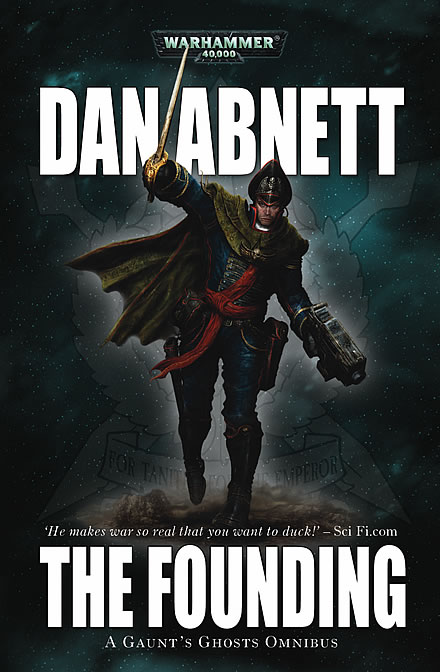
In my ongoing attempt to become more familiar with the Warhammer 40,000 universe, I reviewed The Founding: Gaunt’s Ghosts Omnibus #1 by Dan Abnett:


Although the novels contained within this omnibus (First and Only, Ghostmaker, and Necropolis) tell of the exploits of the Tanith First and Only, each novel is slightly different stylistically speaking. This is one of the strengths of the book.

Led by Colonel-Commissar Ibram Gaunt, the Tanith First and Only are the last survivors of their homeworld, which is how they were dubbed “Ghosts.” The first entry, First & Only, details one of the early campaigns of Gaunt’s Ghosts, hinting at the history of their founding. It is something of a cold start as Abnett gives readers a story of the Ghosts in action. Intertwined are episodes from Gaunt’s past as a teen and young man being educated at Schola Progenium, a military school for orphans of Imperial Officers. Abnett effectively introduces the regiment and what to expect in these stories – action, nice character interaction, and fast-paced plotting.


Dan reviewed Thomas Day's A Grey Moon over China:


To fully appreciate the story, you must tolerate characters who refuse to grow from beginning to end, who never learn from experience, who persist in their tunnel-visioned approach to life. You must cheer for those like the narrator who seem to have some modicum of rationality though their behavior will often tempt you to throw the book away in despair.

I stopped reading for a few days because the attention to politics was driving me crazy. When I came back to it, I discovered I had stopped just short of the saving plot line that made the rest of the book as enjoyable as the opening had been..

Tuesday, November 24, 2009

Slew of Reviews - Anders, Bullington, Butcher, Forbes, and Hill

We at SFFWorld wanted to give you plenty of reviews to read over the next week, which here in the US is Thanksgiving. I’ve got my usual review, Dan has a review and Mark went ballistic and posted three reviews.

As promised last week, I finished off and reviewed the third in David Forbes’s Osserian Saga, The Commanding Stone:

One thing that becomes apparent with each volume in this saga is that David Forbes has a clear vision of where he is taking these characters. Forbes also raises the stakes in this volume, with the threat of returning dragons as a clear indicator that Gerin’s awakening to power as the Amber Wizard was just the first of vast and legendary powers returning to the world.

The novel begins with one young man, Tyne, putting the body of his brother to eternal rest. When the legendary Vanil, giants, awakened in the previous volume, Tyne’s brother was killed. Tyne is grieving, wishing for some kind of retribution, and blames Gerin for his brother’s death. His wish is granted in the form of the titular Commanding Stone, which allows him to bend the will of dragons to his wishes. In short, Tyne makes a deal with the devil, or the Adversary as he’s known in Forbes’s world.

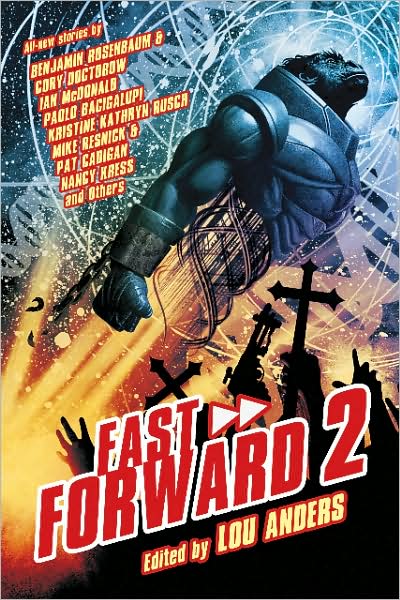
Dan reviewed what the second original anthology Lou Anders has edited for Pyr:, Fast Forward:

Lou Anders says in his introduction: What follows are fourteen tales, from the comedic to the cautionary, as different as the seventeen writers who penned them, as current as tomorrow, and as wild as imagination –and the only constant in them is the reality and inevitability of change. Because, as this volume testifies, the future lies ahead of us, and it’s coming fast..
.
.
Mitigation, Karl Schroeder & Tobias S. Buckell - A few years from now, with global warming wreaking astonishing second and third order havoc, the seeds secreted away at Svalbard become booty, a treasure some countries want to acquire for their own survival, not by using them but by ransoming them. A man and a woman set out to prevent this disaster but their individual solutions differ. A nice twist tells us who succeeded.
As I said, Mark reviewed three books, the first I’ll link to is the 9th Dresden Files novel by Jim Butcher, White Night:

So, as we reach Book Nine of the Dresden Files series (yes, Book Nine!) what can we say that hasn’t already been said?

Surely, by this point fans are already converted and newbies pointed towards earlier books?

Usually by this point, it’s all been done. Hasn’t it?

Well, White Night is still determinedly Dresden. There’s still that dark humour and dry, Butcher drawl spoken through Harry. There’s still the broad range of engaging supporting characters. As you might expect from this far into a series, much of the tale derives its entertainment not from telling anything particularly new but rather from the development of characters and events earlier in the novels.

Another book Mark reviewed is the debut from Jess Bullington, The Sad Tale of the Brothers Grossbart by Jesse Bullington:

The Sad Tale of the Brothers Grossbart by Jesse Bullington is a morality tale for characters with no morals. It is dark, cynical, and at times unpleasant, VERY unpleasant. And yet, in that strange watching a car-crash manner, an enthralling read.

Written in the style of a Brothers Grimm tale, the story tells of Hegel and Manfried Grossbart, whose ugliness on the outside pales to insignificance with their internal malaise. They think nothing of setting alight people who they think have wronged them, of cracking skulls and breaking limbs when the needs arise, whilst often debating their actions in the highest of moral tones..

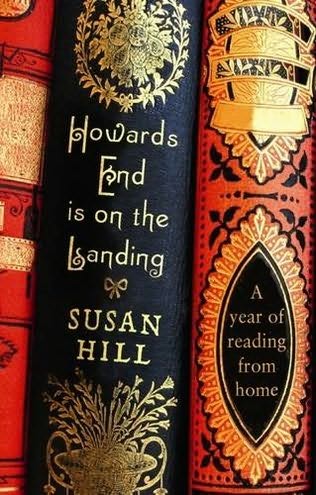
Lastly, Mark took a look at an interesting non-fiction memoir of one woman’s year of reading, Susan Hill’s Howards End is on the Landing: A Year of Reading from Home:

Howards End is on the Landing is a diary cum memoir of a writer’s efforts to do this. At first, such a book may sound dull or quaint. What can you say about books without going into details about each book? How far can you go before such a monologue becomes annoying?

It’s not an easy job, but Susan Hill manages it. Perhaps it should be expected, for Susan Hill’s reputation as a publisher (Long Barn Books) and a writer (ghost stories The Woman in Black and The Man Who Turned Into a Picture, for example) is well known in England, if not elsewhere.