Showing posts with label The Completist. Show all posts

Thursday, October 17, 2024

The Completist: CLOWN IN A CORNFIELD by Adam Cesare

Coulrophobia: the fear of clowns. The setting of a cornfield (Lost in a Maize over at TVTropes). Two prominent and familiar horror elements, so if you combine a creepy clown figure with the tried-and-true setting of cornfields, you’ve got two great tastes that taste great together in the horror genre. Thus, we have Adam Cesare’s Clown in a Cornfield trilogy. 


The first novel in the series, Clown in a Cornfield (published in 2020) introduces readers to Quinn Maybrook, who moved from Philadelphia to Kettle Springs, MO with her father (a Doctor) after the death of her mother. Kettle Springs fits the trope of many such stories: that of a town seemingly passed by the future. A once booming industry/company was at the center or Kettle Springs – The Baypen Corn Syrup Factory, which recently closed and was burned down.

Before we meet Quinn; however, Cesare introduces some of the local Kettle Spring teens hanging out at a flooded rock quarry. As teenagers are won’t to do, they dare each other to do something dangerous and potentially stupid: dive into the water. When one of the kids doesn’t resurface, the tone of the novel (and series) is largely set: there will be deaths.


Quinn is barely settled into her new home and school when Frendo the Clown makes its appearance known. Quinn is invited by her newfound friend Cole Hill (whose father happens to own Baypen) and his friends Janet, Ronnie, Matt, and Tucker to join the Founder’s Day party (the typical small-town celebration) as well as the after-party in the neighboring cornfield. Frendo shows up at the after-party, uninvited, and starts killing people. Frendo was the mascot of the Baypen Corn Syrup company, but its face and appearance have been appropriated – much like the Ghostface from the Scream film franchise – so people could begin murdering the teenagers. Especially the “troublesome” kids. Classic slasher, kill the kids. But who? We don't exactly have a Billy Loomis figure here, but Cesare doesn't try to give a red herring in that way.

Horror has often been laced with social commentary and Cesare picks up that baton from his predecessors. The parents of this community are somewhat locked in their ways, they don’t have much trust in their kids and the kids who live in Kettle Springs. The death at the rock quarry only hones those thoughts even more. One might even say these parents want to make Kettle Springs great again. There’s very much an undercurrent of that “things were better when we were younger, these kids are ruining everything” mentality that can easily lead down a path of toxicity.

Some of those adults include Cole’s father Athur Hill, Sheriff Dunn, a waitress named Trudy, among others, but Arthur and Sheriff Dunn serve as the primary antagonists of the novel who drive the adults to take care of their kids’s mistakes. 

The first novel, then, has elements of the expected (but very much heightened) friction between two generations; slashers; and small town with dark secrets. Think one part Stand by Me, one part Footloose, and one part Scream.

Clown in a Cornfield is an impressive, compulsively addictive novel. Cesare manages to craft a story that has appeal to hardcore horror fans (like myself) as well as a story that is welcoming to readers not as into the genre. The book is published by Harper Teen and has that YA appeal with the youthful protagonists at odds with adult antagonists. For his efforts and the quality that is the outcome of those wonderful efforts, Adam Cesare received the Bram Stoker Award for Best Young Adult Novel for Clown in a Cornfield. I haven’t read the other books on the finalist list from that year, but I can say I am not surprised in the least that Cesare won the award.


The second book, Clown in a Cornfield 2: Frendo Lives, picks up about a year after the events of the first novel. Few have survived the onslaught of Frendo (or rather, Frendos), although Quinn is one of the survivors as are Cole and Rusty, who are now officially a couple. Quinn is at college in Philadelphia and thanks to a “documentary” called The Baypen Hoax nobody believes that what happened to Quinn and her friends is real. Even when she is attacked by another Frendo during a college party at the same time her father is attached by a Frendo back in Kettle Springs. Quinn is still at the center of the story in the second installment, the heart of everything.

Of course, Cole, Rusty, and Quinn return to Kettle Springs where they learn of conspiracies and an internet movement around Frendo, #FrendoLives, which gives us the subtitle of the second novel. There’s a good bit of social commentary in this book again, such as that internet movement and how many people think the events in Kettle Spring are a hoax. Not quite social commentary, but a statement, I suppose is making the primary romantic couple in the book a gay couple. More than anything, it is a normalization of the relationship and it is quite welcome.

In general, I think Cesare did a great job of weaving these kinds of messages into the story, making them essential elements to the story, but not browbeating the reader with any heavy-handedness. Frendo definitely lives, there’s an army of Frendos at one point in a harrowing, pulse-pounding scene. Nobody really escapes this second installment unscathed and by the end, Quinn is a mentally and emotionally scarred young woman with a list and a purpose. 


The finale, Clown in a Cornfield 3: The Church of Frendo, is a departure in some ways from the two novels that preceded it which is not a bad thing at all. Again, though, Quinn is a heart of the novel. She is on a mission to find the various people who donned Frendo masks and tried to storm Kettle Springs in Frendo Lives. Joining Quinn is a young man named Johnny as well as the ghost of the original Frendo masked killer, Arthur Hill although only Quinn can see Arthur. The two regularly converse which makes clear that Quinn is Dealing With Some Shit, understandably.

While Quinn is tackling her hitlist, the “dream” of Frendo is still alive back in Kettle Springs. By dream, I mean church (as the title implies), but what I really mean is a cult. Cesare gives us a great sightline into this church/religious movement through a couple of the young girls whose parents are swept up (in more than one way) in the Church. Another thing Quinn isn’t quite aware of is that somebody is pursuing her. Rather, she knows she’s a recognizable individual and just might be a fugitive, but she isn't fully aware a sinister organization is hunting her just as she’s hunting the members of the Frendo mob.

The Church of Frendo, much like its two predecessors is an addictive read; the pacing is frantic (in a good way) and Cesare continues to give his characters depth, they engender empathy, they are relatable, and they are interesting. A very satisfying conclusion to Quinn Maybrook’s story. Cesare has intimated he may have more stories set in this world, if so, sign me up for them!

Cesare has managed to give horror fans a fascinating and complex take on the “Final Girl” in Quinn Maybrook. You can see elements of Sidney Prescott (Scream) and Nancy Thompson (A Nightmare on Elm Street). Quinn is not going to be kept down, she’s going to take charge of her destiny. Quinn felt very real to me, I couldn't help but root for her throughout the saga. As I said earlier, Clown in a Cornfield is one of those great stories that has appeal to long time horror readers (of which I count myself) and people curious about the genre or somewhat unfamiliar.

As I was writing up this review, I realize how little I mentioned the fact that this is a YA set of books. I think part of that is because my experience reading these books is that Cesare just told a great story, labels be damned. The imprint is Harper Teen and Cesare explicitly aimed these books at young adults. Be that as it may, do NOT let that dissuade you or let you think these books are "soft" or "tame." That’s part of what I was getting at in that these books will and should have wide appeal horror readers of all ages. There's blood, there's murder, there's adult themes. The social commentary is woven naturally and elegantly into the story and it isn’t tacked on.  

The bottom line: Clown in a Cornfield is a modern horror masterpiece and I am looking forward to more stories from Adam Cesare. 

I am also looking forward to see the film, which is written and directed by Eli Craig (Tucker & Dale vs Evil, Little Evil) which is in post-production as of this writing. It is listed on imdb, but I haven't seen too much official about it outside of this post at the venerable and indispensable Bloody Disgusting web site.


Monday, March 25, 2024

The Completist: Richard Swan's EMPIRE OF THE WOLF

Just over a year later and here’s the second installment of my resurrected Completist series.* As a reminder, previous posts of: The Completist from the sadly closed SFSignal are still available via the Internet Archive Wayback Machine.

When a writer is able to publish a trilogy, on a book per year basis, readers, publishers, and the writer themselves is happy. Richard Swan did just that, in 2022 (The Justice of Kings), 2023 (The Tyranny of Faith), and 2024 (The Trials of Empire), through Orbit Books, he released the three-volume fantasy saga, Empire of the Wolf. An impressive accomplishment made even more impressive by the extremely high quality of the books themselves. 


Richard S. Swan has had some success self-publishing about a half-dozen science fiction novels. With The Justice of Kings, his fantasy debut from Orbit, Swan bursts onto the traditionally published scene and kicks off the Empire of the Wolf trilogy. The series is told from the first-person perspective of Helena Sedanka, the law clerk of Sir Konrad Vonvalt. Vonvalt is a King’s Justice of the Imperial Magistratum of the Sovan Empire, very much a knight in shining armor. Not unlike Watson relaying the events of Sherlock Holmes’s investigations, except that Vonvalt is not an independent investigator. He is the Emperor’s Voice, he is judge, jury, and executioner, when necessary. 


The novel, in the form of Helena’s notes, starts when Vonvalt is investigating a small town not practicing the religion of the empire, which might just be home of a witch. Konrad Vonvalt is Accompanying Vonvalt on this investigation is the aforementioned Helena (19 years old the time) and his “protector” Dubine Bressinger. At Vonvalt’s disposal are two powerful, magical/supernatural weapons. The first is the Emperor’s Voice, which compels those he interrogates to speak the truth to him. The other power is the necromantic ability to animate the dead, depending on how recently they’ve been killed and the state of their remains. Similar to the Emperor’s Voice, the dead are compelled to reveal the truth to Sir Konrad. After a short investigation in the hinterlands where a town is suspected of not conforming to the Empire’s religion, Vonvalt resolves the issue, though he gets some pushback from a rather zealous priest for compassionate towards the offenders leading to a conflict of wills. 

From there, the main mystery takes hold – the suspicious murder of a noblewoman. When Vonvalt, Helena, and Bressinger arrive and begin their investigations, they realize there is a deeper conspiracy afoot. It wasn’t a simple, random murder. Also under concern and somewhat connected to the murder is the daughter of the woman murdered was sent to a kloster prior to the events of the novel, but nothing has been heard from the girl since she entered the kloster. 

That’s the gut of the story – a murder mystery/conspiracy story. The world of the novel is at the precipice of a shift in power, and much of the conflict is between secular law and religious law. Those kinds of conflicting ideologies make for great story and Swan does a very good job of presenting this conflict through his characters. Vonvalt is looked upon as one of the highest of his order of Justices, he’s got a very strict definition of the law, he views the law as above everything else. But what makes Swan’s novel so enthralling is largely his voice as a writer, or at least how that voice comes through Helena’s reflective narration years after the events of the novel. I like that it was told from her “notes” rather than from any reflective remove of time through Vonvalt’s diaries. Utilizing this narrative structure allows for some foreshadowing and some very sharp hooks that will dig in at the end of some chapters that will keep you reading.

The magic and supernatural are present, but somewhat subtle. The power of the Emperor’s Voice is not employed very often, but the way in which other characters speak about this compulsion gives it even more weight in the story. The necromantic powers of speaking to the dead are conveyed with even greater awe, instilling even more fear into many of the characters.


Picking up shortly after the events of the previous novel, Helena and Konrad Vonvalt head to the capital of the Empire to investigate how deep the corruption they discovered in The Justice of Kings runs. Vonvalt has been away from the capital for years and so focused on his job as an investigator/inquisitor that he is a bit out of touch with the changes that have been happening, changes that don’t exactly sit well with him. The Magistratum (the body of power) is not as respected as they once were, their influence is not quite as strong and the enigmatic Patria Claver (the root of the Konrad’s problems) has spread his power widely and subtly.

But Vonvalt can’t focus on that, he is charged with retrieving the emperor’s kidnapped grandson, who is in a direct line for the throne. It doesn’t matter that Vonvalt (and most other characters) realize this kidnapping is a diversion. Even Vonvalt’s long-standing relationship with the Emperor can’t deter the Emperor from sending his most trusted knight to retrieve the heir.

Swan’s execution is very precise and measured. The building of the world, the fleshing out of the characters, the narrative drive, and the plotting all flow together from the pen and keyboard of a master. He constructed an extremely impressive foundation in The Justice of Kings and built on it admirably here in The Tyranny of Faith. What he accomplished is even more impressive considering how high the bar was. Helena was already a fantastically drawn character, but here she became more fleshed out. Konrad is still at a bit of a remove from Helena, but their relationship grows through some emotional turns.

Richard Swan’s mastery of the first-person narrative becomes even more evident in this novel. It doesn’t matter that we know at least Helena survives the events of this story, there is still a high amount of tension in the narrative, especially with the stingers like “but the good times wouldn’t last for long” at the end many chapters. It is a delicious sort of tension along the lines of the great Willy Wonka quote, “The suspense is terrible, I hope it will last.”

The somewhat subtle supernatural elements introduced in the first novel grew in prominence in this second novel in the trilogy. From the very beginning of the novel, and especially as Konrad and Helena arrive in the capital, a tingling sense of unease pervades the novel. Konrad’s health begins to deteriorate, the supernatural elements become more prominent and have an infectious affect on Helena. Part of that unease increases because of the necromantic powers Vonvalt – and all Emperor’s Justices can wield – enable him to cross the line of death, a dangerous enterprise.


The third and final volume in the trilogy, The Trials of Empire continues the story seamlessly from The Tyranny of Faith, with Konrad Vonvalt drastically powered down. He’s still got the Emperor’s Voice at his disposal, but from a stature standpoint, he is not what one would call “in good standing” with the empire. Despite this, he, Helena, the knight von Osterlen, and Sir Radomir are determined to put an end to Claver’s uprising. The problem is Claver’s influence has become very far ranging, to the point that Vonvalt is doubting his former allies, especially with Vonvalt being a wanted man.

The companions travel north towards the city of Seagurd, in the hope of finding the Emperor’s grandson. Unfortunately, the rumors of the city being destroyed are rather accurate. Claver’s power and influence are even wider than Vonvalt feared leading up to this point, he and what’s left of the Empire will not be able to defeat the arcane “priest” in its current state. He must find some allies who want to bring down Claver as much as Vonvalt does. This is no easy task because the Empire, and Vonvalt, has made enemies across the land.

The term “by any means necessary” is at the forefront of Vonvalt’s approach and this is quite distressing to Helena. She worries that Vonvalt will descend into the same kind of darkness that engulfed Claver. Vonvalt has already crossed some uncomfortable lines leading up to this point, lines that helped to define him. Vonvalt sees that the ends justifies the means, that any dark deeds he performs will pale in comparison to the world of darkness Claver seeks to unleash.

The demonic and otherworldly forces come more to the stage as the trilogy leads to its conclusion. The demons pulling Claver’s strings are more prominent and Helena’s ties to the god(?) Demon(?) Aegraxes (the character depicted on the cover of The Trials of Empire) become more defined. Aegraxes haunts Helena’s dreams, he may be pushing her towards something, but it may not be as bad as she fears.

While Vonvalt and Helena have their inner struggles, and struggles with each other, the fate of the Empire is hanging in the balance. Whether the Empire survives, is destroyed, or evolves into something else is not certain. This is one of the things Volvalt struggles with the most, for as he’s had to shift his morality – do evil deeds so a greater more imposing evil doesn’t succeed – he has had to examine the Empire that formed him. It is a very interesting concept to tackle, is the Empire we are trying to save worth saving? Has the world changed to the point that something different is better for the world and the people? Swan does not shy from any of these kinds of heavy topics throughout the series and especially here as the saga draws to a conclusion.

The Empire of the Wolf is a magnificent fantasy trilogy. Swan shows great skill in his characterization and how those characters deal with morally complex and philosophical challenges presented throughout the series. Epic Fantasy often flirts with horrific elements, after all, many of these tales demons or demonic entities are major threats or the actual Big Bad/Final Boss. As a reader who thoroughly enjoys horror, I really like when horror elements start to seep into Epic Fantasy and Swan deftly weaves those horrific and terrifying elements into his story. There are some eldritch powers at play in the magical powers in the world of this novel and Swan’s pace at easing those elements into the novel were superb.

Given that Helena was our narrator for the breadth of the series, it is no surprise she survived to the end of it. Swan brought the series to a fantastic conclusion, tying up the majority of the plot threads in a satisfactory and expert fashion. There’s definite potential for more stories to be told in this world and specifically featuring Helena, however changed it became from the first page. Helena is a marvelous narrator and character, I’d say her voice is as consistent and engaging as Fitzchivalry Farseer from Robin Hobb’s Realm of the Elderlings saga. Helena is utterly believable, she exudes empathy, and is magnetic in a way that made me as the reader drawn to her very powerfully. 

I would be remiss if I didn’t draw major attention to the wonderful design and art, by Lauren Panepinto and Martina Fačková respectively. Striking images that provide these three books with a gorgeous visual identity that perfectly match and complement Swan’s powerful and engaging storytelling between the covers.


Each book in the 500-page range and would make for a wonderful reading experience back-to-back-to-back.

Empire of the Wolf is a must-read of 21st Century Speculative Fiction. It is a series that upon completion I can look back and level no real faults at what Swan accomplished. I am eager to see where his words take us next. The series has been very successful: it has sold quite well and it is held in high regard by fans, reviewers, and published authors alike. In short, Empire of the Wolf is an instant classic.

Parts of this column appeared previously at SFFWorld in the form of my reviews of the first two books in the series: 


*having more job responsibilities (A GOOD THING, BTW) does get in the way of regular blogging

All images copyright Orbit Books and used with courtesy. The last tryptich was borrowed in good faith from Martina Fačková's website. Head over there to bask in the glory of her powerful, beautiful images. 

Tuesday, February 21, 2023

The Completist: Duncan M. Hamilton's Dragonslayer Trilogy

I’ve decided to resurrect one of my old columns, at least for this particular post. The column in question: The Completist from the sadly closed SFSignal (still available via the Internet Archive Wayback Machine). 


As I said almost a decade ago: I’ve read a lot of Science Fiction, Fantasy, and Horror over the years and my aim with this feature is to examine those SFFH series which have concluded. In short, all books of the series are available to be read in some format, electronic or print, but ideally both. 


In this edition of The Completist, I’m taking a look at Duncan M. Hamilton’s Dragonslayer trilogy. I read and reviewed the first book for SFFWorld back at the end of 2019, this post will incorporate some elements of that review with my thoughts on book 2, Knight of the Silver Circle and book 3, Servant of the Crown as well as the series as a whole.


Hamilton began the series with Dragonslayer focusing on the protagonist of Guillot [Gill], a disgraced knight brought back from anonymity for that “one last fight." Exiled from the main kingdom of Mirabaya to his familial lands of Villerauvais, Gill’s days are occupied with minor squabbles of his demesne, but mostly drinking wine. He is woken from self-pity when an agent of the Prince tells him of a disturbance in the kingdom, small villages are reporting very unsettling things. The Dragons have been gone for hundreds of years…to the point few believe they ever existed. That is until what amounts to a royal dig accidentally wakens the Dragon Alpheratz. 

Much like Dragons being forgotten and thought to be mythical, magic has similarly disappeared and become scorned, and forbidden and those suspected of practicing magic are eliminated. A young woman in Gill’s village – Solène – is suspected of being a witch and is summarily set for execution. That is, until Gill steps in and saves her life. Those two characters provide much of the point of view for the story, but the other primary POV would be that of the woken Dragon, Alpharatz. We get a few views into Alpharatz’s head which provides a more “truthful” context of Dragons' once high place in this world. The Dragon makes for a very interesting character and while he is not evil, Alpharatz is very much an antagonist for this story and to humanity as a whole. 

Gill fits the trope of the grizzled veteran reluctant to return to the fray. Gill’s fears, anger, and self-pity help to give him a realistic bent. His character arc from when he is introduced as a drunk to his waking from that haze is a strength of the novel. Solène follows an equally rewarding character arc, as she comes to realize what her burgeoning powers of magic can mean. Her full background is somewhat of a mystery, but we’re introduced to her as a village loner, but she is far from a country bumpkin. Her smarts show through in how she navigates the treacherous pathways of court and how the world at large views those who wield magic. 

Set as the human antagonist is Prince Bishop Amaury del Richeau, a man who has sidled himself up close to the royalty. Amaury also has a rather dotted history with Gill, the two were combatants in the past and Gill struck a very potent blow on Amaury. 

Dragonslayer lays the foundation for a fairly familiar fantasy world and plays with the most iconic of fantasy creatures in a fun, familiar, and refreshing fashion. The second installment, Knight of the Silver Circle picks up hot on the heels of the first volume. As it turns out, Alpheratz was not the only Dragon in the world, but his appearance has essentially changed the world. Prince Bishop Amaury uses the threat of Dragons as an opportunity to dig his fingers deeper into the power base. He manipulates the new King into shaping laws that fit his needs all while sending people to search for a magical, long-thought mythical cup that will confer Amaury with great, sorcerous powers. Amaury’s hatred for Gill becomes more of a driving force and along with his lust for power, manipulation of the King, and drive to “Make Mirabaya Great Again” fully carve out Amaury as the Big Bad of the trilogy. 

More importantly, it is revealed that Alpheratz was not the only Dragon in the world. We meet a new Dragon, Pharadon, who steps into a point of view role, which makes for a more interesting plotline for the Dragons in the novel and provides insight into the history of the creatures in this world. We also learn that Dragons are able to shape-shift into human form, which allows for the creature to interact with Gill and other humans. 

Meanwhile, Solène and Gill have gone their separate ways as she tries to gain a better understanding of her magic because it could be deadly if it goes unchecked. She reunites with an old friend after she leaves Gill the magic cup that provides him with the extra boost he needs when fighting Dragons. She returns to Amaury under the auspices if trying to help him find the cup (while also learning more about magic), but comes to realize what a despot he is. 

Amaury’s daughter, Ysabeau is his most trusted agent and provides additional insight into the villain and another layer of his despicableness. She’s an interesting character and isn’t quite the villain her father is, nor is she heroic, either. I feel like she could support a novel focusing on her exploits following the conclusion of the trilogy. 

A deepening of the characters, more angst around Gill and his guilt and pain around his wife and child’s death add depth to the reluctant hero. A deepening of what Dragons are and their relationship to the world at large was most welcome, too. There was a great big hint towards the end of the novel and I felt a nice bit of resonance with what we saw of Godzilla’s “lair” in Godzilla: King of Monsters. Although books 2 and 3 of this series sat on Mount ToBeRead for a couple of years, I was very, very happy that I had book 3, Servant of the Crown ready to read the minute I finished Knight of the Silver Circle

With the cliffhanger-ish ending of Knight of the Silver Circle, Hamilton picks up the events as if he was just turning the page to a new chapter with Servant of the Crown. With the King on the sidelines thanks to Amaury’s misunderstanding of the magic the cup conveys, Amaury is ruling as Regent of the kingdom with the King indisposed. As a result, Amaury is more unhinged. 

In the second book, Gill acquires a squire, a young man named Val and Hamilton shows some of the story from his point of view. He’s an admirable young man who only wants to train at the academy to follow Gil’s path to becoming a knight, or Banneret. We also get to see more of the King in the final volume, though more from Gill’s perspective. Gill, who was burned by the previous King (and father of the current King) has his own misgivings about whomever sits the throne. I enjoyed seeing Gill appreciate the kind of man the King had grown to be through the third installment. 

The emotional weight of the first two volumes comes to a largely satisfying conclusion in Servant of the Crown, even if there are a couple of points of execution that marred it only slightly. Gill’s journey was enjoyable, but I think the most rewarding was following Solène’s character arc through three volumes. I also appreciated that Hamilton is not afraid to kill his darlings, there isn’t as much “plot armor” as one might expect in these three books, not all the characters survive. Especially a few of the supporting characters Hamilton managed to imbue with real heart. 

Dragons are the creatures that most exemplifies the fantasy genre. Many writers have tackled the great winged beasts, shown various shades of what these kinds of creatures could be from monstrous to intelligent and everything in between. Duncan Hamilton follows very closely with perceived tradition of the genre as a whole and the iconic mascot of the genre and adds some spice of his own with the lore and history of the creatures in this world. 

Hamilton tells his story at a great pace that makes the three-hundred page installments for each volume in very consumable volumes. I managed to read the second two books in the series while sitting on the train for two days commuting into New York City, which made those train rides seem to go past rather quickly. Thankfully, those two days were a one time thing.

The Dragonslayer trilogy is a fun, entertaining character-driven story that tackles some interesting themes along the way. It is a throw-back series in some ways. By that I mean it is very much in the classic vein with knights, magic, and Dragons. Where much of fantasy in recent years has trended toward Grimdark and some moral ambiguity with its heroes/protagonists, Hamilton’s story (maybe with the exception of Ysabeau), clearly defines the heroes and villains. I found that somewhat refreshing. This was an extremely entertaining, gripping trilogy that is worth your time. The books are available in trade paperback and audible/audio. With the very consumable length of the first book (and all three, frankly), it is worth your time to give the first book, Dragonslayer your time.


Friday, April 24, 2015

Friday Round-Up: Reviews at SFFWorld, Mind Meld & Completist at SF Signal

Here's where I round up some of the SFF-related posts I've published over the past couple of weeks; most often reviews at SFFWorld and/or the various columns I write for SF Signal.  Going back the furthest is my review of The Three-Body Problem by Cixin Liu and translated by Ken Liu. The Three-Body Problem is the first major English publication of a Chinese SF novel and Liu is sort of like the equivalent to Arthur C. Clarke.


The Three-Body Problem is a novel spanning decades, galaxies, and civilizations while also showcasing intimate portraits of people caught up in the first communication between humanity and an alien species. The novel begins during China’s Cultural Revolution; a time of chaos and internal strife wherein Communism takes a stronger grip on China when a fairly prominent scientist is killed for protesting his thoughts. His daughter, Ye Wenjie, is of course affected by his death but moves into a life of science eventually working at Red Coast, a radar station for monitoring extra-terrestrial life in the late 1960s. Red Coast is also the source of many strange occurrences: people have suffered sickness and dizziness in its presence while animals show great anxiety and snow melts to rain when its antenna is extended. To say watching her father murdered before her eyes set her mind down a specific path is an understatement.
...
Liu’s narrative is not exactly linear as it is told from multiple points of view focusing on various points in time, but the whole of it builds a mesmerizing picture. As a Westerner, the world of China presented in the novel was alien in some ways, particularly the conversational patterns and the societal mores that come across from the dialogue as well as the culture on the whole. In effect, this gave a sense of not just one alien culture conversing with Earth across vast distances for the first time, but rather of two alien cultures meeting. What makes this all the more fascinating is that the physical description of the Trisolarians (what the Chinese/humans dub the aliens) is minimal and the fact that humans and Trisolarians don’t actually meet.


Also last week, my April Mind Meld was posted to SF Signal, wherein I asked Beth Cato, Cora Buhlert, Fran Wilde, Howard Andrew Jones, Joe Sherry, Kelly McCullough, Lisa McCurrach, and Rachel Aukes their thoughts about the following:

Q: What is your favorite story/novel/movie focusing on a City or the City as the Epic Road Trip destination?


A couple of weeks ago I read and enjoyed The Thorn of Dentonhill, the swashbuckling superhero sword & sorcery fantasy from Marshal Ryan Maresca. Following my staggered review schedule, I posted the review this week:

Veranix Calbert is a student at the University of Maradaine learning the history and uses of magic. He mostly keeps to himself, aside from a few close companions: Kaiana, a young woman and his closest friend who works in the custodial department of the University; his roommate Delmin; and his cousin Colin, a high-ranking member of the Rose Street Princes [a street gang]. Veranix mostly keeps to himself because when he isn’t in his dorm or classroom he roams the streets of Dentonhill trying to bring down the drug kingpin William Fenmere, the man responsible for both the death of Veranix’s father and the mindless state of Veranix’s mother. Veranix also has something of a Harry Potter/Dumbledore relationship with Alimen, the chief instructor of Veranix’s studies at the University. Alimen helped usher both Veranix and Kaiana into the University’s society and there’s a sense that he knows far more than he lets on about Veranix’s double life. Kai is aware of Veranix’s double life, and as the novel begins, she’s the only character who does. Alimen pushes Veranix to be a better student because he both worries for the young man’s safety and sees great potential in him.

The relationship between Kaiana and Veranix is filled with tension, Kai continually warns Veranix that he could get hurt or that his identity might be discovered. Veranix pushes the boundaries of what she’ll do to protect him and his identity. There’s a bit of romantic tension between the two, but at this point their relationship seems open to go in any direction. That is, Maresca hasn’t pigeon holed them as a romantic, but he hasn’t closed off that possibility either. I found it a bit refreshing that they didn’t end up paired up in this fashion, despite the rumors about the two of them that were floating around the University’s campus. However, when Delmin is finally introduced to Kai, Delmin finds himself drawn to her and not just because of their shared concern for and relationship with Veranix.

Lastly, just yesterday my April Completist column posted to SF Signal. In it, I discuss an author who has garnered his fair share of controversy. However, I highlight one of his lesser known, but perhaps most accessible series: Stephen R. Donaldson's Mordant's Need:


Mordant’s Need is a portal fantasy; that is, a person from “our world” travels through a portal or some other means to a different world, most often a world where magic and strange creatures live. In this case, the protagonist Terisa Morgan is a character who feels as if she has no purpose, a shrinking violet if you will. She lives in an apartment filled with mirrors so she can constantly see herself, not out of vanity, but rather to confirm her existence. A magician from the land of Mordant appears through a mirror seeking her aid. The magician, Geraden speaks of monsters “translated” to Mordant from other worlds. As serendipity/coincidence would have it, magic in the land of Mordant is connected to mirrors so Terisa’s mirror-laden apartment leads Geraden to believe he has found the right champion to fulfill Mordant’s need.
...
The pace also picks up in A Man Rides Through. He only touches upon some of the lands, enough that it makes you want to read more about those lands. Towards the final half of A Man Rides Through, Donaldson pulls together all the plot threads into one gestalt of a story which shows just how well constructed his plot and story was from the very start.

Friday, March 27, 2015

Friday Round Up McKillip, Cato, and Valentine

A few new things over the past couple of weeks from me SF Signal and SFFWorld from me. Let’s take a look, shall we?

Last week I posted my review of an super debut novel, Beth Cato’s The Clockwork Dagger

I couldn’t have been more pleased with The Clockwork Dagger. I was especially pleased that Beth Cato set the story in a secondary world, rather than an alternate past, which I think gave her much more room to breathe with the characters, setting and overall story. The setting of a secondary world, the supernatural elements, as well as Octavia’s stature as an orphan and the aforementioned hidden princess, give this steampunk novel a heavy and enticing dose of epic fantasy.


Cato did a spectacular job introducing Octavia in the first chapter; we see her motivations, who she thinks she is; her powers of healing; it adds up to a wonderful foundation/launch-pad for the novel and I was immediately in Octavia’s corner rooting for her and hanging in the background of her story to watch follow her journey. She is an empowered, engaging, progressive, proactive, take-no-shit character who has a great deal of agency even in her more dire circumstances. In short, Octavia is defined by herself in all the important ways and is just a fun character to follow.


My March Completest column was posted to SF Signal, which shines the spotlight on Patricia McKillip’s Riddle-Master Trilogy:


The trilogy is one of those “foundational” fantasy series; a lot of people who have been genre readers for much of their life have read it early in their lives and point to it as one that helped to put them or keep them on the road known as the fantasy genre. The three books in the series are The Riddle-Master of Hed (1976), Heir of Sea and Fire (1977), and Harpist in the Wind (1979).


The story has some superficial elements/tropes closely associated with the genre like a secondary world, coming of age/Bildungsroman story, a hidden heir, as well as wizards, magic and strange/fantastical creatures. While those fantastical elements are the set dressings which draw the reader into the story, what makes the series so special is McKillip’s elegant, lovely and evocative prose that makes for a wonderful ‘conversation’ between reader and writer. Although the magical elements are ever present, McKillip is able to evoke these elements in such a way that they simply are a part of the world Morgon and Raederle inhabit.


Like many of the best fantasies, McKillip has provided a wonderful backdrop of history and a deep world these characters populate. There’s a great rd to the wizards of the world as well as the races which populate the many lands, including the long gone “Earth Masters.” Just the name alone – Earth Masters – is a great conjuration to spark the imagination. What works best is the amount of detail she provides. The reader isn’t overburdened by infodumps, rather, history is revealed in pieces throughout the narrative. As I indicated above, this rich world comes through as a conversation, between the reader and the narrative. It allows the reader to connect with the world and become something of an active participant in the story.


Earlier this week, I posted my review of one Saga Press’s launch titles, Persona by Genevieve Valentine:

Valentine intersperses the fast paced thriller narrative with flashbacks of Suyana’s past which led her to where we first met her in the beginning of the novel. When Suyana attempts to evade Daniel who reluctantly brings her to at the hospital to tend to her injuries she realizes he’s not going anywhere. So, she takes him underground when her handler falsely and very publicly reveals Suyana has been kidnapped. There’s no turning back at that point and Valentine manages to reveal multiple layers while keeping a frenetic pace. However, there were times the transition from present to flashback and flashback to present felt a bit jarring to me and it took flipping back a page or two for me to regain my footing in the story.


Persona has thin genre ties so readers should be more prepared for a political thriller with some near future elements. By no means is this a slight, because Persona is very effective as a thriller. The Twenty Minutes from Now setting and great characters very much reminded me of Tobias Buckell’s Arctic Rising. Of course, Valentine’s novel is doing some things differently and has some different goals, but the two novels could easily sit side by side as examples of science fiction crossing into the thriller novel.


Friday, February 27, 2015

Friday Round-Up: Stover @ SF Signal, Staveley & Aaron @ SFFWorld, and Me Interviewed

Lots of stuff posted since my last Friday Round up, so I’ll just get into it…

Perhaps the thing I’m most pleased with is my Completist column at SF Signal on Matthew (Woodring) Stover’s Acts of Caine sequence:


Each novel in the sequence is proof that as a writer, artist and let me just say it: Creative Force, Matthew Stover is unwilling to retread previous paths, he challenges and reinvents himself (and challenges his readers) with each book. “The Acts of Caine,” particularly the first novel Heroes Die is a novel ahead of its time. Stover tackles grimdark themes seen in the work of Mark Lawrence, Kameron Hurley, and Joe Abercrombie – well over a decade before those books were published. His blurring to decimation of the line dividing Science Fiction from Fantasy, though not new at the time, is something few writers were doing in the very late 1990s when Heroes Die first published. This series is one of the great underappreciated sets of books in the genre, but the people who have read all four, by and large, rank them very highly.

A couple of weeks back, I posted my review of Brian Staveley’s second Chronicle of the Unhewn Throne, The Providence of Fire:


The most welcome element of The Providence of Fire is the increased “screen time” of Adare, and more importantly, Adare as a character with agency who has an effect on events in the story. She goes through a rebirth as she leaves her city and trudges through muck and gathers a cadre of allies in her hope to take back what is hers by birthright and redeem her family’s name. Although the princess has lived a relatively sheltered life of royalty, she is willing to get dirty to see justice for her family and her people. Along the way she finds herself “taken in” by a harsh woman by the name of Nira, whom Adare comes to trust for the woman’s brutal honesty. There’s a threat of death and violence from Nira much of the time they are together, but as their relationship developed, I found some resonance with how Wesley depicts his life as a prisoner of the Dread Pirate Roberts in The Princess Bride by William Goldman.

The Providence of Fire marks a “leveling up” in character development/story, a spreading out of the world canvas, a deepening of the plot, and the book is longer by about a hundred pages.


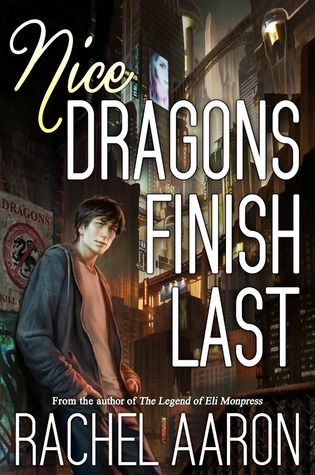
Earlier this week, my review of Rachel Aaron’s Nice Dragons Finish Last, the first installment of her self-published urban fantasy series, Heartstrikers:


Julius Heartstriker is the protagonist here, one of the youngest dragons in a long line of dragons –  He is the least like his family, an introvert more concerned with continuing his online education and playing MMPORGs until his mother Bethesda kicks him out and tells him she will kill him unless he starts acting like a real dragon. Bethesda, as one might surmise by this small introduction is not a kind dragon (as is befitting her race), for she excommunicates Julius to DFZ, the Detroit Free Zone sealed in his human form…which is fine since Detroit is the one place where Dragons are not permitted by the Algonquin, Lady of Lake, the magical/supernatural ruler of the domain. 

...
I found the world-building here very interesting and fun; the explanation of how magic and supernatural creatures exist in a near future version of our world to have an interesting starting point. A meteor crashed into Canada in 2035, which triggered a powerful surge of forgotten magic into the world, including spirits that had lain dormant for nearly one thousand years. The action of the novel takes place 60 years after magic’s return, so there is a status quo and a generation of people who have known only a world with magic. So even though this novel reads primarily as an urban fantasy, there are also hints of post-apocalypse in that the world has been changed by a cataclysmic event.

Last but not least, blogger Stuart (SC) Flynn interviewed me for his blog, as a part of his series of interviews with reviewers, podcasters and bloggers.

Friday, January 23, 2015

Friday Round-Up: SF Signal and SFFWorld Goodies

The Bagel Lord of SF Signal John DeNardo recently put SF Signal into a new magazine theme, and has dubbed the look as SF Signal 5.0, go take a look. In addition, John recently "promoted" Kristin Centorcelli (aka My Bookish Ways) as the New Associate Editor. Kristin is one of the most active bloggers in the genre so this is great news for both John/SF Signal and Kristin.

Over at SFFWorld, the forums are still alive, despite twitter, facebook, and reddit drawing conversation away from discussion forums. We've come to realize this is not localized to the forums at SFFWorld (for example, the once lively forums of Terry Brooks's Web site recently closed). But with SFFWorld having active  forums since 1999 or so, we (the moderators and members) don't want to see the place go away. So check out what other fans of the genre are talking about. Site owner Dag Rambruat is cleaning up the forums and layout based on some member feedback.


Back to SF Signal, I've posted a couple of articles/reviews over the past couple of weeks to SF Signal. Two weeks ago, my January Mind Meld was posted:


Lastly, about a week ago, my January Completist column posted, which features Eric Brown's Bengal Station Trilogy:


Eric Brown has written and published just about one novel per year since his first in 1992. Many of those novels have published through Solaris Books, including his Bengal Station Trilogy. At their heart, the books of “The Bengal Station Trilogy” are a modern Psychic Detective novels, albeit set on a space station in the future and involving aliens. That “psychic detective” would be Jeff Vaughan, a cynical, distrustful man who, at times, is trying to run from his past. As the title of the series implies, the novels are set on (or launch from) Bengal Station, a space ship station above India and Thailand.
...
What becomes clear over the course of these three books is how Brown sets up a framework for the series, but with each novel in the series, tweaks the dressing for that framework in fun and interesting ways. Part of the fun in reading such books is revisiting with the characters in each installment.

Friday, November 21, 2014

Friday Round Up: Rocket Talk with Justin Landon; Lou Anders and Joshua Palmatier @ SF Signal

After a couple of relatively slower weeks of no new reviews or any content from me, two things appear on the same day, such is life in the hectic world of SFF blogging and reviewing. . Add to those a review which appeared appeared the day after my last link round up, and you have my post for today. Speaking of SFF blogging and reviewing, that was the topic of discussion in one of my appearances this week.  My pal and Tor.com colleague Justin Landon (of the now closed Staffers Book Review blog, the Joe Abercrombie Re-read for Tor.com, and general genre rabble-rouser) had me on the Tor.com Rocket Talk podcast he leads. We talk about the reviewer/fan/author relationship, some other bloggers and a few books we've both enjoyed.  I thank Justin for having me on his show because in all honesty, I'm pretty pleased to be a guest on the same podcast that has featured some great genre folks like Joe Monti, Kate Elliott, N.K. Jemisin, Robert Jackson Bennett, and Delilah S. Dawson.

Listen to Foolish Talk Ye Mortals and Despair!


A couple of weeks ago, my review of Lou Anders's debut novel Frostborn, itself the launch book for his Thrones and Bones series went up to SF Signal:

Frostborn by Lou Anders - Review @ SF Signal
Perhaps what I enjoyed most about the novel are the hints at so much more to come, from the hinted-at future for their further adventures to the wonderful world-building which serves as the backdrop of the story. As I often say in novels with great world-building, the world itself is a character and the details are seamlessly delivered through the characters. Such is the case with Frostborn. The world-building does not smother the story nor is it over-indulgent; it enhances the story. I’ve been following the author on social media and listening to podcasts in whch he is featured, and he often spoke about the world-building in this novel and how he fell in love with the Norse region/myth as he was writing this novel. That love comes through quite well. When an author is able to show how much fun he or she had writing and creating a work, it can make for an even more engaging read, like it did here with Frostborn. Many people reading this review will know of the author’s experience on the other side of the publishing desk, which can be seen in his smart approach to the novel.


About an hour Rocket Talk posted, my November Completist column posted to SF Signal. This time, I took a look at Joshua Palmatier's The Throne of Amenkor trilogy:


I turn my focus on Joshua Palmatier’s “Throne of Amenkor” trilogy of books; a series about a haunted throne and the street urchin/thief who becomes tied to the throne. At the time Joshua’s debut published, he might have been overshadowed a bit by two other authors debuting at the same time – Patrick Rothfuss (a DAW stable mate) and Scott Lynch (who tells Lies about a thief named Locke). Joshua’s books are fun, engaging, and where they have an edge over Lynch and Rothfuss’s series is the fact that the series is complete.

In an SFFH landscape where readers are seeking stories which eschew the standard male protagonist, Palmatier has created a powerful and engaging female protagonist in “The Throne of Amenkor.”


Friday, September 05, 2014

Friday Link Update: Hunter, Hurley, Russell and Bennett

A couple of new book reviews since my last round-up/update, a guest post, and a new installment of my Completist column at SF Signal.

Last week I posted my review of Sylvia Izzo Hunter's magical debut, The Midnight Queen, a Regency-era inspired fantasy:


Set in an alternate England somewhat reminiscent of the Regency era, where Magic is taught to young men at Oxford’s Merlin College, Sylvia Izzo Hunter’s debut novel wastes no time introducing the protagonist, Graham (nicknamed Gray) Marshall, and the situation which propels his plight through The Midnight Queen. Specifically, some of his college friends encourage Gray to join them in a night time escapade, a heist of sorts, which ends in tragedy and Gray receiving a forced dismissal from the school. Gray is taken by Appius Callender, the Professor who sent Gray and his friends on the ill-fated mission to Callender’s estate where Gray is something of a prisoner and indentured servant. The only thing that gives him respite during his dreary days is young Sophie Callender, the Professor’s middle child.

...to suggest that The Midnight Queen is merely a period piece / fantasy of manners / romance / conspiracy mystery is selling the novel and Hunter quite short. Sure, it is essentially a mash up of those four things, but there’s quite a bit of character development, world building, and fun storytelling throughout its short, but densely packed pages. It isn’t even in the explicit details of the world and magic that provided for the depth of the world but rather those elements only hinted at by the characters and the narrative. Although superficially, the church depicted in the story initially has a vaguely Catholic feel, there are actually multiple gods worshipped as the Roman and Celtic pantheons/religions dominate.

Earlier this week, I posted my review of what will likely take the #1 spot of 2014 books, Robert Jackson Bennett's City of Stairs:


Set in the imagined city of Bulikov, the novel is the first Bennett has penned which does not take place in a version of our world (although the parallels and echoes are there), but rather a fully realized secondary world. The gods (Divinities as they are referred to in the novel) have been driven from the Continent (where Bulikov is situated), having been pushed out by the Kaj – a legendary figure of the past. The “now” of the novel is filtered through the eyes of protagonist Shara, a spy working in Bulikov for her home land of Saypur with her “secretary” Sigurd, a hulking nigh-indestructible Dreyling, a humanoid race of the world. Saypur is drawn to Bulikov to investigate the murder of a prominent figure of Bulikov, setting the early portion of the novel as a mystery story after the murder of historian Dr. Efrem Pangyui. With the gods having been driven from Bulikov, the city has lost a great deal of its luster. Even with the milieu of a secondary world, Bennett frames the initial plot to lull the reader into the story with a murder mystery which possesses some spy elements
...
Few writers’ have been able to make me think deeply about their work while also entertaining me as has Bennett’s work. I loved the world-building in this novel, how the gods could be brought down by men (or a lesser set of beings) which I found to have some echoes of the Greek Gods toppling the Titans while the city of Bulikov itself had more of an Eastern European feel. The characters felt plausibly real, flawed and imperfect. The implied history to the characters in the narrative is just as powerful as the implied history to the world itself. I want to hang out with these people more, I want to read about this world.

Speaking of Bennett, in a bit of a response to a recent blog post of Bennett's, Kameron Hurley's Blog Tour for The Mirror Empire at SFFWorld spoke to the idea of genre.


Lastly, my latest Completist column features a duo of books, The Sparrow and Children of God by Mary Doria Russell:


Nearly twenty years ago a debut novel took the genre world by storm, at least in terms of awards. It won the Arthur C. Clarke Award, BSFA, the James Tiptree, Jr. Award, and author Mary Doria Russell received the John W. Campbell Award for Best New Writer. It was a novel that walked a fine line in its themes between science and faith. The intersection between the two is not always a comfortable one and if anything can be a one-word apt descriptor of Mary Doria Russell’s The Sparrow and Children of God it is the word uncomfortable. In trying to come up with a “completed” series of books for this column, I pored over my reading logs and it wasn’t long before these two books shouted to me from deep within my memory banks. So again, I’m stretching the definition of completed by including a book and its sequel, but these are excellent books that people should be reading even today — nearly 20 years after The Sparrow first published.


Friday, August 15, 2014

Friday Roundup: Hobb @ SFFWorld, Abraham @ Tor.com, and Buettner @SF Signal

I haven't posted one of these link round-ups in a couple of weeks. More importantly, this week I posted a new review to SFFWorld, the first in a little over a month.  That isn't to say I haven't been reviewing, but as my plethora (OK, under 700) of twitter followers likely know, I've been posting quite a few reviews to Tor.com over the past few weeks.  So, what does today's fancy link round-up include?

Let's start with my latest review for SFFWorld, a book that I hadn't realized how much I was looking forward to reading it until I stuck my head into it: Fool's Assassin by Robin Hobb.  Admittedly, I was a bit nervous about this one based on how badly I bounced off of her second Soldier Son novel, Forest Mage (more for the story than anything, because through everything Hobb has incredible prose), which was the last book by Robin Hobb I read despite her writing five novels since then. All of that having been said, I was more than satisfied with Fool's Assassin and chances are it will be one of (maybe THE) top fantasy novel for me by year's end.


Years have passed since readers were last privy Fitz’s thoughts, he is now married to his boyhood love Molly, his daughter Nettle (whom Molly’s first husband Burrich raised as his own and is now very much enmeshed in the life of Buckkeep court) has appointed him the Holder of the Withywoods Estate she’s been bequeathed. In short, life for the man many know as Tom Badgerlock is far more bucolic than the courtly intrigue in which he spent much of his life embroiled. Then one Winterfest, a traveling group of minstrels and performers arrive; these strangers are very different indeed and bear little resemblance to any folk to have passed through Withywoods as far as any of the staff and people can remember. Life soon returns to its leisurely pace for Molly and Fitz until Molly boldly proclaims she is pregnant. This is something she and Fitz always wanted for many of the children she bore were from Burrich, her first husband and the man who served as a father figure to Fitz.

Much of the novel from this point deals with Fitz as a father to this new child, a child who appears healthy but much smaller than any child should. This young girl, whom Molly and Fitz come to name Bee, is not very communicative and is very withdrawn. She shirks away from Fitz and bonds immediately to Molly. Because of her diminutive size and silence, she is thought by many of Withywoods to be mentally slow and damaged. As the novel progresses, Hobb conveys the emotional turmoil a parent might experience with a child who is so out of what is considered normal.

Last week, my review of another incredible Epic Fantasy novel went live at Tor.com - The Widow's House by Daniel Abraham.  Abraham is climbing the ranks of my personal favorite genre writers and this book raises his stature on that list even more.


In The Widow’s House, the fourth installment of The Dagger and the Coin sequence, author Daniel Abraham continues to deftly explore positions of power, and how perception lends credence to reality. Abraham tells the story through the same points of view as in the previous volume, though these characters have evolved quite a bit since we first met them. Clara Kalliam, widow, mother, plotter against the Lord Regent; Cithrin bel Sarcour, ‘rogue’ banker, former lover and scorner of the Lord Regent; the aforementioned Geder, Lord Regent and emotional basket case; and Captain Marcus Wester, a hardened man of war. Abraham bookends the novel with two additional points of view: a prologue from the POV of the last Dragon Inys, and an epilogue from a soldier’s point of view.

What is most fascinating about this novel, and the story as a whole as Abraham has allowed it to unfold, is how he is playing with archetypes, both propping them up and shattering them. War is most often fought in Epic Fantasy with the standard machinations of war—men with weapons. What if the solution to winning a war is to not fight the war; to pull the proverbial rug out from under the war and completely change the rules? It is an intriguing concept that has been simmering throughout the series as Abraham set Cithrin and Geder, as seeming allies at first, and now characters at ideological cross purposes.

Lastly (and most recently), my latest Completist column went live at SF Signal and features a more recent series than some of the recent column installments. Robert Buettner's Orphange / Jason Wander 5 book Military Science Fiction series.


This series is set approximately 40 years in the future with Earth being attacked by aliens who come to be known as Slugs. Many of the people chosen for this interstellar war are orphans, people whose families were destroyed in the attacks, which take the form of large stone projectiles, with no nuclear armaments, hurtling through space, which destroy the surrounding area where they land, most often populated cities like Pittsburgh or Indianapolis. It is with this premise Robert Buettner introduces the reader to the world of Orphanage and its protagonist, Jason Wander whose hometown is the destroyed Indianapolis.

The premise of alien invasion and a humanity that fights back is a familiar one in Science Fiction, and military Science Fiction specifically. Furthermore, the first person narrative Buettner employs is quite common in Military SF. However, it is no less effective. Rather, Buettner builds an effective, empathetic protagonist in Jason Wander. With his experience as a former Military Intelligence Officer, it should come as no surprise how effectively Buettner conveys military life.