Showing posts with label SPOTLIGHT. Show all posts

Monday, October 20, 2014

Hallowe'en Reading 2014 - 'SALEM'S LOT by Stephen King

I have a long association with Stephen King’s fiction, as I may have mentioned in the past. I would say I’ve read about 80% of his novels and many of short stories, but before last week, one of the major oversights of his bibliography for me was his classic vampire novel ’Salem’s Lot. Well, that oversight has been “corrected,” to borrow a term from another of King’s work. In short, I enjoyed the hell out of the novel.

Cover of original US Hardback.
My dad has a copy of this.

As has likely been recounted about this novel, ’Salem’s Lot is King’s mash-up of Peyton Place and Dracula. Both novels are referenced in the text of ’Salem’s Lot: one character (Matt Burke) is remarked to remind the others of Van Helsing and Peyton Place is even called out by another character. After a brief prologue featuring Ben Mears and a young boy after the events of the novel transpire, King introduces the populace of Jerusalem’s Lot in a leisurely fashion. ‘Salem’s Lot (or The Lot), as the inhabitants call it, seem to know each other and each other’s business; the quintessential New England small town. Their everyday life is shaken up when visitors arrive: writer Ben Mears arrives looking to exorcise some past demons through writing a book and Straker & Barlow, two antique salesmen who arrive looking to set up a new shop. Ben and Straker & Barlow are both interested in the old Marsten house which overlooks the Lot to the point that Ben was going to rent it out until he discovered Straker & Barlow have taken up residence in what many feel is a haunted mansion.

Cover of the MMPB I read. I've
had the copy for at least a decade.
While some of the characters can be considered to lean towards cardboard cut-out territory, King gives a lived in, familiar, and quaint feel to the Lot. This is one of the novel’s strengths, its sense of place and initial comfort. The other strength is the subtlety and slow reveal of the terror hiding in the shadows, aside from the dog’s head on the pike early in the novel, of course. The subtlety is when the human characters interact with the vampire; there are more hints than description, allowing the reader to finish the scene with their own imagination. Though King can imagine terrifying things, it is this cooperative horror that proves to be so effective in ’Salem’s Lot.

Where the novel stumbles is two-fold and both of these I’ll generously attribute to the time the novel was published and the fact that it was King’s second published novel. The relative lack of female characters stood out to me. We have one primary female character – Susan Norton – and while it is through her eyes we initially see the novel she’s little more than a romantic entanglement used to drive Ben Mears through the plot and provide him tension and action. The only other truly (and fully) positive female character in the novel is Eva Miller, owner of the boarding house where Ben takes up residence during his time in the Lot. Most of the other women are portrayed in varying degrees from middling to quite negative.

The other stumble is some of the flowery early interaction, between Susan, her family, and Ben. I’ll chalk this up to being a novel of its time in how the characters talk. Susan and Ben fall for each other quite quickly and the language King uses to show them falling for each other reads as a bit put upon by today’s standards.

Some other points to note about ’Salem’s Lot:
  • It is the first (of many) Stephen King novels to feature a writer as the protagonist
  • King would return to similar themes, specifically small town with a dark cloud of monster(s) hovering: It, Needful Things, The Tommyknockers and to a lesser extent The Dark Half
  • Tangentially, like Needful Things, ’Salem’s Lot features a small town disrupted by the arrival of a strange visitor
  • Like IT, ’Salem’s Lot features a small town with some historically recurring darkness
  • As the King constant reader knows, Father Callahan later shows up in the fifth Dark Tower novel, Wolves of the Calla
  • I think part of the reason Needful Things has a lesser reputation in King’s bibliography might be because of how it echoes ’Salem’s Lot (I personally liked Needful Things but it has a special spot for me relating a great deal to when I read it, as I point out in that link at the top of this post).

My colleague (though we’ve never met, and I mean colleague in the sense that some of our writing appears at the same place) Grady Hendrix over at Tor.com wrote about ’Salem’s Lot as part of his Great Stephen King Reread. While he does make some points I can grok even if I don’t agree with them, one interpretive point I can’t agree with is his assessment of the Marsten House. He suggests there’s no real reason for Barlow and Straker to set up residence at the Marsten House. The answer, for me, is right there in the novel. Throughout the novel, characters remark that The Marsten House is a magnet for evil, ever since old Hubie Marsten lived there and committed horrific acts, supposedly demonic sacrifices, killing children, and killing his wife.

The other point on which Grady is also flat out wrong is the character of Mark Petrie; Grady makes Mark out to be something like Harold Emery Lauter when in fact, Mark is fairly well-adjusted and manages to take out the school bully early in the novel. This sort of informs us that Mark, coupled with his love and knowledge of horror/monster movies, is as well-equipped as any character in the novel to take out Barlow. Mark’s calculative methods prove very useful to the plot and if he were nerdy and off-putting, the two other kids we see in the novel (the Glick Brothers) would have been more hesitant to visit him. (Admittedly, Grady recants some of his thoughts on Mark).

I’ll split the hairs regarding Grady’s take on the one-dimensional hillbilly characterization of the ‘Lot’s inhabitants. Most of them don’t really stretch beyond their cliches, like that of a cheating spouse or an abusive mother, but those folks don’t need much more attention than their archetypes in this particular story for me. Again, I see Grady’s point here and can agree with it to an extent.

As for the adaptations of the novel, I watched the old TV miniseries once years and years ago. I hadn’t been aware of who James Mason was at the time, but now I want to rewatch it just for James Mason. I did not see the 2004 remake with the stellar cast of Rob Lowe, James Cromwell and Rutger Hauer but that interests me now, too.

’Salem’s Lot was an incredibly addictive read and I can understand why this helped to set King on the path of superstardom. I’m not sure exactly where it ranks against the other King novels I’ve read only because the later books I read were after he became a more polished writer and storyteller. All told, I really enjoyed the novel despite some of its flaws.

A post-script: Any and all King fans and Constant Readers should check out Grady’s reread project, there’s some good insight to the books in his articles and I’ve reexamined my own thoughts on some of King’s work.

Wednesday, October 27, 2010

SPOTLIGHT: Hallowe'en Reading - Dark Harvest by Norman Partridge


Norman Partridge's Dark Harvest has been on my radar for a couple of years now having won the Bram Stoker award and receiving mentions by SFFWorld's resident Horror Expert Randy. M. The book was published first in limited edition by specialty horror press Cemetery Dance then by Tor with that terrific Jon Foster cover.

Small towns are often the settings for some of the best horror stories. Dark secrets add to the mix, and the sense of everybody knowing everybody, is the tip of the iceberg. In Norman Partridge’s Dark Harvest, these elements set the tension for the annual Hallowe’en night event where young boys try to catch the October Boy. Penned up and unfed by their families in the days leading up to Hallowe’en, these boys are released into the town to chase and take down the October Boy. In a sense, this is reminiscent of the mythical Wild Hunt. The boy who takes down the Pumpkin-headed monstrosity gets to leave the dead end town and his family is showered with prizes.

See, nobody ever leaves this unnamed town. Ever. Taking down the October Boy is the only chance anybody has of leaving and Hallowe'en and the hunt for the Boy is the focal point for this small town which has had wonderful crops as long as anybody can remember. Just like young men have been chasing the October Boy for as long as anybody can remember.

Our point-character is Pete McCormick. He’s got father issues, and is determined to win and leave the past and the down behind. We know Pete, or so the narrator tells us, and we do get to know Pete. Pete gets to know more about the October Boy than most other boys who hunt ol’ Hacksaw face, another nickname for the walking Jack O' Lantern.

With a flaming pumpkin-head, the October Boy is that iconic Hallowe’en image personified. That coupled with the evocative fall nights having turned from summer and the bristling cornfields adds to the ghostly, iconic resonance in which Partridge steeps his novel.

Partridge does something interesting with the voice used in the novel, switching from third person omniscient to second person conversational. It works very well on a number of levels, not the least of which is to put the reader into the heart of the story, to feel almost a participant who knows the players. This is an extremely effective way to make the novel all the more intimate.

What turns this novel from something of a typical and straightforward story to a more layered narrative is a little trick Partridge plays about halfway through the novel. The narrative lead me to believe the story was about one character, but Partridge very skillfully, and quickly, turns the story on its rear, and makes it more than just one boy’s wish to escape.

Partridge depicts the teens very well here, they aren’t whiney and are on par (wait for it) with Stephen King’s depictions of the Losers from IT and the kids from his short novel The Body. Sorry, but it is pretty tough not to compare a youthful protagonists in horror novel to Stephen King.

In the end, the imagery is powerful, the themes of youth awakening and small town dark secrets familiar, and the narrative pull thrillingly addictive. The fact that the town is never named and little background is given about the events leading up to those events that take place in the novel, gives the novel a greater sense of mythic resonance. I think it’s pretty fair to say that Norman Partridge has crafted one of those novels readers will return to in future Hallowe’en readings – in other words an iconic novel.

Highly recommended


Wednesday, July 30, 2008

SPOTLIGHT: The Blog/Review Ranting Meme

For the purposes of this post, I’ll just consider blogging and online reviewing the same kin. Also, there will be many parentheses throughout.

Rather than respond to all the posts in my blogroll about this topic, I decided to continue the meme. This rant may wind up being more to voice my thoughts to myself than anything, though.

All over the genre blogosphere (at least the blogosphere that consists of my sidebar and other haunts) the topic of blog/reviewing has reared its head again. This creature comes out of hiding every few months and this time, the questioning creature has something of a different face – the bloggers themselves are asking these questions, whereas in the past publishers (not exclusively) have been the ones to spark these discussions. Perhaps because of the two new genre blogs (Suvudu and Tor) having recently been launched not to mention the venerable Web sites like SFSite & SF Signal, we (the FSF review/blog community) find ourselves navel gazing again.

About, I don’t know a year ago or something on that order, the blogosphere started to make its presence known in the SFFWorld forums, where a lot of new bloggers thought they could just drop in and get some free publicity and linkage to their blogs without really ingratiating themselves into or becoming part of the community there. Admittedly this put the moderators at SFFWorld in an interesting place, especially me since I have my own blog. The sense of community we’d built at SFFWorld over the past half-decade plus was now (at that point) perceived by the blogging community, by some of us behind-the-scenes folks, as nothing more than a free advertisement forum for these new bloggers. In the time since, I think (and hope) we’ve been able to build and tow a decent line between keeping SFFWorld discussions active the forums themselves while also continuing to foster a good genre community to consider cool for discussion. Essentially, I hope we’ve been able to foster a good community between the SFFWorld forums and the bloggers who visit.

So, where were we? Jonathan McCalmont started it, the returning Gabe continued it, Pat took the relay, and Larry kept the ball rolling. One of the points brought up was how (or if) getting paid for writing these reviews was viable. Getting paid would make it almost like a job, wouldn't it? A lot of us start doing this blogging / reviewing thing in our "personal time" out of our enjoyment of the books we read. This idea of payment could also bring into the validity of the reviews; after all couldn’t we just be seen as paid members of the PR machine – paid to pander to those who pay us to help promote their product? In one sense, we reviewers / bloggers are part of the PR machine, but right now we are basically unpaid independent contractors. What we need is a union!

The publishers, in about the past year, saw the sense of community between the bloggers/ reviewers and started paying attention to us. Granted I’d been receiving review copies for a few years, but the bloggers started receiving them for review on their blogs. Most notably, newer publishers like Pyr and Solaris, but the Del Reys, Roc & Aces, and Tors of the world are there too. It’s a tricksy place we find ourselves in nowadays. There seems to be an almost, I don’t know, over-worked sense to some of the discussions I’m seeing. As people have been posting their daily and weekly hauls of books they receive in the mail (both from publishers and bought on their own, but mostly the free books for review) it seems as if some of us are overwhelmed by our place in the genre community. Or perhaps, I’m speaking solely for myself here. Part of the issue is that (as I’ve said in comments on other blogs and probably here as well) it is impossible to review everything I (or any other blogger/reviewer) receives.

This begs the question posed and intimated in the links above – how does one decide which book to read out of the plethora of choices? Initially it can be pretty easy – Book 4 of a series in which I haven’t read or even own books 1 through 3 get shunted to the pile of unread books. That eliminates about a book a week. I’ve had Richard Morgan’s The Steel Remains on the pile for a few months and I feel it is a book I have to read and review since it seems to be one of “the” books this year. Matt Stover’s next Caine novel, Caine Black Knife arrived recently and that’s a definite. Conversely, if one of the books I receive doesn’t seem to be getting all that much attention around the blogosphere (at least those limited to my sidebar), I’ll try to get that book into the mix. Star Wars: The Force Unleashed, a media tie in arrived and primarily because I really enjoy the writer, Sean Williams, I’ll be reading/reviewing it. But I wonder what affect, if any, reviews from our portion of the genre community, will have on a book that basically has a built-in audience of Star Wars fans and gamers. (This could be a topic all to itself.) What of a book like The City at the End of Time by Greg Bear? The book sounds like pretty interesting Big Idea novel and I’ve enjoyed much of what I’ve read by Bear, yet there doesn’t seem to be much chatter about the book, so how do I factor that into the decision on whether or not to read the book?

In terms of quantity vs. quality, one Harriet Klausner is enough and the majority of us are self-aware enough of what we don’t want to do in our reviews. As such, we’ve all crafted our own personalities and quirks. In a more snarky sense, McCalmont seems to be contrarian, Adam’s reviews are solid and very balanced, and not a one of us can figure out Pat’s damned number ratings.

I recall Cheryl Morgan’s last postings at Emerald City and her talk of review burn-out. I’ve been posting at least one new book review a week for the majority of this year and much of 2007 and times, more than one review. I know some of the reviews are stronger than others, it’s only natural. I can feel it when I force myself to write some of the reviews both the positive and the negative reviews, and some would say I often lean towards the positive in my reviews. I also don’t want to keep saying the same things over and over again, even if I’m lucky enough to be reading books that often work for me. I’ve also thought about taking a break, if not completely putting and end to this whole reviewer thing. The thing of it is, I love the genre and I really like being a part of it even in my small capacity as reviewer and administrator/moderator at SFFWorld and maintaining this blog. I’m also working on my own fiction and generating these reviews, irrespective of their length, do take a decent amount of time to think about and craft. In some form, though, I feel a great drive to write, be it review of my own fiction.

After this sense of review burnout creeps in; however, I’ll read a book like Cory Doctorow’s Little Brother and want to shout how great it is or, on the other hand, I’ll read a book that didn’t agree with me like Karen Miller’s Empress and feel the drive to put my thoughts about that book down. Or, right now I’m reading a book that didn’t initially interest me too much based on the premise and the author was untested (by me), but I figured I would go outside my comfort zone and give it a try. I think that’s something we all need to do, is go outside our reading comfort zone and Jeff VanderMeer has said as much. Conversely, I really enjoy Epic Fantasy and I’ve really begun to enjoy Urban Fantasy / Detective Wizard, so if something new with one of those slants comes down the pike, I feel a responsibility (for lack of a better word) to measure it against other books if its kind.

As I said, this whole reviewing thing started out because I enjoy reading and sharing my thoughts about what I read. The reviewing gives me an opportunity to voice my thoughts and opinions on a larger scale. Contrary to this though, sometimes I just want to read a book without having to write a review or with a review as the ‘endgame.’ Books like Jim Butcher’s Dresden Files, Steven Erikson’s Malazan saga, the Star Wars Legacy of the Force series, an anthology like the Strahan/Dozois edited New Space Opera, Michael Chabon’s Gentlemen of the Road, or other books that have remain unread for upwards of a year or two, but at times, I’ll feel a little guilty about reading one of those while 10-20 books I’ve received from publishers await on the TBR pile for reviewing. This doesn’t even factor in my weekly/monthly haul of comics and graphic novels.

Don’t get me wrong, these aren’t life-shattering decisions or frustrations (I don’t think), but they are things I and (probably) my peers think about. I enjoy being involved, knowing what books are out there, and being afforded the opportunity to have my voice heard. I also have to admit that I like getting the free books, but I think it’s only natural (based on the resonance I’ve seen in other’s thoughts) to feel a bit guilty about not being able to read all that arrives. Strange dichotomy, I realize.

Where does this all leave us? Still in that strange place between fan and critic, I suppose. Granted, my blog is not as trafficked nor does it have the volume (and consistent substance) of postings as many others, but I feel responsibility to maintain it. I enjoy maintaining it and being part of this community. In the end, my drive to write (be it my fiction, the book reviews, on this blog, or if somebody wants to be kind enough to compensate my monetarily for my thoughts) will continue and push me to be a presence.

Wednesday, June 11, 2008

SPOTLIGHT: Catching up with the Classics - Glen Cook's Dread Empire

This one is from the archives of 2007. I never got around to posting it here or at SFFWorld, so I figured with The Black Company being the book of the month in the SFFWorld Fantasy Book Club, now was as good a time as any to post my review of A Cruel Wind: A Chronicle of the Dread Empire. I was also way overdue on my plans to do a Spotlight/Catching up with the Classics once a month.

The cover is just so gorgeous I had to post it as big as I did.

Without further ado...


NightShade Books
ISBN 978-1-59780-055-6
August 2006
904 Pages

Glen Cook has been writing acclaimed fantasy (and some science fiction) for many years, just on the outskirts of the big brand names like Donaldson, Jordan, and Martin. This is not to say his writing is inferior to those more recognized names, in fact, quite the opposite. After having read Cook’s first three Dread Empire novels, collected in a beautiful omnibus from the fine folks at NightShade books under the title A Cruel Wind, I find myself eager to read more of his works, if not in the Dread Empire, then any of his novels. I was not a novice to Cook when I opened this book, I read and enjoyed three of his Black Company novels, published by the Science Fiction Book Club under the title The Annals of the Black Company. It has been a number of years since I read the Black Company novels, so I can’t fairly and precisely compare the two sets of books other than the feel both worlds evoke. Cook doesn’t mince words, either in his descriptions or dialogues. These people live in harsh worlds were war is prevalent and a fact of daily life.

The first book in A Cruel Wind, A Shadow of All Night Falling, flips between to time periods. The ‘present’ of the world and the past, illustrating the origins of a great wizard, Varthlokur. Cook presents a harsh, desert-like landscape in which the wizard-to-be is born and raised. Much of his early life is spent without speaking, though he plots a plenty. Those scenes alternate with Varthlokur’s plans coming to fruition, as he sends spies to invade the nation where his prophesized future wife rules. The foremost spy goes by the name of Mocker, a rather unassuming individual from a physical standpoint, but able to win over crowds and individuals thanks to his amazing charisma. Eventually Mocker’s way with words wins over the queen, whom he originally was intended to sway to Varthlokur’s side as his wife, as a lover of Mocker’s own. This novel sets the stage for the events in the subsequent novels, while also ending with a sense of closure. A Shadow of All Night Falling set the stage, obviously, and it was the book I enjoyed most in the omnibus. I really liked the alternating perspective Cook utilized in the narrative and his evocation of the setting which reminded me of the Hyborian Age of the Conan novels than of anything else.

The second book, October’s Child, takes more of a physical approach to the action. Whereas A Shadow of All Night Falling was more a novel of political play, the gruesome, tireless and seemingly endless cloud of war permeated the second installment of The Dread Empire. Throughout this second novel, Cook terrifically injects the darkness of war, especially in the way the characters feel. Though I thought narrative was as strong here, it fell a bit short of how much I enjoyed A Shadow of All Night Falling.

The final volume in this book, All Darkness Met, again brings more of the focus on Varthlokur’s efforts, though he is more of a secondary character. After following the wizard’s ascent in the first volume, Cook expertly builds on the character with other character’s thoughts and fears about Varthlokur. Cook's method of characterization from a distance worked for me here and I enjoyed All Darkness Met probably as much as October's Baby.

While a number of the characters are important across the three books, perhaps the most well-drawn throughout is Mocker. A fat man, with high charisma and a unique speech pattern make for a memorable and enigmatic character. Some might find his manner speaking annoying, with it’s Yoda-like word placements, but it comes across as an endearing quality, much like the small, green Jedi master. On can also see the similarities between Mocker and Steven Erikson’s Kruppe, which is no surprise since Erikson has listed Cook’s writing as an influence.

The Ragnarsson clan evoking a Nordic influence, factor a great deal throughout the storyline, particularly the final two books.

The physical book itself deserves mention. From small-press NightShade, this is a beautiful looking book, from the evocative Raymond Swanland cover, to the nice paper, to the overall feel and design of the book, one can tell the publishers put a great deal of thought into their final product. It should also be noted the book includes a great introduction by Jeff VanderMeer who paints a great picture of Cook’s writing; the preface works as both an introduction and a “love letter” of sorts.

The suggestion is often made, but fans of Erikson’s Malazan series should check out this book, as well as Cook’s Black Company. Fans with an interest in the down-in-the trenches approach without so much veneer would do well to check out these books. Hell, fans of fantasy in general would do well to read these books. I enjoyed A Cruel Wind a great deal for many reasons - the evocation of the setting, the different approaches Cook utilized from book to book, and quite simply, the overall story itself in each volume and as a whole for the saga. I did think the pacing was slightly uneven in spots from book to book, but on the whole I liked A Cruel Wind quite a bit.

© 2008 Rob H. Bedford

Thanks for the nudging Joe.

Thursday, February 28, 2008

SPOTLIGHT: Detective Wizards, Vampire Hunters, and Werewolves Oh My!

The wizard detective, the vampire hunter, the werewolf D.J, these are but three of the popular characters in one of increasingly popular subgenres of speculative fiction. Some call it supernatural fantasy, others urban horror, while others call it urban/dark fantasy. No matter what it is called, readers know what it is and have been gobbling up many of the titles over the past ten years or so as the this subgenre has exploded (yeah, next I’ll tell genre readers that the sun rises every day). Just check out this fairly extensive discussion at SFFWorld. For my part, I’ve read some of the authors but by no means have I read all of them, nor would I completely consider myself an expert on the subgenre. However, I am finding myself drawn to books of this ilk more strongly. Writers like China Miéville, and Charles de Lint wander into this territory, but they are not exactly the authors to whom I’m referring. What follows is just a brief overview of some of the writers/series.

Laurell K. Hamilton
When and why has the subgenre proven so successful? The character and set of books that kickstarted this trend would arguably be Laurel K. Hamilton’s Anita Blake: Vampire Hunter series. These books were able to catch on to the genre-reading public in no small part because of the success of Anne Rice’s Vampire Chronicles and perhaps more so, Buffy the Vampire Slayer (TV). Although the Anita Blake books may not have been the earliest in the latest trend, they have proven extremely popular. Vampires have always fascinated people and between Rice’s success in humanizing them and the strong, powerful female protagonist, Hamilton’s series is in retrospect a no brainer for success. Of the Anita Blake novels, I read the first four or five before being pulled away. Readers have criticized the later books for being little more than erotic fantasy with an overabundance of sex, but the early books are very good and are considered by some as a benchmark in this subgenre.

Jim Butcher
Another ingredient for the success of this subgenre probably has something to do with the presence of these creatures in the “modern/real” world and people possessing arcane abilities in modern society. Another highly popular example of this would be Jim Butcher’s Dresden Files. Harry Dresden is the only practicing wizard listed in the Chicago yellow pages and as such, he is on retainer to the Chicago PD’s Special Investigations division. Cases involving werewolves, vampires, ghosts and other things that go bump in the night are his purvey and when the Police can’t wrap their heads around such a case, they call in Harry. I’ve only read three of these books but they could turn out to be a favorite series if the books continue to entertain me in the same fashion. The series is in the double digits with little sign of slowing down, so the good part is that there are plenty of books for me to read. The world Butcher has created for this milieu is incredibly detailed, and very well thought-out. He’s got the White Council, which is the governing body of the practice of magic, several Vampire Clans, a faerie world (Nevernever) two which Harry travels. A sure sign of the success of this series is that it started out in Mass Market Paperback and with the 5th or 6th book, jumped into Hardcover for the initial release of each book.

A short-lived series on the SciFi channel might have helped to raise the awareness of this already popular series (the first book, Storm Front, is probably in its 20th printing by now), but got the Axe. After a slow start, the series really gained momentum but the ratings apparently weren’t to SciFi’s liking, despite being somewhat comparable to those of Eureka and the abysmal Flash Gordon.
SFFWorld’s Hobbit reviewed many of the books in the series, beware spoilers though: (1) Storm Front (2) Fool Moon (3) Grave Peril (4) Summer Knight (5) Death Masks (6) Blood Rites

Glen Cook
Before Anita Blake and Jim Butcher; however, Glen Cook was writing a little series about Garrett (Glen Cook Wiki entry), a Private Investigator in a “Fantasyland” called TunFaire. I personally haven’t read the books, but one member of the SFFWorld forums whose opinion I can trust (KatG) consistently recommends this series. From what I’ve gathered, the series functions very much like a hard-boiled detective story with goblins, orcs, and wizards thrown in the mix. Based on my enjoyment of Cook’s Dread Empire and Black Company, I’ve really got to check out these books, of which there are already 11 books.

Carrie Vaughn
A werewolf in modern times should be able to fit in, shouldn’t she, especially if wizards and vampires can? Well, Carrie Vaughn’s Kitty Norville is doing her best as a radio talk show host in the series that bears her name. The first book, Kitty and the Midnight Hour published in 2005 to some positive reviews, including my own review. The fourth book is out this year and the Science Fiction Book Club put the first three books under one cover in one of their popular omnibus editions. The subsequent books seem to follow the trend of pleasing readers.


Liz Williams
Liz Williams
has a very strong series going with her Detective Inspector Chen novels. At least based on the first novel, the series seems to be working with a buddy-cop/police procedural template whilst mixing elements of magic and Chinese/Asian mythology. Night Shade Books is publishing this series, which is helping to make their already impressive list of authors even more impressive. Also, the first book Snake Agent was one of the launch titles for Night Shade’s Mass Market Paperback line. This is a very promising series as I said in my recent review of Snake Agent.


Tim Pratt
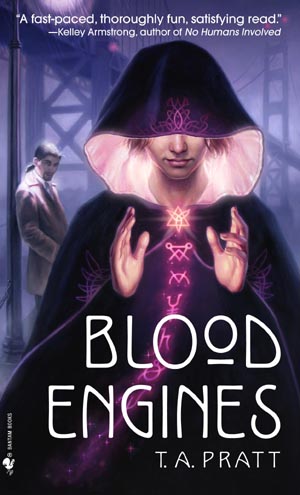
Tim Pratt (writing as T.A. Pratt) is two books into his Marla Mason series. I’ve only read a short story from that world, but what I saw I liked. The short story had a very Lovecraftian feel to it and I’ve got the first book, Blood Engines, on my To Buy pile. Here’s a nice review from Robert over at FantasyBookCritic.


Kim Harrison
Kim Harrison is another popular writer who seems to churn out a new book every year in her Rachel Morgan/The Hollows series. On the surface, the series blends elements of post-apocalyptic fiction with the “wizard detective,” or in this case, the “witch detective.” Morgan is similar to Harry in that she is an adjunct of sorts to the local law enforcement. I think the post-apocalyptic elements to this series sound interesting so I will eventually check out the books. My friend’s wife really digs this series, so I may just have to borrow the first book. Here is a recent discussion at SFFWorld.


Other authors worth mentioning include:
Kelley Armstrong – Women of Otherworld
Rachel Caine – Weather Warderns & Morganvilee Vampires
Simon Green – Nightside
Justin Gustainis – Quincey Morris Supernatural Investigation
Charlaine Harris – Sookie Stackhouse
Charlie Huston – Joe Pitt Casefiles (My review of Already Dead)
C.E. Murphy – The Walker Papers
Rob Thurman – series begun with Nightlife

Wikipedia helped me sort out a couple of things with this little article as did the folks in the SFFWorld forums, including the participants in the Supernatural Fantasy: Ghosts, Vampires, Werefolk and Wizards tread.

Tuesday, January 15, 2008

SPOTLIGHT: Catching up with the Classics - Starship Troopers

So, here's the new "feature" at the Blog o' Stuff. Once a month (at the very least, I hope), I'll be taking a look at a classic book or novel from the Fantasy/Science Fiction genres. This will either be a book I haven't read in a while, or the case of in this installment's book Starship Troopers, a classic I have yet to read. How can I never have read this book? I just never got around to it, simple.

What I can I say about one of the most famous, acclaimed, influential, popular, and important Science Fiction books of all time and a Hugo winner, to boot? What can I add to all the words that have been extolled or exhorted in frustration? I don’t know, except for my opinion and my own response. Suffice it to say, it is virtually impossible to open up this book and read it for the first time without knowing about it, its reputation, or having some preconceived notions.

Much of the novel deals with Johnny Rico’s experiences in the Mobile Infantry and how he deals with the equivalent of boot camp in the future. Heinlein basically paints a picture of the life of one volunteer in what amounts to the Space Marines. Throughout, Rico’s thoughts about life, politics become shaped by his training, his superiors, his “drops,” and the battles in which he engages with the “Bugs.” He goes from one who is unsure of his thoughts to a man with strong-held convictions, and in this sense, the story works as a coming-of-age story.

One thing that surprised me as I was reading the book was how little action and science-fictiony stuff happens for the better part of the novel. Don’t get me wrong, I don’t think this is necessarily a bad thing. In fact, I think the best science fiction novels, like this one, have an utterly human quality to them. Even if Johnny Rico serves as something of a mouthpiece for Heinlein (as some have said), the character comes across as genuinely human.

Another part of the story that surprised me was the nonchalance with which Rico reacts to the attack of the Bugs and the beginnings and of the Bug War. Despite Rico losing his mother and the momentary grief he experienced because of it, the attack and break out of the war are dealt with very matter-of-factly. I understand that Rico and his peers are training for war, but there didn’’t seem to be any kind of panic or any great swell of emotion when the Bugs attack Earth, or not as much as I would have expected.

I don’t know Heinlein’s writing well enough, but one item in particular struck me as very far sighted. Much of the novel, probably because it is in an unspecified future, has a timeless air about it. You get the sense that Heinlein was writing this both as a reaction to what he saw as well as a treatise as what he thought. One can also get the feeling that he wrote this book with the intention that it could ring true for many years to come, particularly the chapter where Rico describes something he takes for granted, what most people of that time take for granted, and something that has become a staple of the Military Science Fiction genre – Power Armor:

No need to describe what it looks like, since it has been pictured so often. Suited up, you look like a big steel gorilla, armed with gorilla-sized weapos. … But the suits are considerably stronger than a gorilla. If an M.I. in a suit swapped hugs with a gorilla, the gorilla would be dead, crushed; the M.I. and the suit wouldn’t be mussed. (Page 100 Ace mmpb)

That description says more in the words it doesn’t use than it does in anything else. It allows the reader to visualize something big and powerful; something iconic. It doesn’t rigidly define the thing and allows the thing to stand the test of time.

Although (as I said) I’ve never read the book before now, I do know of its reputation and influence, it arguably spawned the entire Military Science Fiction subgenre. Half of the authors of Baen Books were likely heavily influenced by Heinlein, and this book specifically. As I was reading through the book, I recalled some of the books I’ve read and realized how they were influenced by Starship Troopers – Old Man’s War by John Scalzi. Mr. Scalzi admits to patterning his novel off Heinlein’s. Robert Buettner’s Orphanage* is a very similar story line (the alien enemies are Slugs, close enough to bugs for me), though a good book in its own right. Ender’s Game also has a strong similarity. The whole drop scene and group of Space Marines from the film Aliens were likely patterned after the Mobile Infantry. Look at any of the popular science fiction video games, many can trace their origins and influences back to this book.

Lastly, I have to believe Stanley Kubrick read Starship Troopers at some point in his life prior to making his war masterpiece, Full Metal Jacket. The depiction of boot camp is very similar and there is a point in both stories where they seem like two different novels/movies. As soon as Private Pyle blows off his head and Private Joker heads off to Viet Nam, it seems like a different film. Granted, Full Metal Jacket is an adapted screenplay so the source material may be structured this way, but Starship Troopers fits the mold, to a degree. The cut isn’t as drastic in Starship Troopers, but the tone of the book changes, at least in my internal reading voice, after Rico leaves.

Obviously, I can’t speak on how much the novel is “of its times” nor can I speak directly of how much validity there is that certain characters in the book are simply mouthpieces for Heinlein, I haven’t read all that much by him. What I can say is that the novel is very powerful and I agree with William Lexner’s sentiments – this is a must read and probably one of the five most important Science Fiction novels ever written. I’d go as far as to say one of the most important books written in the 20th Century considering it is on the reading list for three of the four US Military Academies.

I still haven’t seen the movie, and I’m not making any plans to watch or TiVo it. So, have I added anything to the discourse that has been going on about this book since its publication nearly 50 years ago**? Perhaps. If nothing else, it shows that the book is still effective to an experienced reader of the genre like myself.
In sum, I really enjoyed the book and am torn. On one hand, I feel I should have read it many years ago. On the other, I'm glad I just read it for the first time. I'm not sure what my next book will be for this "feature" but I certainly started it off with a bang.

* Buettner's next Jason Wander novel, Orphan's Destiny, publishes later this year through the new Orbit US imprint, which absorbed the WarnerAspect Science Fiction line. Good for Robert, the books are a lot of fun. The covers are redesigned and look very good, but I still like this original piece from Fred Gambino.

**I wouldn’t be surprised if some sort of fancy 50th anniversary edition of the novel will be published next year.