Showing posts with label David Anthony Durham. Show all posts

Friday, December 06, 2013

SFFWorld/SF Signal Weekly-ish Wrap Up: David Anthony Durham and Elizabeth Moon

Earlier this week, Tuesday to be specific, I posted my first review to SFFWorld in a few weeks, David Anthony Durham's The Other Lands. This is the second installment of his superb Acacia Trilogy and after finishing the third and final book recently, stands quite high in my echelon of Fantasy series.


http://www.sffworld.com/2013/12/lands-acacia-book-2-david-anthony-durham/ A prologue illustrates the horrors of the Quota – the pogrom in which children are stolen and used either as slaves and/or their life force is sapped to power the boats, machines, and indeed the lives of the Lothan Aklun, one of the nations in the world. This prologue shows a glimpse of the despair and horrors of slave life and how in an instant, a brother and sister can be torn apart.

...

In each of the first two novels in this series, the incoming leader has goals of ridding the world of the Quota, of slaves, before ascending the throne. A throne, mind you, that both times was gained through violence and the death of the previous throne’s sitter. Hanish Mein wanted to abolish the Quota, but realized how powerful a tool it was to making the world turn. Removing such a foundation proves more difficult than idealistic minds anticipate. Haunting the novel is the specter of Aliver, Corinn’s older brother who was the rightful king of Acacia. His proclamation to rid the Known World of slavery and the mist (an addictive drug used by the ruling class to keep the great unwashed populace in check) is seen by his now ruling sister as a childish dream. While the mist’s hold over the populace was broken thanks to the sorcerous events of the first novel, the Quota is still an unchangeable thing. Corinn seems to embrace the Quota and goes to great lengths to create a new tool to control the populace in the same fashion the mist was used in the past. Rather than an addictive mist, she charges her alchemists to create a wine – the Vintage – which will bring all the people who consume it fully under her sway.


Over at SF Signal, my latest completest column is up and features the seminal Military Fantasy trilogy by Elizabeth Moon - The Deed of Paksenarrion.
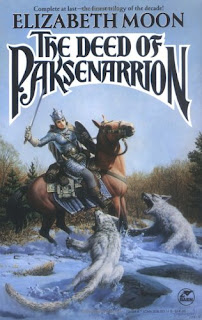

http://t.co/MDiPNBMafJ One of the strongest elements of this trilogy was how that Moon chose to tell the story of Paks, not as the Hidden Heir Chosen to Rule, but rather she who finds the Hidden Heir Chosen to Rule. I liked nearly everything about the three books contained in the big grey/blue book published by Baen. What’s more impressive is that these three books are the first three published by Elizabeth Moon. I think she developed the character of Paks very well throughout the novels and the world came across as quite real, especially because of the solid and believable groundwork she laid down in the first novel Sheepfarmer’s Daughter. If you want readers to believe in the fantastic elements (elves, magic, etc.) the real elements must be authentic and true, it seems Elizabeth Moon takes that statement to heart. I’ve also seen the criticism leveled ad Paks that she’s too perfect, but a lot of her gains and successes are through hard-earned work and some suffering, she gives up part of herself in service to her goals and what she hopes to achieve, especially by trilogy’s end so it isn’t as if she just picks up a magical sword and becomes the greatest sword-wielder the world has ever seen.


Also at SFFWorld, Mark reviewed the latest massive tome edited by Ann and Jeff Vandermeer, The Time Traveler's Almanac.

http://www.sffworld.com/2013/11/time-travellers-almanac-edited-ann-jeff-vandermeer/
It is difficult to summarize such a tome, and it would perhaps be wrong of me to try. However, like the previous Vandermeer collection, I found old personal favourites (Ray Bradbury, HG Wells, Asimov, Kuttner and Moore, Connie Willis) as well as ones totally new to me (Vandana Singh, Dean Francis Alfar, Rosaleen Love, Karen Haber, Rjurik Davidson). I found stories from authors I liked, but hadn’t read (George RR Martin, Kristine Kathryn Rusch, Adrian Tchaikovsky, Kim Newman, Eric Frank Russell) and stories I know others will like but left me cold (Ursula K leGuin, Adam Roberts). There are some old ones (Edward Page Mitchell’s The Clock that went Backward, 1881, regarded here as one of the earliest time-travel tales, Max Beerbohn’s Enoch Soames, 1916, EF Benson’s In the Tube 1923), and some relatively new ones (John Chu’s Thirty Seconds from Now, 2011, Adrian Tchaikovsky’s The Mouse Ran Down, 2012). There were some that I forgot nearly as soon as I had finished reading them, even some I disliked. But that is the nature of such an eclectic assemblage: if you don’t like one, there’ll be another along in a minute that you probably will.

Friday, November 22, 2013

Double Duty at SF Signal (SFFWorld not Forgotten!)

I haven't had much activity reviewing at SFFWorld in the past couple of weeks for a couple of reasons.

First, the books I have been reading, David Anthony Durham's spectacular Acacia novels are large and take a lot of my attention.  The first one is  re-read which I mentioned last week that I initially reviewed in 2007. As I'm reading second novel The Other Lands, the story continues to keep my attention in a very powerful way whereas other books which have taken as long for me to read fell to the wayside. I short, as I've said before, Durham is a great storyteller.

Secondly, I've been doing weekly Orphan Black posts for Tor.com as I mentioned in my last blog post.

Thirdly and fourthly, depending on how you choose to count it, I've had a couple of things go live at SF Signal this week.  Wednesday, the Mind Meld Paul Weimer invited me to give thought to: Everything You Always Wanted to Know About Genre Series: Series vs. Standalones; Ones We Abandoned; Ones We Returned To.  Here's a bit of what I said (and of course I mentioned Acacia):

Of course there are series that I read immediately upon publication of a new book in the series: George R.R. Martin’s A Song of Ice and Fire (though I re-read the whole series when each book publishes), any series that Tad Williams has published or will publish, and more recently Myke Cole’s Shadow OPS books, Peter Brett’s Demonwar cycle, and since reading her latest as Rachel Bach, any series Rachel Aaron writes, and so on and so forth…


Yesterday, the latest installment of my column for SF Signal, The Completist went live wherein I pull from a decade plus time laps since reading Jeffrey Ford's Well-Built City trilogy to try to expound upon the books powerful virtues.


https://www.sfsignal.com/archives/2013/11/the-completist-jeffrey-fords-the-well-built-city/


These novels should not be dismissed for their short length, as the three combined are smaller than many fantasy novels with which they share shelf space. The combination of literary weight and breadth of imagination on display in these three novels (frankly, all of the work I’ve read by Jeffrey Ford) is nothing short of brilliance. At the intersection of Fantasy, Science Fiction, and Horror lies The Well-Built City, enter at your own risk, but the rewards will spoil you for other fantasy, for nothing is quite like it.

Thursday, November 14, 2013

Worthy of a Second Read - Acacia Book One: The War with the Mein by David Anthony Durham

This review of Acacia Book One: The War with the Mein by David Anthony Durham is a first for me, I’m writing a second review of a book I reviewed in the past (June 2007 when this book first published) so it will be interesting for me to tread over ground I’ve previously trod. On to the review, which is more of a reaction than a review actually…

http://www.sffworld.com/brevoff/373.html
Cover Art used on ARC
otherwise unused
When Acacia Book One The War with the Mein first published in 2007, it was to a great deal of buzz for a couple of reasons. One, Durham had a Literary-with-a-capital-L pedigree; his fiction had won and / or was nominated for a couple of awards. Two, Durham is a writer of color and Epic Fantasy is a genre dominated, to a large degree, by old white dudes. In other words, on the surface, he was bringing a very unique perspective to a genre that rests heavily on familiar tropes and story elements. Underneath the surface is a superb novel on many levels.

The War with the Mein opens on a kingdom during a gilded age during its waning days, King Leodan is old weakened, but keeps up a façade for his children whom he loves above everything; he wishes them to see only the beauty in the world. When the king is murdered in full view by an ancient enemy, the children soon learn of the truth behind the thin façade their father was projecting. The prosperity of Acacia has been built on the backs of slaves and its own citizens who are addicted to a drug, the mist, the monarchy uses to keep the populace under control.

The king’s plan upon dying was to scatter the children across the world so they could learn about the world outside without the rose tinted glasses afforded them by their station as royalty. Of course, not all goes to plan and eldest daughter Corinn is left behind to be slave and concubine to Hanish Mein, leader of the nation who brought down King Leodan.

Cover Art
UK Edition
Durham tells the novel in three major parts, introduction of the Arkan family, scattering of the Arkan family across the Known World, and their return to claim their birthright as heirs to the throne. The eldest son, Aliver, arrives in an untamed land of Talay where he rises through hard work and challenges to become a mythic hero; youngest son Dariel becomes a privateer/pirate under the name Spratling, and youngest daughter Mena barely survives her journey and finds herself on an island where she’s proclaimed to be the reincarnation of a powerful bird goddess, Maeben. As mentioned, Corinn is left behind and her relationship with Hanish is fascinating to watch unfold as she develops feelings for the man who tore her world asunder.

Of the Epic Fantasy novels I’ve read (and I’ve read quite a few), Durham manages to pull off the myth come to life better than any of them this side of Robert Jordan. He taps into the intersection of the collective unconscious of myth and power of trope to evoke a resonant tale in this first installment of Acacia. Reading the book felt like reading a powerful myth that informed a society.

In my earlier review of the novel, I may have been tad too tough on the book, in terms of Durham’s supposed info-dumps. On second reading, I did not get a sense of that at all and was fully swept up in the tale he was telling. 

I also, on this second reading, was able to get a better feel for the structure of the novel. Re-reading it, I realize how similar the first third of the novel; essentially, the set up; is to the setup of many other fantasies. However, just when the reader is lulled into that familiarity; BAM! Durham upends the playing table and lets the story roll down a new path of his own making. On a somewhat more granular level, each chapter is just long enough to consume in relatively brief settings so a sense of reading accomplishment is gained, and with that a great feel of progression in the story is accomplished. By novel’s end, Durham achieves resolution with each of the four siblings, but left me wanting more with the implications of how the story was resolved.

Full spread of Mass Market Paperback
I think I’ve made it pretty clear that Epic Fantasy is my favorite branch of Speculative Fiction and when done right, when the familiar elements are imbued with fresh flavors, it is what I like the most. With The War with the Mein, David Anthony Durham has done it all right and launched what looks to be a great fantasy saga. (As of this writing, I'm about 1/3 into the second novel in the trilogy, The Other Lands.) The conflict of different ideologies, rather than black and white good v. evil; the feel of the story as an evolving, living myth (which happens to be the title of the third portion of the novel); ancient powers of sorcery reawakening; monstrous creatures; adventure; etc., all come together so well.

In short, this book was well worth the second read and I highly, highly recommend it.

Friday, March 20, 2009

Hugo Awards 2009

This is the first Novel Ballot where I've read the majority of the nominees. Links on the novels, obviously, point to my reviews and for the shorter lengths, links point to the my review of the anthology in which I the story appeared. Locus gives a brief, and helpful analysis.

For all others, I've bolded the books I have, but haven't yet read, and italicized in orange in those I have read but not reviewed. Where I can, I've listed my selection under each category

Best Novel
(639 Ballots)


Anathem by Neal Stephenson (Morrow; Atlantic UK)

Little Brother by Cory Doctorow (Tor Teen; HarperVoyager UK)
Saturn’s Children by Charles Stross (Ace; Orbit UK)
Zoe’s Tale by John Scalzi (Tor)

Rob's Choice: I'm torn between The Graveyard Book and Little Brother even though I enjoyed the other two I read in this category. They happened to be 2 of the 3 of my best reads from 2008.

Best Novella
(337 Ballots)

“The Erdmann Nexus” by Nancy Kress (Asimov’s Oct/Nov 2008)
“The Political Prisoner” by Charles Coleman Finlay (F&SF Aug 2008)
“The Tear” by Ian McDonald (Galactic Empires)
“True Names” by Benjamin Rosenbaum & Cory Doctorow (Fast Forward 2)
“Truth” by Robert Reed (Asimov’s Oct/Nov 2008)

Best Novelette
(373 Ballots)

“Alastair Baffle’s Emporium of Wonders” by Mike Resnick (Asimov’s Jan 2008)
“The Gambler” by Paolo Bacigalupi (Fast Forward 2)
“Pride and Prometheus” by John Kessel (F&SF Jan 2008)
“The Ray-Gun: A Love Story” by James Alan Gardner (Asimov’s Feb 2008)
“Shoggoths in Bloom” by Elizabeth Bear (Asimov’s Mar 2008)

Best Short Story
(448 Ballots)

“26 Monkeys, Also the Abyss” by Kij Johnson (Asimov’s Jul 2008)
“Article of Faith” by Mike Resnick (Baen’s Universe Oct 2008)
“Evil Robot Monkey” by Mary Robinette Kowal (The Solaris Book of New Science Fiction, Volume Two)
“Exhalation” by Ted Chiang (Eclipse Two)
“From Babel’s Fall’n Glory We Fled” by Michael Swanwick (Asimov’s Feb 2008)

Best Related Book
(263 Ballots)

Rhetorics of Fantasy by Farah Mendlesohn (Wesleyan University Press)
Spectrum 15: The Best in Contemporary Fantastic Art by Cathy & Arnie Fenner, eds. (Underwood Books)
The Vorkosigan Companion: The Universe of Lois McMaster Bujold by Lillian Stewart Carl & John Helfers, eds. (Baen)
What It Is We Do When We Read Science Fiction by Paul Kincaid (Beccon Publications)
Your Hate Mail Will be Graded: A Decade of Whatever, 1998-2008 by John Scalzi (Subterranean Press)

Best Graphic Story
(212 Ballots)

The Dresden Files: Welcome to the Jungle Written by Jim Butcher, art by Ardian Syaf (Del Rey/Dabel Brothers Publishing)
Girl Genius, Volume 8: Agatha Heterodyne and the Chapel of Bones Written by Kaja & Phil Foglio, art by Phil Foglio, colors by Cheyenne Wright (Airship Entertainment)
Fables: War and Pieces Written by Bill Willingham, pencilled by Mark Buckingham, art by Steve Leialoha and Andrew Pepoy, color by Lee Loughridge, letters by Todd Klein (DC/Vertigo Comics)
Schlock Mercenary: The Body Politic Story and art by Howard Tayler (The Tayler Corporation)
Serenity: Better Days Written by Joss Whedon & Brett Matthews, art by Will Conrad, color by Michelle Madsen, cover by Jo Chen (Dark Horse Comics)
Y: The Last Man, Volume 10: Whys and Wherefores Written/created by Brian K. Vaughan, penciled/created by Pia Guerra, inked by Jose Marzan, Jr. (DC/Vertigo Comics)

Rob's Choice: Y: The Last Man, Volume 10: Whys and Wherefores - The ending was terrific to one of the landmark pieces of comic book/graphic novel fiction of the decade. This series was consistent, smart, entertaining and really cemented Vaughan as a premier writer of comics. I'm sure it also helped him get the Lost gig, which in turn, has helped to make the show as terrific as has been over the past season or two.

Best Dramatic Presentation, Long Form
(436 Ballots)

The Dark Knight Christopher Nolan & David S. Goyer, story; Jonathan Nolan and Christopher Nolan, screenplay; based on characters created by Bob Kane; Christopher Nolan, director (Warner Brothers)
Hellboy II: The Golden Army Guillermo del Toro & Mike Mignola, story; Guillermo del Toro, screenplay; based on the comic by Mike Mignola; Guillermo del Toro, director (Dark Horse, Universal)
Iron Man Mark Fergus & Hawk Ostby and Art Marcum & Matt Holloway, screenplay; based on characters created by Stan Lee & Don Heck & Larry Lieber & Jack Kirby; Jon Favreau, director (Paramount, Marvel Studios)
METAtropolis by John Scalzi, ed. Written by: Elizabeth Bear, Jay Lake, Tobias Buckell and Karl Schroeder (Audible Inc)
WALL-E Andrew Stanton & Pete Docter, story; Andrew Stanton & Jim Reardon, screenplay; Andrew Stanton, director (Pixar/Walt Disney)

Rob's Choice: It'll go to either WALL-E or The Dark Knight, but my choice is with the Bat. I thought WALL-E was good, but nothing compares to The Dark Knight.

Best Dramatic Presentation, Short Form
(336 Ballots)

“The Constant” (Lost) Carlton Cuse & Damon Lindelof, writers; Jack Bender, director (Bad Robot, ABC studios)
Doctor Horrible’s Sing-Along Blog Joss Whedon, & Zack Whedon, & Jed Whedon & Maurissa Tancharoen , writers; Joss Whedon, director (Mutant Enemy)
“Revelations” (Battlestar Galactica) Bradley Thompson & David Weddle, writers; Michael Rymer, director (NBC Universal)
“Silence in the Library/Forest of the Dead” (Doctor Who) Steven Moffat, writer; Euros Lyn, director (BBC Wales)
“Turn Left” (Doctor Who) Russell T. Davies, writer; Graeme Harper, director (BBC Wales)

Rob's Choice: This might be toughest of all, but I'm going with "The Constant." Each episode/Webisode was good on the list was very good, but "The Constant" might have been the strongest episode of Lost on the season that really put the show back on track.

Best Editor, Short Form
(377 Ballots)

Ellen Datlow
Stanley Schmidt
Jonathan Strahan
Gordon Van Gelder
Sheila Williams


Rob's Choice: I've read more Strahan-edited fiction last year than the others, so he's my choice.

Best Editor, Long Form
(273 Ballots)

Lou Anders
Ginjer Buchanan
David G. Hartwell
Beth Meacham
Patrick Nielsen Hayden

Rob's Choice: Without any other easy way to find out what books these fine folks edited/commissioned in the nomination year, this is a tough one, too. Patrick Nielsen Hayden edited two of the books on the novel short list and Pyr/Lou Anders published 4 of my favorite books of 2008. Ginjer Buchana, I think, was responsible for one of the better debut authors I read last year, Taylor Anderson, as well as Saturn’s Children on the short list. I think I’d lean towards Lou Anders, on this one but reserve the right to modify my choice in the future.

Best Professional Artist
(334 Ballots)

Daniel Dos Santos
Bob Eggleton
Donato Giancola
John Picacio
Shaun Tan

I'll go with Picacio, followed closely by Dos Santos.


Best Semiprozine
(283 Ballots)

Clarkesworld Magazine edited by Neil Clarke, Nick Mamatas & Sean Wallace
Interzone edited by Andy Cox
Locus edited by Charles N. Brown, Kirsten Gong-Wong, &; Liza Groen Trombi
The New York Review of Science Fiction edited by Kathryn Cramer, Kris Dikeman, David G. Hartwell, & Kevin J. Maroney
Weird Tales edited by Ann VanderMeer &; Stephen H. Segal

Rob's Choice: Clarkesworld gets my nod here.

Best Fanzine
(257 Ballots)

Argentus edited by Steven H Silver
Banana Wings edited by Claire Brialey and Mark Plummer
Challenger edited by Guy H. Lillian III
The Drink Tank edited by Chris Garcia
Electric Velocipede edited by John Klima
File 770 edited by Mike Glyer

Best Fan Writer
(291 Ballots)

Chris Garcia
John Hertz
Dave Langford
Cheryl Morgan
Steven H Silver

Best Fan Artist
(187 Ballots)

Alan F. Beck
Brad W. Foster
Sue Mason
Taral Wayne
Frank Wu

The John W. Campbell Award for Best New Writer
(288 Ballots)

Aliette de Bodard*
David Anthony Durham*
Felix Gilman
Tony Pi*
Gord Sellar*

*(Second year of eligibility)

Rob's Choice: Only having read Gilman and Durham, my nod would definitely go to Durham.
A total of 799 nomination ballots were cast.

Sunday, August 10, 2008

Books in the Mail (W/E 8/9/2008)

The Empress of Mars by Kage Baker - First came Edgar Rice Burroughs' view of the Red Planet, then the romance of Leigh Brackett, the poetic visions of Ray Bradbury, and the hard sf underpinnings of Kim Stanley Robinson’s trilogy. Now, added to that estimable list, we have Kage Baker, who makes Earth’s nearest neighbor all her own. When the British Arean Company founded its Martian colony, it welcomed any settlers it could get to undertake the grueling task of terraforming the cold red planet. Outcasts, misfits and dreamers emigrated there in droves--only to be abandoned when the BAC discovered it couldn’t turn a profit on Mars. This is the story of Mary Griffith, a determined woman with three daughters, who opened the only place to buy a beer on the Tharsis Bulge. It’s the story of Manco Inca, whose attempt to terraform Mars brought a new goddess vividly to life; of Stanford Crosley, con man extraordinaire; of Ottorino Vespucci, space cowboy and romantic hero; of the Clan Morrigan, of the denizens of the Martian Motel, and of the machinations of another Company entirely, all of whom contribute to the downfall of the BAC and the founding of a new world.

Based on the Hugo-nominated novella of the same name, The Empress of Mars is a rollicking novel of action, offworld romance and high adventure.

Acacia Book One: The War with the Mein by David Anthony Durham – I read and reviewed this just before it published about a year ago. The copy that came in the mail this week was/is the mass market paperback. A nice looking one at that. From my review:
David Anthony Durham, already acclaimed as an author of historical novels, switches genres with Acacia Book One: The War with the Mein, the launch of a fantasy trilogy. The land of Acacia is a gilded one, the royals live a life free of struggle while the life that affords them this luxury is one of dark trades and immoral practices, such as drug trafficking, slavery, and human consignment. Durham does a convincing job of both setting up this dichotomy and reinforcing it throughout the novel without brow-beating the subject.

As this review suggested earlier, Durham maintains a palpable level of tension throughout. What he does with even more skill is flavoring the entire novel with an air of mythic resonance. However, this air of myth is something Durham builds slowly. It comes through first in the stories Arkan tells his children about the history and prehistory of their nation and world. In particular, Leodan tells his children the story of Basher and Cashen, two brothers who initially were very close but were ultimately torn apart by their own lust and craving for power. The air of myth builds as further stories and myths are brought into the fold. In the second third of the novel, the style changes somewhat as Durham begins to relay the "where are they now" of the Akaran children with a mythic voice.
Quofum: A Novel of the Commonwealth by Alan Dean Foster - Bestselling author Alan Dean Foster’s new adventure takes place in the amazing Humanx Commonwealth, home of the ever-popular Pip & Flinx. Although the dynamic redhead and his daring minidrag do not appear in Quofum, this knockout thriller sets the stage for their explosive date with destiny in the duo’s final climactic adventure, Flinx Transcendent. The mission to planet Quofum is supposed to be a quickie for Captain Boylan and his crew. Boylan is tasked with delivering four scientists–two men, one woman, and one thranx–to the unknown world, setting up camp while the experts investigate flora and fauna, then ferrying them safely home. The first surprise is that Quofum, which regularly slips in and out of existence on Commonwealth monitors, is actually there when Boylan and company arrive. The second surprise is more about what Quofum is not: The planet is not logical, ordered, or rational.

To Rescue Tanelorn by Michael Moorcock - Elric of Melniboné. The name is like a magic spell, conjuring up the image of an albino champion and his cursed, vampiric sword, Stormbringer. Elric, the last emperor of a cruel and decadent race, rogue and adventurer, hero and murderer, lover and traitor, is mystery and paradox personified–a timeless testament to the creative achievement of Michael Moorcock, the most significant fantasy writer since Tolkien.

Now comes the second in this definitive series of Elric volumes. Gorgeously illustrated by acclaimed artist Michael Wm. Kaluta and including a new Introduction by Michael Moorcock, this collection features, along with Elric, such renowned characters as Erekosë, Rackhir the Red Archer, and Count Renark von Bek. Readers will delight in adventures that include “To Rescue Tanelorn . . .,” “Master of Chaos,” “The Singing Citadel,” “The Black Blade’s Song,” and the novella version of “The Eternal Champion.”

The Company by K.J. Parker - Hoping for a better life, five war veterans colonize an abandoned island. They take with them everything they could possibly need - food, clothes, tools, weapons, even wives. But an unanticipated discovery shatters their dream and replaces it with a very different one. The colonists feel sure that their friendship will keep them together. Only then do they begin to realize that they’ve brought with them rather more than they bargained for.

For one of them, it seems, has been hiding a terrible secret from the rest of the company. And when the truth begins to emerge, it soon becomes clear that the war is far from over.

Just One Bite (A Dead-End Dating Novel) by Kimberly Raye – With comparisons to Bridget Jones Diary and Carrie from Sex in the City, I highly doubt I’ll be reading this one. Lil Marchette, vampire extraordinaire and owner of Manhattan’s hottest hook-up service, is an expert at matching up the lonely and desperate (and sometimes dead). And thanks to the popular local reality dating show Manhattan’s Most Wanted, Lil has plenty of fresh blood to add to the mix–including the biggest, baddest vampire in the Big Apple. Vinnie Balducci, Brooklyn representative for the Snipers of Otherworldly Beings, is making Lil an offer she can’t refuse: find him the perfect woman or she’s going to be swimming with the fishes.

But Lil may not be the only one taking the plunge. The three hunky demon Prince brothers are poking around Lil’s office–hot on the trail of a rogue spirit trying to escape the land down under (not Australia) by possessing some poor, clueless human soul. Then Lil makes a startling discovery: The oblivious human vessel is none other than her loyal assistant, Evie. Between saving Evie from eternal damnation and saving herself from Vinnie’s lethal ultimatum, Lil is sure to be in for the most hellish ride of her afterlife.

Tuesday, July 29, 2008

David Louis Edelmen Interview & SFFWorld Round Up

We’ve been posting a slew of new stuff up at SFFWorld in the past couple of days. I posted the e-mail interview I recently conducted with David Louis Edelman:

Science Fiction is a language of mirrors by which we (readers and writers) can compare and contrast our own society and its problems. This is clearly the case with the Jump 225 trilogy, so when you created this future history, how necessary do you feel it was to sort of destroy everything and restart?

Wiping the slate clean with an Armageddon scenario five hundred years before the events of Jump 225 was really just a narrative trick. It enabled me to focus on the things I wanted to focus on -- namely, software and business and sociology -- and conveniently ignore the things I didn’t want to talk about. AIs? Boom! They were destroyed in the Autonomous Revolt. Nuclear weapons? Boom! Used in the Revolt and then subsequently abandoned. Cloning and genetic engineering? Same thing.


Mark/Hobbit has churned out some top notch reviews:

The Night Sessions by Ken MacLeod

The Night Sessions is set in the near future with an intriguing premise: what if the world secularized religion, if the world decided that there was to be a total severance of religion from state and politics, with religion prevented from interfering with state affairs and from controlling government or exercising political power?

The Ten Thousand by Paul Kearney

To their rescue then, we can add Paul Kearney. His latest, The Ten Thousand, is an unusual book that could appear to the reader simultaneously as perversely both contemporary Fantasy and old-fashioned style Fantasy, in the sense that it will appeal to those readers who like the current vogues in the genre (dark, gritty, melancholic) that make Fantasy quite popular

The Mirrored Heavens by David J Williams

Consequently the book is pretty well paced but, unlike the cover may lead you to expect, there is an emphasis on more talk than action, though the action pieces, when they happen, are well done.

Enemy's Son by James Johnson

The Enemy’s Son is a rip-roaring space opera debut novel from new writer and artist James Johnson. It reads pretty much as old-style SF with a modern twist. There are Slan-style mutants, flying cities, old-Venusian-style continental jungles and tales of a lost Erth reminiscent of Jack Vance’s Tales of the Dying Earth.

Saturday, January 05, 2008

2007: A Review of Rob's Readings

Well, everybody else is doing it, so why not me. Right? I’m of course referring to a brief summary of what books I liked best from my readings in 2007. Sure, I mentioned a few books in my contribution to the annual SFFWorld round up, but that was limited to only those books published in 2007. As is the case with most readers like myself, not all of my reading is comprised of books published in that specific year. Though in my personal ratings, no book I read last year received a “10,” quite a few received a “9.”
The best science fiction book I read last year was Robert Charles Wilson’s Hugo-award winning novel, Spin. As I said on the blog a few weeks ago:

On the whole, I really REALLY enjoyed this book. I thought it was an extremely human look at a near future where people were confronted with a technological event far beyond anything people in the world are capable of doing. I am not surprised it received the Hugo and think it will be considered a top SF book for a while. The ending was a little frustrating because I wanted to see what would happen next, but I also consider the ending to be appropriate.

The best collection, perhaps the best overall fantasy book I read last year was Jeffrey Ford’s The Empire of Ice Cream. The book contains award-winning stories, which is becoming par for the course with Mr. Ford’s collections. Here’ what I said back in Novermber:

I don’t know if this collection is better than his previous World Fantasy Award winning collection, The Fantasy Writer’s Assistant, but it isn’t any lesser a collection. What we have here is a writer unrestrained by bounds of genre and imagination. Jeffrey Ford’s writing has such an authenticity about it, you cannot help but trust that the stories he tells have a ring of truth to them. More importantly, you want to believe them as real and year for the next stories to be told.

Every year has it fair share of debut novelists, the three whose work most connected with me were Joe Hill’s Heart-Shaped Box, Joe Abercrombie’s The Blade Itself, and the “hot new star” Patrick Rothfuss’s The Name of the Wind. I reviewed both of these for SFFWorld. Here’s a snippet from my review of Heart-Shaped Box:

Where the story transcends both the genre and just being a “good story” is how effectively Joe Hill puts forth the reality of Jude’s situation. One gets the sense that the story could be an episode of VH1’s Behind the Music after taking a very dark turn. Even though Jude is a living legend of an almost Ozzy Osbourne status, Hill paints a picture of a real man haunted by his past and current demons.

Here's a snippet of what I said about The Blade Itself when Pyr delivered the book to US readers:

I thought the novel started a bit slow, I was thinking all the hype surrounding the book upon its UK release last year was going to leave me disappointed. It has happened with other books in the past for me. Thankfully, Abercrombie’s story, and more convincingly, his characters pulled me into the story unheeded. ... Abercrombie is a damned frustrating writer. He writes so well and his story is so infectious it is difficult to stop reading and even thinking about the layers of his story and world.


From The Name of the Wind (which I was lucky enough to read before much of the hype took hold of the book):

Where will The Name of the Wind stand at year’s end and over the next few years in the genre? At least for this year, Rothfuss has set the bar very high for any other author publishing their first novel in 2007. As for where the book will stand in the years to come, it will likely stand as the start of one of the bright careers in fantasy fiction. Suffice it to say, the book is very good and has all the elements of greatness – characters with which the reader can empathize, a fascinating backdrop where these characters live, and the key ingredient: leaving the reader wanting for more. Since this is just the first book in a trilogy, that want will be met.

Though not a new author, I came across her work for the first time in 2007 and the book turned out to be the Science Fiction novel I enjoyed the most, Bright of the Sky by Kay Kenyon.

With a rich and vivid setting, peopled with believable and sympathetic characters and fascinating aliens, Kay Kenyon has launched an impressive saga with Bright of the Sky. My only criticism involves some of the scenes where the narratives point of view character switches from Quinn to those who interact with him in the Entire. The transitions aren’t entirely smooth and I found myself re-reading passages to be sure to whom the words were being attributed. These scenes were very few, but did jar the otherwise smooth and quick pace of the story. That said, Bright of the Sky, like the best novels opening a larger sequence, balances closure with open plot strands.

Scott Lynch’s second book was just as good as his first. This is not surprising because he made Locke Lamora and Jean pirates. I loved the dialogue and interplay betwixt the two and really liked the non-straightforward timeline Lynch used to tell the story in Red Seas Under Red Skies.
As sequels go, Red Seas Under Red Skies is fabulous and a more accomplished, more tightly written novel than its predecessor. Considering what a top notch job Lynch did with his debut, this is impressive. As importantly, Red Seas Under Red Skies doesn’t work so bad as an introduction to the Gentleman Bastards. I found myself smiling throughout most of the book, grinning at the dialogue, and riding right along with Jean and Locke on their pirate adventure. At its heart, Red Seas Under Red Skies is pure fun.

Even though I knew the events that form the backdrop of the book, Buster Olney’s The Last Night of the Yankees Dynasty was a superb book. Being a Yankees fan for the past 30+ years, I’ve followed the team through ups and downs, and none were more “up” than the championship run at the turn of the Century. Even knowing much of the outcome, Olney managed to keep my glued to every word on the page.

The Author I rediscovered in 2007 was Steven Erikson. I’m still slowly making my way through the Malazan Book of the Fallen, but the saga took hold of me fully in the summer of 2007 when I read the first two books whilst serving Jury Duty in May and June.

Another series I rediscovered, after breezing through much of it a few years ago, was Steven Brust’s Vlad Taltos series. Specifically, the latest book, Dzur, which I liked very much.Other books that stood out for me were Peter David’s
Darkness of the Light, Tobias Buckell’s Ragamuffin, David Anthony Durham’s Acacia Book I, and the two books in Brandon Sanderson’s Mistborn trilogy.

I also read a couple of stinkers last year, David Keck’s In the Eye of Heaven. The book seems to be somewhat polarizing, I’m in the camp that didn’t care much for it. Gail Z. Martin’s The Summoner didn’t work for me either, I couldn’t even finish the book. I hate when that happens, but buy the halfway point, nothing worked for me and I felt it was a story I read many times before with more originality. Brian Ruckley’s
Winterbirth didn’t work so well for me either, I just couldn’t find anything in the story about which to care. The book, coincidentally, is the January 2008 Fantasy Book Club of the Month at SFFWorld, others have reacted differently than I did. The most disappointing; however, was Robin Hobb’s Forest Mage. I love Hobb’s writing, but this story angered my like almost no other book I’ve read.

So that’s it, the brief summary of the highlights and lowlights of my 2007 readings.

Monday, September 03, 2007

Ascension

Another Monday* and another new review up at SFFWorld by yours truly. This time it’s Mistborn: Well of Ascension by Brandon Sanderson. I liked this one very much and can see why Tor is getting behind him in a big way. So far, he’s cranked out three books in three years, so he delivers regularly. More importantly he delivers quality in spades.

We also posted the David Anthony Durham interview I conducted alongside with Pat, Larry, and Ken. Pat posted a while ago, but SFFWorld put it up tonight. I read Durham’s Acacia Book I: War with the Mein earlier in the year and was really impressed with the book.

RU started off the season very nicely, beating the point spread. It was a bit “different,” shall I say, to see a completely packed stadium, as well as participating in crowd chants numerous times throughout the game. Granted, there were some games when I attended that had big crowds, but the atmosphere was odd: it felt like what a college football game should feel like. As one friend I ran into at the tailgate said, its kind of weird to see so many people at a Rutgers game wearing Rutgers attire.

If Rutgers want to maintain and/or move up, we need to see more of the same, in terms of offense. I was never a big proponent of teams running up the score; however, it seems to be an unfortunate means to an end of getting the top rankings.

*I know, sometimes I put up my new reviews on Tuesday.

Monday, June 11, 2007

Newest "New" Fantasy Author on the Block: D.A. Durham

My latest review, David Anthony Durham’s Acacia Book I: War with the Mein, is now up at SFFWorld.com. Like last year, this seems to be a strong year for opening novels for multi-volume sequences. Last year Scott Lynch, David Louis Edelman, and Sean Williams* all launched impressive sequences. This year has already seen Patrick Rotfhuss and now David Anthony Durham’s sequence launch. Both authors have been making the rounds with interviews on SF Web sites and blogs.

Patrick Rothfuss interviewed by me and Pat (of the Fantasy Hot List)
A Dribble of Ink interview with Patrick Rothfuss (Part 2)
A Dribble of Ink interview with David Anthony Durham
Fantasy Book Critic interview with David Anthony Durham
Fantasy Book Critic interview with Patrick Rothfuss
FantasyBookSpot.com interviews Patrick Rothfuss
FantasyBookSpot.com / Jay Tomio interviews David Anthony Durham
WOTMANIA’s OFBlog interview with Patrick Rothfuss

*Technically Sean Williams saga launched a couple of years ago, but 2006 was when it was published in the States.

Also, I know Joe Abercrombie was highly-touted last year, so I'm looking forward to reading The Blade Itself when Pyr publishes it later this year.

I've been hearing a lot of grumbling at night lately, and it has been getting louder over the past couple of days. I could swear I'm hearing the word brains, but I can't imagine why.