I read a lot of books in 2009. I read 82 books, which includes graphic novels (10) but not the many single-issue comics I’ve read. This is down only 2 books from 2008, which is a blip, I should say.
In 2009, I posted 56 reviews to
SFFWorld and one new one to the
Sacramento Book Review /San Francisco Book Review.
I’d say that’s a pretty decent number of reviews. Having said that, in the coming year, I’ll be cutting back on the number of reviews I post. Since I started
getting review books from publishers, a lot of books have been piling up. Not only those I’ve received for review, but the books that I’ve purchased and others that have been put aside in favor of the review books. I also want to do a
Wheel of Time re-read/catch up and the same for Glen Cook’s
Black Company. One or both of those may be an ongoing feature here on the blog. Or, since
SFFWorld doesn’t have any *official* reviews for any of the
Wheel of Time books, I may just post reviews of the books there. Plus I want to catch up with other series (for example David Weber’s
Safehold, Ian M. Banks’s
Culture, Jim Butcher’s
Dresden Files and
Codex Alera) and now that some series are complete (Daniel Abraham’s
Long Price and Sean Williams’s
Astrolopolis to name only two), I want to get through them too.
One of my personal ‘reading goals’ for 2009 was to read more books by women, which I did more than doubling the number of women-authored books I read 2008. That’s 12.5 in 2009 (one of the books was
The Dragons of Ordinary Farm co-authored by Deborah Beale) vs 5 in 2008.
54 of the 82 books I read were published in 2009, roughly 2/3. Breaking down the genres, 26 could be considered SF, 32 Fantasy, 6 Horror (and a few of the books could fit in two (
The Sad Tale of the Brothers Grossbartcould be considered both fantasy and horror or all three like Gregory’s
The Devil’s Alphabet) and 5 short story collections/anthologies.
All that said, on to the categories for the 2009 … Robloggies? ManBearPiggies? Stuffies? I don’t know! This isn’t a typical top 10 or 12 or anything, but whatever you want to call them, here are some categories for what I read in 2009 and what I put at the top of those categories.
Rob Favorite Science Fiction Novel(s) Read in 2009
This year I rediscovered Alastair Reynolds, first with
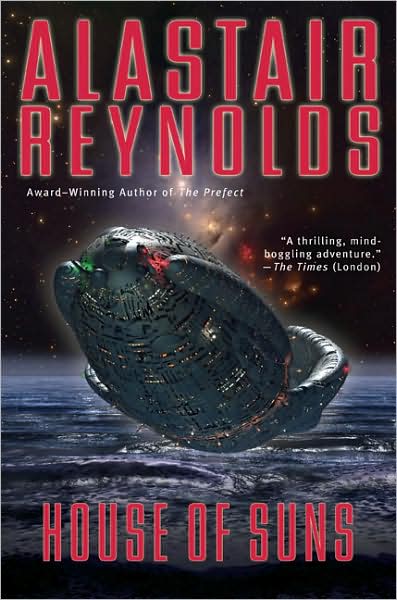
Pushing Ice then with what amounted to one of my favorite SF novels of 2009
House of Suns.
 Since this is an Alastair Reynolds novel, one would expect some big-ideas and one would not be let down. Set millions of years in the future, ample time has passed in the galaxy for humanity to evolve and join the greater universal civilization. And what a civilization it is. Some scenes worked really well to show off a grittiness of the future, that there are still scrupulous creatures willing to make a hazy deal. Conversely, the ideals of love haven’t changed too much – certain love is embraced and other love is shunned and looked down upon. On the other, the great leaps of time that take place in Reynolds human history as well as the characters lives showcases how far humanity has evolved in this novel.
The sheer scale of intelligent civilization in this universe is mind-boggling. Perhaps most fascinating are the Machine People and the Machines who preceded them thousands of years before the events in even Abigail Gentian’s time. On the other hand, that sense of time, that tens of thousands of years can pass so effortlessly in these characters lives really adds to the sense of wonder for which Reynolds is so well known. These themes are handled with an expert’s care in Reynolds’s assured storytelling ability.
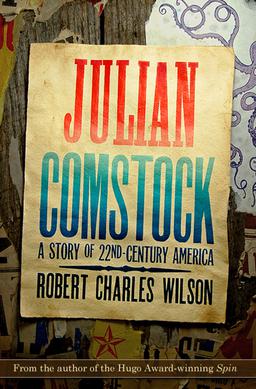
Another book at the top of my SF list for 2009 has a very strong alternate history vibe, with a bits of post-apocalyptic fiction and steampunk thrown into the mix, even though it is set about a hundred years in the future, Robert Charles Wilson’s
Julian Comstock: A Story of 22nd-Century America:
 The tone is very comfortable and Wilson’s prose is just wonderful to read and digest. The comfortable to which I’m referring is the tone is inasmuch as we the reader, through Adam’s positioning of words, know who Julian Comstock really is. Essentially, the feel of the novel is that we are taking a peek behind the curtain at how the real events transpired around a legendary and historical figure.
…
It isn’t through info dumps or anything obtrusive that the reader learns about the world at large, technology like cars and travel to the moon are viewed as nearly magical things of the past or fallacies of fantasy outright banished from collective thought. Wilson also manages to conjure the reality of the future world and layer the details very well through the characters thoughts, actions, and words. Furthermore, by just touching on some of the details rather than flat out explaining them, Wilson lends a credibility to 22nd Century America which gives a deeper sense of resonance. Credibility and believability in this world is also conjured through Adam Hazzard’s footnotes sprinkled throughout the novel.
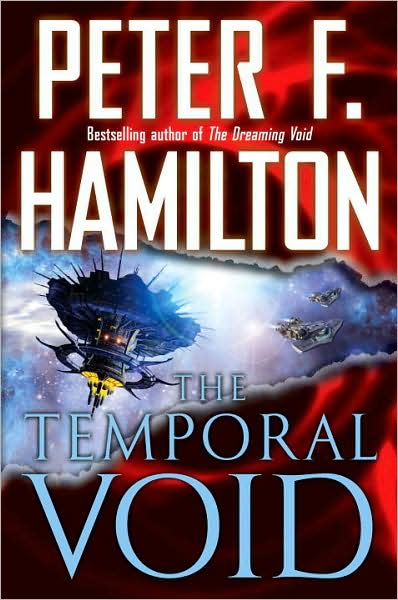
I couldn’t get through a top 2009 list without mentioning Peter F. Hamilton’s
The Temporal Void, the middle book of a rollicking, over-the-top-in-the-best-way Space Opera trilogy.
 The Temporal Void really is two intertwined novels under one cover – the Waterwalker storyline which takes place in the Void and the effect of the expanding Void and Living Dream movement outside of the Void could conceivably stand on their own as two separate books. Both ‘novels’ are compelling, with the Edeard story being slightly more so. However, considering the book (at least in US ARC form) is large enough to stop a rhino in its tracks, the read was quick and engaging thanks to the best pacing I’ve read from Hamilton. (Admittedly, I’ve yet to complete what many consider his landmark work – The Night's Dawn Trilogy). The link between the Waterwalker’s world and the Commonwealth seem tangential at first, but Hamilton hints at connections between the two throughout with further hints of a more concrete connection perhaps to be revealed in the concluding volume, The Evolutionary Void.
In a book packed with great storytelling, flaws are minor but existent. Perhaps the greatest flaw is in Edeard the Waterwalker himself. Throughout his storyline, he manages to triumph over every defeat. Reading those scenes proved exciting, but as the final chapters of the Waterwalker storyline came and went, some of the dramatic tension was lost. Despite his youth and initial lack of experience with his telekinetic powers, he still defeated all of his enemies. Theconclusion to Edeard’s story was both revelatory and powerful. I’m also hopeful that Hamilton will reveal more of Edeard and the Void’s true nature so as to better explain why Edeard overcame every obstacle. I also trust enough in Hamilton’s storytelling abilities to anticipate a solid (if at times protracted) conclusion and revelation of the connection between the Void and the outer galaxy.
Rob’s Favorite Fantasy Novel(s) Read in 2009
Again I’m torn between two books and each time I think to myself, ‘yeah,
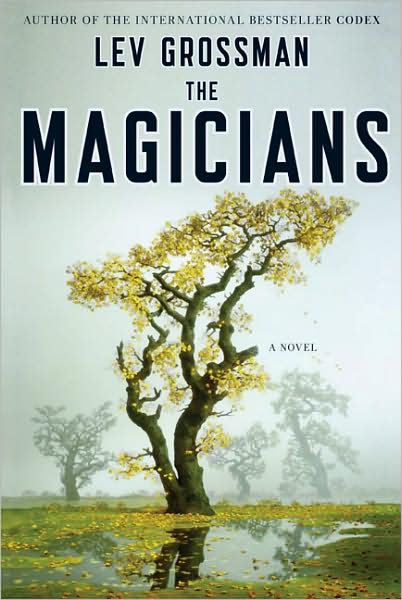
that’s the best fantasy novel I read this year’ I then think about the other one. The first of those two is Lev Grossman’s
The Magicians.
 Grossman’s writing is subtle and relaxed on the whole, but like the sex scene between the two male students I mentioned earlier, he will throw a sucker punch in the midst of otherwise well-flowing narrative. In two cases, this comes in the form of Penny, one scene of which is literally a sucker punch from Penny to Quentin. Another scene (not with Penny) involves a standard lecture, with Quentin being bored (as most students tend to get during college lectures) when suddenly the Beast appears shocking everyone including the instructor and killing a student. These “sucker-punch” scenes occur even more explicitly once the Physical Kids finally arrive in Fillory. Grossman shows how magic might work in the real world in an effective manner, with possibly terrifying implications. Perhaps the strongest parallel I can draw here is how well Alan Moore / Dave Gibbons showed the effects of superheroes in the real world in their landmark graphic novel Watchmen. In this sense, Grossman illustrates just how unsafe magic could be, especially in the unpracticed hands of young college students, and even older students and thos who graduated – perhaps the axiom a little bit of knowledge can be a dangerous thing applies. Gone is the safe illusion of magic as Quentin and his friends soon realize. Just like Watchmen, The Magicians is a work I can see myself returning to multiple times in the future
That other book, is R. Scott Bakker’s return to Eärwa, The Judging Eye, which is the latest entry in his über-saga, The Second Apocalypse:
 There are no absolutes in Bakker’s fictional world, or rather once something is thought of as an absolute, something or someone thrusts that absolute into the fire both illuminating and destroying what could be considered absolute. Take Sorweel again - his hatred for Kellhus is thrown asunder once Kellhus appears. The dichotomy of conflicting absolutes drives much of the fiction and can be seen in the mirrored journeys of Achamanian and the Skin Eaters and the march of the Great Ordeal. Both are striving towards what they see as the greater good, although part of what fuels Achamanian is his hatred of Kellhus. Whereas the Great Ordeal is marching in the name of good against an accepted evil, Akka’s march in the depths of darkness may eventually illuminate the true nature of Kellhus. The Great Ordeal is an army of knights and order, Akka’s march is basically a mish-mash of chaos and those on the fringes of society.
While The Judging Eye is “just the opening” of a greater story, Bakker does bring the storyline to a satisfactory stopping point. As a relatively slim volume of just over 400 pages of story, the book is somewhat small compared to other Epic Fantasies. What Bakker’s done in those 400 pages is crafted the best novel of the year, and one that hints at greater things to come. As the characters who seemingly know Kellhus the most intimately come to question much about the God who was once a man, the reader can only do the same. Is he a savior of the world, preventer of the Second Apocalypse or is he the destroyer and igniter of the Second Apocalypse. Bakker is not one to give absolute answers, but the novel gives many things to consider about unconditional perceptions.
Rob's Favorite Debut(s) of 2009
Two of the three strongest debuts for me were both published by
Orbit Books. The first was a book that kind took me by surprise,
Kate Griffin’s
Madness of Angels which I thought
“epitomizes more of an earlier (think 80s & early 90s) definition of Urban Fantasy - street magician/sorcerer, magical monsters made of trash, the Bag Lady as a prophetess/seer. No vampire fighting chicks in leather to be seen here (and that isn't a slight), just the magic of life.”
The other debut from Orbit that really impressed me was
The Sad Tale of the Brothers Grossbart, which I thought that if
“readers can handle Hegel and Manfried as protagonists , they will be rewarded with an ultimately rich and entertaining reading experience, that is especially more impressive since it is the author’s first novel.”
My favorite debut of the year; however, was
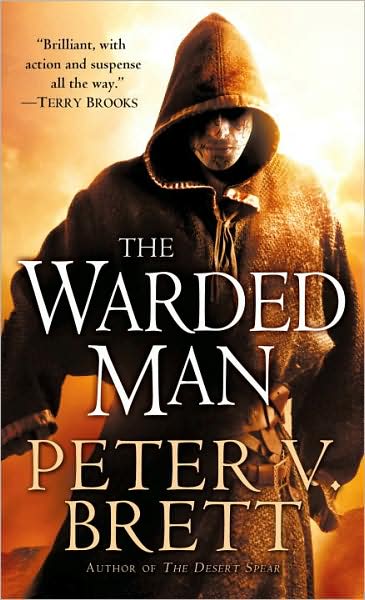
Peter V. Brett’s
The Warded Man, the first in a series. Not only was this book one of my top debut novels, it was one of my top reads for the entire year. This is a very promising start to a series and a writer’s career:
 The small isolated villages comprise the majority of human society in this novel and while I wouldn’t say it isn’t exactly a medieval setting it is a degradation to a level of technology equal to medieval. In some ways, a minor parallel can be drawn to Terry Brooks’s Shannara series in that the world of 3,000 years prior to the novel could possibly be our own world. A stronger parallel that resonated with me is the world of Stephen King’s Dark Tower – in many ways, the aura of a technological breakdown and even the Old West feel permeates Brett’s world. The harshness and unconnected pools of humanity that flavor Brett’s world also remind me of King’s opus. Other things like the name Rojer, a phonetic cousin to Roger, and much of the language bears potential fruit for a phonetically similar past as “our” world. Brett does well to only hint at such things, giving readers questions to ponder as we wait for The Desert Spear, the second volume of the as-yet untitled series.
Some readers may be put-off by the youthful protagonists and straightforward writing at the beginning would do well to soldier on towards the end. Brett’s evolution of style subtly matches the evolution of the story itself.
Favorite Multi-Genre/Non-Genre Books of 2009
These two books fit more than one genre, but both really stood out to me as engrossing, solid reads that really deserve to be called out in some fashion.
Dan Simmons’s
Drood, easily falls into this category with elements of horror, Victorian literature, possible fantasy, and an unreliable narrator. I’ve read quite a few of his books and regard them all very highly. As for
Drood, I read it early in the year and loved it, considering it a masterpiece:
 The feel of the novel is rich and exquisitely evokes Victorian London. Since I can’t really travel back in time to check on Simmon’s veracity in his ability to evoke the time and place, I can only go with my gut and it tells me Simmons hit the mark in this respect. In that sense, the novel’s haunted feel is only strengthened by the time and place – an era of gaslights, trains and a world at the cusp of vast technological change. The London of Drood, especially the London nights, is very much hidden in shadows with smoke ‘round the corner and hints of danger and otherworldy Underworlds.
Both Collins and Dickens take mythic journeys in this novel, most notably to the Underworld of London. A vast cavern of tunnels underneath the great city where day laborers live in abject poverty and opium dens are visited by men of society, including Collins. It is a dangerous place, a place where vagrants live, where "lost boys" roam the catacombs, and where the dark figure of Drood and his two steersmen usher Dickens on a gondola to the deepest recesses of Underworld. The mythic parallels to Charon, and more explicitly, the Egyptian god of the dead, Anubis are evocative and resonant in their power. Here again, Collins’s role as Unreliable Narrator comes into play, if not during these scenes as much as they do later upon reflection of the events.
I finished
The Devil’s Alphabet by
Daryl Gregory late in the year and I was almost equally wowed. In it Gregory mixes up a lot of things – horror, science fiction, fantasy, to name just three:
 Pax also has a difficult time reconciling with his father, whose small flashes of sanity in his dark and horrific life almost string Pax along for what could be an unrewarding ride. Gregory set up the three offshoots, charlies, argos, and betas, as distinct societal groups within Switchcreek. Lording over everything is the outwardly charming and matronly Aunt Rhoda who, in the intervening 15 years since Pax left Switchcreek, has become mayor. At times she is very supportive of Pax in welcoming him back to Switchcreek. Other times, when Pax wishes to get his father back home and out of the halfway/healing home, she vehemently, but very politely, tells him he should let things be as they are. In many ways, Aunt Rhoda reminded me of the character Frau Totenkinder from Bill Willingham’s superb comic book series Fables – on the surface warm and welcoming, but beneath the surface lies a depth and cunning.
One element of the book that slowly comes to light is how the majority of the characters who hold power are women. Aunt Rhoda, arguably the most powerful character in the novel, is of course a woman. The top doctor in town is a woman. The specter of Jo Lynn, who to me seemed the smartest character in the novel even in death, is a woman. There’s another play with gender since Pax becomes as dependent on his father’s vintage as a child is on his/her mother’s milk.
The Road by Cormac McCarthy could easily fall into this category. Granted it was published a few years ago, but I didn't get to it until this year. Although it published as a literature and fiction novel, the post-apocalyptic setting thrusts it right into Science Fiction. This was one of the best books I have ever read. Moving, powerful, and remarkable.
MVP Author of 2009
Quite a few authors managed to have multiple books on the shelves in 2009, but few had the impact and reach of who I’ve dubbed the MVP author of 2009:
He only published three novels and helped to revive
The Wheel of Time, the defining Fantasy Saga of this generation. His solo fantasy novel,
Warbreaker was a solid follow-up to his superb
Mistborn trilogy and a top 10 book for me in 2009
 So, after a successful trilogy, Brandon Sanderson has given readers a done-in-one (for now, at least) Epic Fantasy novel that is engaging, entertaining, and like his Mistborn trilogy, gives a new lens with which to view familiar elements of a pleasing story. If I can level any negative criticism at the novel it is that once Vivenna leaves her homeland of Idris, it is only spoken of as a place to keep out of war. Considering Vivenna is the only remaining princess after Siri is sent off to be married, I was expecting her father or a group of men from Idris to come into Hallendren in search for Vivenna. This never happened and seemed odd that a King wouldn’t search out for a runaway princess especially when that princess is his daughter. On the whole, this aspect wasn’t a detriment to my enjoyment of the novel, but it itched at my brain a bit. In many ways, the story initially has a faery-tale feel to it, with a royal daughter’s marriage binding two kingdoms. What unfolds from that simple premise is well-wrought, intelligent, and at times, surprising – one might say a conspiracy novel with hints of slight hints 1984 wrapped in a wonderful fantasy package.
He published the third book in his popular
Alcatraz series.

Didn’t he publish something else though? Oh yeah, the little book that toppled the Mighty Dan Brown from the #1 spot on the NY Times Bestseller list. To say that
The Gathering Storm sparked some life in Robert Jordan’s
Wheel of Time saga is like saying The Flash can run somewhat fast and the New York Yankees are a relatively successful sports franchise. Though I’ve yet to read it (see above for my
Wheel of Time re-read/catch-up nod), the book has been
nearly universally praised by
many,
many,
people.
Favorite ‘New To Me’ Author(s) of 2009
These are books or authors that have been publishing/published for quite some time, but for whatever reason, I only managed to get to them this past year.
In no particular order:
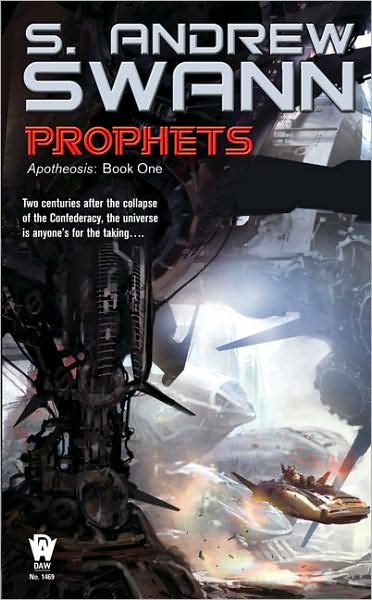
 S. Andrew Swann
 – I read two books by him in 2009 and though very highly of both of them. One of those books was the Space Opera
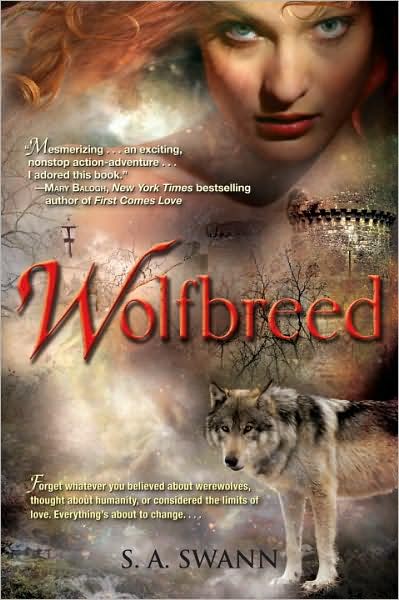
Prophets and the other was the Werewolf/Historical Fantasy/Romance
Wolfbreed. I’ll be following those two series and I plan to read the books that precede
Prophets, plus I have the omnibus/duology
Dragons and Dwarves awaiting a read.
Based on the two books I did read by Swann, he flows very well between the related subsets of Speculative Fiction. Taking a look at his
bibliography would bear this out - Space Opera, Mystery, Thriller, Historical Fantasy, Urban Fantasy.
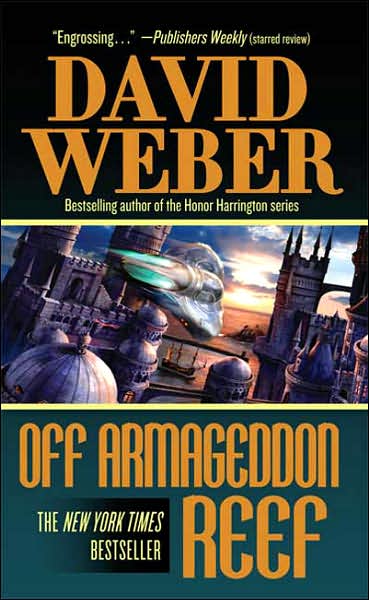
 David Weber
 - I read his retrospective anthology
Worlds of Weber in 2008 and in the Fall of this past year, I picked up
Off Armageddon’s Reef the highly enjoyable opening novel of his
Safehold series. Since Santa brought the second and third books in the series, with a fourth one publishing in 2010, I’ve got a nice chunk of reading ahead of me in this promising series. I also may go back to his
Honorverse novels.
Warhammer/ Warhammer 40,000 - I know this franchise has been around for a while, but I read
a couple of the
books this past year and have a slew on the plate to review. So far, I’ve enjoyed what I read quite a bit and can really see why the universe appeals to so many people
Most Disappointing Reads of 2009
Three books for which I had high hopes didn’t work for me that I had high hopes for when I began reading them last in 2009. Each book disappointed me for different reasons, though.
The Quiet War by Paul J. McAuley is a book I looked forward to a great deal since Mark enjoyed it and I was in the mood for a good solid space opera. I didn’t get that with this book. What I got was more of a mystery with not nearly as much space opera goodies as I hoped to read.
How to Make Friends with Demons by Graham Joyce was another major reading disappointment of 2009 for me. I just couldn’t attach myself to the story enough to care. This is really a shame because everything up to this point I read by Joyce I enjoyed a great deal. I’ll chalk this up to a case of the wrong book at the wrong time.
Soulless by Gail Carriger was quite disappointing, too. The premise sounded fairly interesting – Steampunk meets Vampires, but the protagonist really wore on me after a while:
By this point, it would seem that I enjoyed the novel. I did – up to the first 80-100 pages, which worked well for me. I was enjoying the way Carriger revealed her supernatural world and I liked the characters of Lord Maccoon, Alexia, and Lord Akeldama. Unfortunately, the immediacy of the opening of the novel and the charm of the characters began to wear off as the novel progressed, especially the prattling between Alexia and her friend Miss Ivy Hisselpenny, a constant wearer of ugly hats. I also found Alexia’s and Maccon’s back and forth to lack the pull when they first began their romance in the novel. Lastly, I felt browbeat by a lot of the repetitive aspects of the novel, the continual reference to Hisselpenny’s ugly hats, and the even more derogatory slant of Alexia’s Italian heritage which seemed to be pointed out every five pages, to the point where I started to say to myself, "OK, I get it, she’s half Italian and that’s not a good thing."
Favorite Author Whose Work I Revisited in 2009
Robert J. Sawyer, with
WWW: Wake is what puts him in this category.
I read a handful of his novels years ago but never managed to return to them and in that time he’s published over a half-dozen books and won some awards. This
WWW trilogy is quite promising.