Showing posts with label Jack McDevitt. Show all posts

Sunday, October 20, 2013

Books in the Mail (W/E 2013-10-19)

Here's the small haul for this week at the 'o Stuff. I've given up trying to predict which books I'll read of those that arrived, but I have enjoyed books by two of authors in today's post.


Copperhead (Ironskin #2) by Tina Connolly (Tor Hardcover 10/15/2013) – Turn of the Century Fantasy of Manners, sequel to Ironskin


Set in an alternate version of early 1900s England, Copperhead is the sequel to Tina Connolly's stunning historical fantasy debut.

Helen Huntingdon is beautiful—so beautiful she has to wear an iron mask.

Six months ago her sister Jane uncovered a fey plot to take over the city. Too late for Helen, who opted for fey beauty in her face—and now has to cover her face with iron so she won’t be taken over, her personality erased by the bodiless fey.

Not that Helen would mind that some days. Stuck in a marriage with the wealthy and controlling Alistair, she lives at the edges of her life, secretly helping Jane remove the dangerous fey beauty from the wealthy society women who paid for it. But when the chancy procedure turns deadly, Jane goes missing—and is implicated in a murder.

Meanwhile, Alistair’s influential clique Copperhead—whose emblem is the poisonous copperhead hydra—is out to restore humans to their “rightful” place, even to the point of destroying the dwarvven who have always been allies.

Helen is determined to find her missing sister, as well as continue the good fight against the fey. But when that pits her against her own husband—and when she meets an enigmatic young revolutionary—she’s pushed to discover how far she’ll bend society’s rules to do what’s right. It may be more than her beauty at stake. It may be her honor...and her heart.


Fiendish Schemes by Tor Trade Paperback 10/15/2013) – Sequel to Jeter’s landmark Stempunk novel Infernal Devices


In 1986 K. W. Jeter coined the term "steampunk," applying it to his first Victorian-era science fiction alternate-history adventure. At last he has returned with Fiendish Schemes, a tale of George Dower, son of the inventor of Infernal Devices, who has been in new self-imposed exile…accumulating debts.

The world Dower left when he went into hiding was significantly simpler than the new, steam-powered Victorian London, a mad whirl of civilization filled with gadgets and gears in the least expected places. After accepting congratulations for his late father's grandest invention—a walking, steam-powered lighthouse—Dower is enticed by the prospect of financial gain into a web of intrigue with ominously mysterious players who have nefarious plans of which he can only guess.

If he can locate and make his father’s Vox Universalis work as it was intended, his future, he is promised, is assured. But his efforts are confounded by the strange Vicar Stonebrake, who promises him aid, but is more interested in converting sentient whales to Christianity—and making money—than in helping George. Drugged, arrested, and interrogated by men, women, and the steam-powered Prime Minister, Dower is trapped in a maelstrom of secrets, corruption, and schemes that threaten to drown him in the chaos of this mad new world.


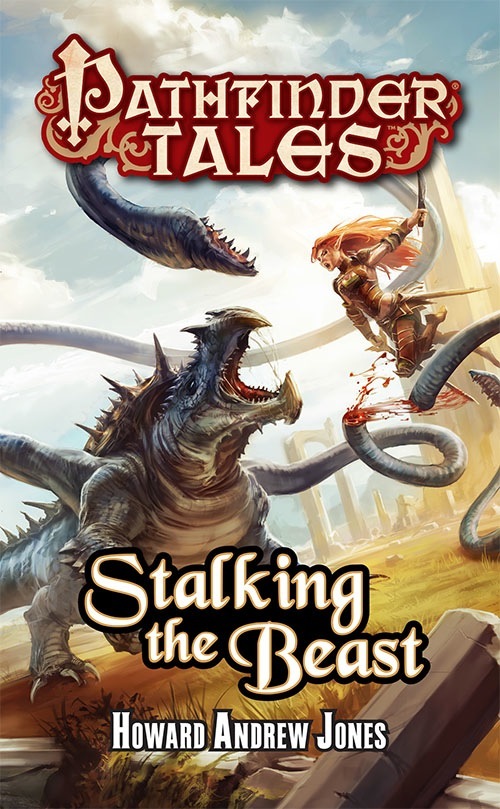
Stalking the Beast (A Pathfinder Tales novel) by Howard Andrew Jones (Paizo Mass Market Paperback 10/22/2013) – This is Jones’s second Pathfinder novel and I loved his second installment of The Chronicles of Sword and Sand so I’ll be reading this one.

When a mysterious monster carves a path of destruction across the southern River Kingdoms, desperate townsfolk look to the famed elven ranger Elyana and her half-orc companion Drelm for salvation. For Drelm, however, the mission is about more than simple justice, as without a great victory proving his worth, a prejudiced populace will never allow him to marry the human woman he loves. Together with a fresh band of allies, including the mysterious gunslinger Lisette, the heroes must set off into the wilderness, hunting a terrifying beast that will test their abilities—and their friendships—to the breaking point and beyond.

From acclaimed author Howard Andrew Jones comes a new adventure of love, death, and unnatural creatures, set in the award-winning world of the Pathfinder Roleplaying Game. 


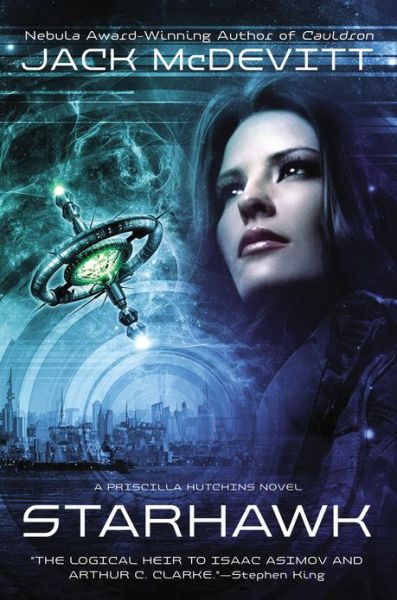
Starhawk
by Jack McDevitt (Ace, Hardcover 11/05/2012) I’ve read a handful of novels from McDevitt and enjoyed most of them. This is a prequel to the series featuring the character who first appeared in The Engines of God

Priscilla Hutchins has been through many experiences. This is the story of her first unforgettable adventure…

Priscilla "Hutch" Hutchins has finally realized her lifelong dream: She's completed a nerve-bending qualification flight for a pilot's license.

Her timing is far from optimal, however. Faster-than-light travel has only recently become a reality, and the World Space Authority is still learning how to manage long-range missions safely. To make matters worse, efforts to prepare two planets for colonization are killing off native life-forms, outraging people on Earth.

So there's not a lot of demand for space pilots. Priscilla thinks her career may be over before it has begun. But her ambition won't be denied, and soon she is on the bridge of an interstellar ship, working for the corporation that is responsible for the terraforming.

Her working conditions include bomb threats, sabotage, clashes with her employers—and a mission to a world, adrift between the stars, that harbors a life-form unlike anything humanity has ever seen. Ultimately, she will be part of a life-and-death struggle that will test both her capabilities and her character…

Wednesday, December 16, 2009

Time Travelers Never Die @ Sacramento / San Francisco Book Review

In addition to reviewing for SFFWorld, I’m now reviewing for the Sacramento Book Review /San Francisco Book Review. The über cool Dot Lin connected me with the fine folks who run the magazine, so a big thanks goes out to her for setting this up and them for agreeing to bring me aboard.

I was waiting to announce this here on the blog until my first review, Time Travelers Never Die, went live which it did sometime yesterday.


So, click through and to read and find out my thoughts on Jack McDevitt’s latest novel.

The review also appears in the print version of their magazine, which is distributed to a bunch of bookstores, libraries, coffee shops, colleges, and other gathering places each month in the Greater Sacramento and San Francisco Bay Area every month.

Tuesday, January 13, 2009

Cracked Review, Hines Interview, SFFWorld Review, & Reading Resolutions

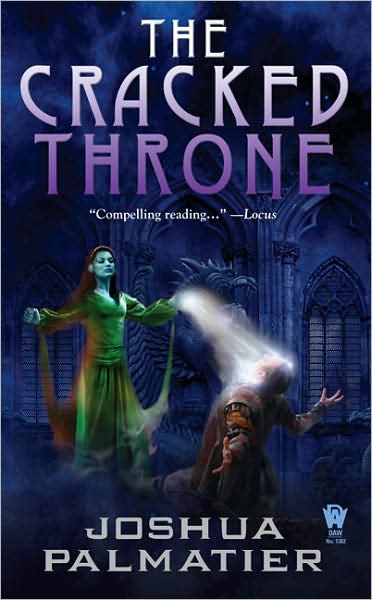
Following on from last week, I posted my review of Joshua Palmatier’s The Cracked Throne, which more than straddles the line as a simple middle book in a trilogy. The book started a bit slow for me, but the ending really cranked up and more than balanced that beginning. Here’s a snippet:

The throne itself comes more into play and Palmatier expands on its strange history. Varis soon learns the souls of the former rulers of Amekor are housed within Throne, and more importantly, so are the souls of the seven who poured their essences into the creation of the throne. The visions of destruction are both a reminder of the past and a harbinger of the future, the throne was created to keep an invading force of blue-skinned nomads, the Chorl, from destroying Amenkor.

What makes this novel is very much what made its predecessor work – Varis’s engaging narrative voice. There are no pretentions and the strength of any first person narrative is one of Varis’s strengths – the reader (for lack of a better term) learns about things alongside the protagonist. Another strength of Palmatier’s story is the throne itself and the slow reveal of its nature. It might be odd to make another comic book comparison to Palmatier’s work, but the Throne reminded me a great deal of an element of the Superman/Doomsday storyline where by rulers of a world pool their magical abilities together to create a super-being to battle the threat of the monster Doomsday. Palmatier’s theme of sacrifice for the greater good and its ultimate consequences echo more powerfully and subtly.

I’m also conducting an e-mail interview with Joshua which should probably go up when my review of The Vacant Throne is posted.

Also in SFFWorld updates, an interview with Jim C. Hines went up over the weekend. His Jig the Goblin books have been fairly well-received and I have his latest, The Stepsister Scheme on the review pile.

Hobbit also posted the third and final part of SFFWorld’s 2008 Year in Review.

Some reading resolutions I’d like to make for 2009:

Read more short fiction
Last year I read only 6 collections/anthologies, one of which was new fiction (Eclipse One), two were the John Joseph Adams-edited reprints; two were reprint anthologies/retrospectives (David Weber, Kull). I’ve got a backlog of some anthologies and will hopefully pick up some more with different authors/editors. Short fiction never comprised a majority of my genre reading and every year I tell myself to read more of it.

Read more fiction from different voices
This is somewhat encompassing. I read only three women writers last year in novel length form (Liz Williams, Kay Kenyon, and Karen Miller) and most of what I read was written by white guys. While I can’t control what books publishers publish and send to me, I can choose from that pool which books to read. In past years when I keep tallies of what I read, I read more women and more than just white guys.

Read outside of what I typically read
Most of the fantasy I read is secondary world/epic/high fantasy. While I’ve been dipping my toes into Urban Fantasy for a while, I would like to read more of it and from across the board. As for the Science Fiction I read, it often leans to Space Opera/Military Science Fiction. Point being, both genres have enough variation for me to try the many different flavors of Speculative Fiction. I’d also like to read some more mystery and more non-genre work, Mrs. Blog o’ Stuff has plenty of non-fiction stuff for me to tackle like a recent Ben Franklin biography and some history books.

Catch up with series fiction
The Dresden Files; Vampire Earth by E.E. Knight; Wess'Har by Karen Traviss; Vlad Taltos by Steven Brust (I'm only one book behind); Shadowmarch (I'm only one book behind); Marla Mason by T.A. Pratt; Malazan; Black Company, Dread Empire, and Garrett, P.I. (OK, I didn't even start the Garrett, P.I. books yet) by Glen Cook; Dune (a re-visit and catch-up really), Takeshi Kovacs by Richard K. Morgan; Alex Benedict by Jack McDevitt; and the list could probably continue. Shit, I just added another dozen plus books and may be counter-intuitive to some of the above reading resolutions

All of the above are things I’ve been thinking about as constantly reshuffle my Pile o' Shame /"To read"pile, and with the amount of books I receive for review and still have unread, it isn’t practical to justify spending hard earned cash on more books. But what is practical, anyway? There are just too many books to read at this rate.

Thursday, January 08, 2009

Rob's 2008 Reading Year in Review

Since 2008 has been finished for over a week, now's about time to post my year in review. Here's a few other year in review posts from my blogroll:

Aidan/A Dribble of Ink
Andrew Wheeler/Antimuck Musings
Pat (The Hotties)/Fantasy Hotlist
Larry/OFBlog (Novels, Anthologies, Debuts, YA) {just when I think I read a lot, I'm put to shame by Larry}
Grasping for the Wind
Adam/The Wertzone

2008 proved to be another year of good reading. All told, I read over 80 books in 2008, most of which were novels, a few collections/anthologies and a handful of graphic novels.

Since I mentioned the best 2008 books I read in the annual SFFWorld Review (Part One, Fantasy, Part Two Science Fiction & Media), I’ll not limit myself here to just 2008 books.

The majority of the books I read last year (50 out of84) were released in 2008, which is pretty much the percentage I’ve been hitting in past falling years. Jim Butcher’s Dresden Files continues to keep my interests very high. I made it through four of the novels, Dead Beat, Summer Knight, Death Masks, and Blood Rites as well as the novella Backup and the comic/graphic novel Welcome to the Jungle. Some may call these novels guilty pleasures, regardless, they are really entertaining reads. Most of the other non-2008 books I read were part of series that saw new volumes publish in 2008 or were reissues/compilations of earlier editions. On to the 2008 reads…


Rob Favorite Science Fiction Novel(s) Read in 2008

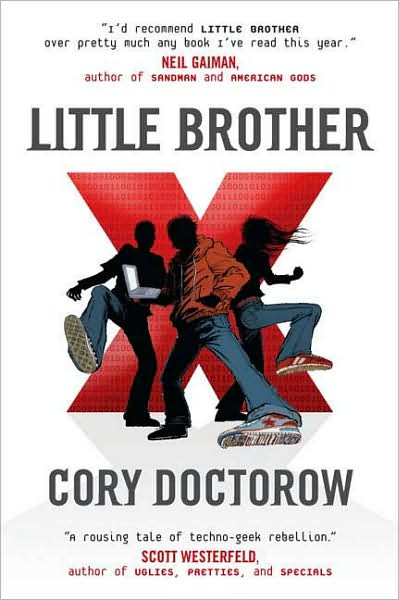
This was a dead tie between a new book for 2008, a genre classic, and a book I re-read this year. This year’s book was obviously Little Brother by Cory Doctorow.
Despite that analogy and the frightening overtones of the scope of this story, Doctorow provides a great balance and manages to keep the story upbeat throughout. He also gives the reader what amounts to a guide to security evasion and computer hacking. Since the book is told from Marcus’s first-person point-of-view, these passages are very readable and come across more of a conversation than anything else. Only a couple of these “conversational instructions” slowed the pace of the plot.

Doctorow’s novel is scary because it resonates so much with the real world; personal freedoms are sacrificed in order for our own “safety.” Doctorow evokes b
oth Orwell and Philip K. Dick in the sense of paranoia, but Doctorow (obviously) brings a more modern sensibility to the fore. Doctorow has been at the forefront of electronic rights and in the science fiction genre. Aside from the aforementioned slow patches, the novel is note-perfect and I found it very difficult to put the book down. Entertaining, enlightening and eye-opening, Little Brother will only further reinforce Cory Doctorow’s presence as one of the visionaries of free speech advocacy and great storytelling in the 21st Century.
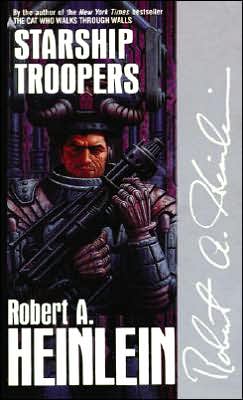
The classic is Robert A. Heinlein’s seminal Starship Troopers, which I reviewed here on the blog earlier in 2008. At the time I said:
One thing that surprised me as I was reading the book was how little action and science-fictiony stuff happens for the better part of the novel. Don’t get me wrong, I don’t think this is necessarily a bad thing. In fact, I think the best science fiction novels, like this one, have an utterly human quality to them. Even if Johnny Rico serves as something of a mouthpiece for Heinlein (as some have said), the character comes across as genuinely human.


Honorable mention goes to Matthew Stover’s Heroes Die, which I read for the third time this past year (and yes it is science fiction although it also works as fantasy). His voice, particularly as Caine, is the most compelling fictional hero I’ve ever read in novel form.

Rob’s Favorite Fantasy Novel(s) Read in 2008

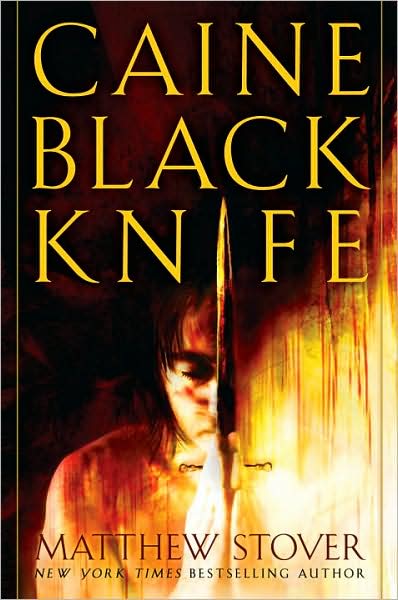
Caine Black Knife was not only my favorite Fantasy novel of 2008, it was my top novel overall. It was great to get back into Caine’s head and hear his voice narrate for me.

Back to Caine, though, because Stover really leaves the reader no choice in the matter, which is not a complaint by any means. Because the majority of the novel is told through Caine’s voice and reactions, we as the reader are not given any other option on who to believe or trust. Caine’s POV is the only one and as such, his voice flows and filters the narrative more smoothly than just about any first person narrator this side of Severian of the Guild. The difference here is Severian is explicitly an unreliable narrator, Caine seems more reliable. To paraphrase and sum up the themes of Stover’s work, Caine isn’t trying to sell us anything, he puts his faults and scars on the table for all to view. His voice is frank, direct, and a terrifically engaging one that comes across as, for lack of a more refined term, a very likeable and endearing asshole. Then again, I can say that because I’ve never been on the opposite end of Caine’s frustrations.

In addition to Caine’s internal dialogue informing the narrative and plot, his dialogue with other characters helps to move the plot along at a brisk pace. With multi-character dialogue comprising multiple pages, I was again reminded of Roger Zelazny. From what I recall, vast pages of his Amber novels are primarily dialogue between characters. Here, both Stover and Zelazny’s dialogue is somewhat terse in that the exchanges between characters is brief as each character takes their turn speaking to the other, but dense in how it conveys the individual scenes of the novel and the over-reaching plot as a whole. It is a nice trick to pull of when it works so well; but one of those easy looking things you get a sense aren’t that easy to refine.


Carlos Ruiz Zafon’s Shadow of the Wind is one of the most powerful, haunting and beautifully written novels I have ever read. It defies genres and slips into fantasy mainly because of the wonderful Cemetery of Forgotten Books. The review has taken me a while to write because the novel was so powerful. I can’t recommend this novel enough.

I also thoroughly enjoyed the conclusion to Brandon Sanderson's Mistborn trilogy, The Hero of Ages and the conclusion Greg Keyes's Kingdom of Thorn and Bones trilogy The Born Queen.

Favorite Debut(s) of 2008

It was a pretty solid year, but standing out for me was Brent Weeks and his Night Angel Trilogy. With very little (compared to Rothfuss and Lynch) prepublication Internet buzz, this trilogy swept in the final three months of the year and really generated a great deal of steam, particularly at SFFWorld. I still haven’t read the final book in the trilogy, but I did review The Way of Shadows and Shadows Edge.

Taylor Anderson also impressed me with the first two books (Destroyermen I: Into the Storm and Destroyermen II: Crusade) of his alternate history/crossover saga about a World War II Naval Destroyer swept into a world with intelligent lemurs and lizards.

Favorite Undiscovered/Overlook Gem of 2008

By undiscovered/overlooked, I mean an author and/or book(s) that have been on the shelves for a couple of years but didn’t receive that much attention from the reading circles in which I find myself. In other words, SFFWorld, my blogroll, and Westeros. This just might have to go to Joshua Palmatier whose Throne of Amenkor trilogy was finished in January 2008. Granted, I came to these books late in 2008, but the series is very entertaining and seemed to be drowned out when The Skewed Throne was published in 2006 by cries of Rotfhuss and Lynch.

Favorite Publisher of the Year

Newish publishers continue to make big splashes in the genre; Pyr is trucking along and ended the year with great news – they are bringing James Barclay’s Raven novels to the US. These are very solid heroic fantasy novels in the David Gemmell vein. Not to be outdone, Orbit Books has made a considerable impact since its US debut in 2007. Orbit has been bringing Iain M. Banks’s Culture novels back into print and ended their publishing year with Brent Weeks’s Night Angel Trilogy, publishing the three books in successive months. Tor keeps trucking along, as do the other major publishers (Roc/Ace, DAW, Harper/Eos, Del Rey, and BantamSpectra). Smaller presses are growing and their books are looking terrific – NightShade Books and Subterranean Press have produced great limited editions; solid anthologies; and important & well regarded reprints.

As for favorite, this is a tough one because many of the publishers published interesting books in 2008. Pyr has been impressing me a lot in the past few years, but slightly newer (at least in the US) is Orbit Books who has been publishing a very diverse group of authors and keeping a relatively updated Web presence has impressed me the most in 2008.


Favorite Short Story Collections/Anthologyies Read in 2008

John Joseph Adams released three anthologies, two of which I read and were outstanding. Both are reprint anthologies and will likely stand as benchmarks and seminal anthologies in the respective subgenres. Wastelands is an awesome anthology of apocalyptic proportions. Here’s what I said about it:

Post-apocalyptic stories have long been a popular subset of Science Fiction and Fantasy. From short stories to novels to movies to television shows, the milieu of a people trying to cope with a world after the collapse of civilization has proven fertile ground for writer’s and reader’s imaginations for many years. In this collection, John Joseph Adams, long time editor at the Magazine of Fantasy and Science Fiction gathers some of the pre-eminent storytellers and their visions of a devastated world in this admirable collection. The introduction by John Joseph Adams sets the mood and tone for the collection, going into greater detail upon the subgenre.
.
.
.
With 85% of the stories working not just well, but extremely well for me, I can’t help but give this collection the highest recommendation. I think this will be a cornerstone for most reader’s shelves.

The Living Dead tackles Zombies and is just as solid:
Like his Wastelands anthology respective to post-apocalyptic fiction, Adams has culled together a massive amount (34 in total) number of stories on Zombies. To call this volume anything other than must have would be selling it short, the stories range a great number of years and capture many unique voices on one of the seminal images and iconic characters of Horror fiction and is something I know I’ll be pulling down every Hallowe’en. This impressive, massive anthology would make a great gift to give by the light of the Jack o’ Lantern.

David Weber’s Worlds of Weber retrospective was pretty good, too and works (as it did for me) as a great introduction to his work.


Favorite Author Whose Work I Revisited

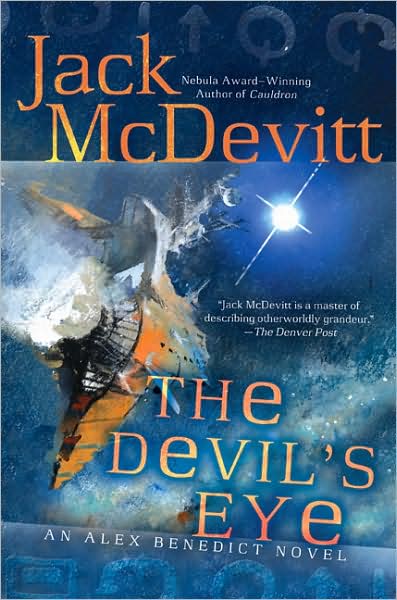
Jack McDevitt. I went through a spate a few years ago where I read a good four or five of his novels, but nothing since. In that time, he won an award and published a slew of new novels. Most recently was The Devil’s Eye. That was the only book I read from him last year, but it reminded me that I really need to catch up with those books he published in the past few years.
Jack McDevitt returns with an all new novel featuring Alex Benedict and Chase Kolpath, the heroes of McDevitt’s 2006 Nebula Award Winning novel, Seeker. Though I’ve read a good portion of McDevitt’s output, The Devil’s Eye is the first book I’ve read by him in quite a while (having enjoyed most of his other novels, particularly Moonfall) and the first I’m reading to feature Benedict and Kolpath. Like the earlier Alex Benedict novels, The Devil’s Eye is a science fiction/mystery hybrid. The Alex Benedict novels are set approximately 10,000 years in our future, with humanity having spread across the galaxy encountering intelligent alien species. This other species, Ashyyur, is feared by humanity at large both for the tall appearance, lack of true speaking voice, and ability to read minds. Benedict is a dealer in archaeological antiquities, which serves to connect with the reader in that Benedict shows a predilection for 20th Century antiquities. The far-future setting also is quite recognizable as human, except on a galactic scale.


Most Disappointing Reads of 2008

Three books didn’t work for me that I had high hopes for when I began reading them last year. Each book disappointed me for different reasons, though.

Thunderer by Felix Gilman came out late enough in 2007 to really be considered a 2008 book, and it just didn’t work for me. I had relatively high hopes for it because people whose taste I often trust had good things to say about the book. The book wasn’t really bad, but it just didn’t click with me and may be one of those books I try at a later date.

Empress by Karen Miller was the other major reading disappointment of 2008 for me. The first, I don’t know, quarter of the book was pretty gripping. I was in synch with what Miller was trying to do in building up what amounts to an Evil Empress. The character, Hekat, was engaging. However, something really turned the bend for me in both the character of Hekat and the story itself. I began hating her, which isn’t necessarily a bad thing for a main character. That hate very quickly turned into outright annoyance, which spread from Hekat to the whole story.

Juggler of Worlds by Larry Niven and Edward M. Lerner was disappointing, too. I really enjoyed, and was surprised by how much I enjoyed, Fleet of Worlds by the same duo. The sequel really missed the mark for me and didn’t capture what I enjoyed about the first one.

So what’s more a frustrating disappointing read? Expectations based on other’s recommendations, a book just losing everything that made it good for a small early portion, or a disappointing sequel not living up to its predecessor?

OK, I think I’ve covered it all, in terms of books read. I will, most likely, remember something a few days after posting this, though.

Tuesday, November 18, 2008

The Devil's Eye Reviewed, Gaiman-Batman, and Me

Jack McDevitt, through the fine publishing imprint Ace Books, just released a new book a couple of weeks ago. I read it, reviewed it, and posted said review to SFFWorld yesterday. I went through a spate of McDevitt’s novels a few years back and enjoyed them quite a bit, so was happy to tackle this latest one for SFFWorld. Reading The Devil's Eye reminded me how much I enjoy McDevitt's books and that I've got some catching up to do. As if I don't have enough to read.


Here’s a snapshot of my review:
The action starts when Vicki Greene, a popular horror writer of the era pleads for Benedict to help her, leaving only a cryptic message as his primary clue: “God help me, they are all dead.” Alex is intrigued, though he is relatively unfamiliar with Greene’s work, his partner Chase is and they take the job. With very few clues by which to guide them, Alex and Chase embark on a mystery that spans the galaxy and whose roots have dire ramifications for a planet with both humans and Ashyyur.

McDevitt unravels, or rather the fact that he deftly weaves a number of plot elements together keeps his skilled hand hidden, multiple plot strands throughout the novel rather seamlessly. As such, The Devil’s Eye works on many levels – mystery, conspiracy story, galactic travelogue, alien/human relations, adventure novel, horror novel, character study. Dramatic tension and sense of wonder played off each other quite well. In fact, each element serves the other in the novel very effectively, much like familiar people/characters effectively play off of each other’s personalities.

Speaking of British Comic Book writers, happy birthday to Alan Moore!

Lastly, I did something over the weekend I’d been bugging myself to do for a while. I joined the Online Writing Workshop for SF, Fantasy & Horror (formerly hosted/sponsored by Del Rey) and submitted the first couple chapters of the novel I’ve been working on for the past couple of years. Some respected and popular authors have come out of the workshop: Joshua Palmatier (The Skewed Throne); Sarah Prineas (The Magic Thief); Chris Evans (A Darkness Forged in Fire); Elizabeth Bear and a personal favorite of mine (R.) Scott Bakker so I fell like I’m on the right track by joining the workshop.

Sunday, October 12, 2008

Books in the Mail (W/E 10/11/2008)

Orphan’s Alliance by Robert Buettner (Orbit Books Paperback 10/28/2008) – I’ve read and enjoyed all three books (Orphanage, Orphan’s Destiny, Orphan’s Journey) in the Jason Wander Series, which I’ve mentioned here at the o’ Stuff in the past. I’m really looking forward to this one. Buettner writes solid military science fiction and he took the series in a cool direction with the third book, Orphan’s Journey. All told, Buettner has a very entertaining Military Science fiction series going with these books.

Humans have been discovered on the Outworlds. And the Army decides to send emissaries. Emissaries like Jason Wander. As intraplanetary conflicts rage around him, and the personal stakes get ever higher, Jason finds that playing planet-hopping politician can be harder than commanding armies. When united mankind squares off to battle the Slugs for a precious interstellar crossroad, Jason will discover that the most dangerous enemy may be the one he least expects.

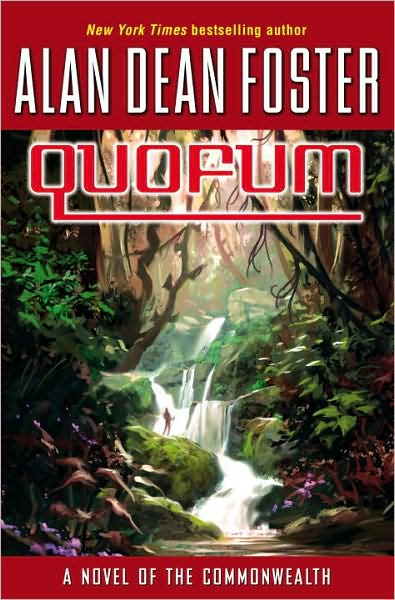
Quofum (A Novel of the Humanx Commonwealth) by Alan Dean Foster (Del Rey 10/28/2008) – I’m know the title is very relevant to the story and anything that starts with the letter Q is cool, it still has a silly sounding title. I know I’m prejudging here, but who doesn’t on ocassion. This is a book in a series with 25+ books, which is a bit daunting though I suspect this is enough of a stand-alone for new readers. I’ve never read anything by 2008 Grand Master award from the International Association of Media Tie-In Writers. I’m sure the book will do well with Foster’s many fans.

The mission to planet Quofum is supposed to be a quickie for Captain Boylan and his crew. Boylan is tasked with delivering four scientists–two men, one woman, and one thranx–to the unknown world, setting up camp while the experts investigate flora and fauna, then ferrying them safely home. The first surprise is that Quofum, which regularly slips in and out of existence on Commonwealth monitors, is actually there when Boylan and company arrive. The second surprise is more about what Quofum is not: The planet is not logical, ordered, or rational.

The team encounters three intelligent, warring species–some carbon-based, others silicate-based, all bizarre–along with thousands of unique, often unclassifiable life-forms. Quofum’s wild biodiversity doesn’t appear to be natural. But if it is by design, then by whose, and for what purpose?

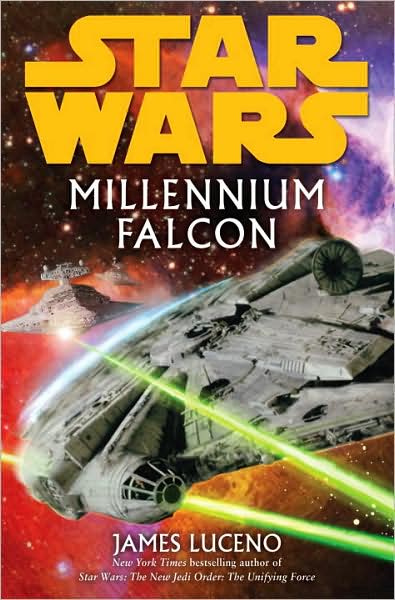
Star Wars: Millennium Falcon by James Luceno (Del Rey Hardcover 10/21/2008) – From the moment the Falcon broke loose from a Corellian assembly line like an untamed creature with a will of its own, it seemed destined to seek out trouble. It wasn’t long before the feisty YT-1300 freighter went from shuttling cargo to smuggling contraband. But it‘s a fateful rendezvous on Coruscant, at the explosive height of the Republic/Separatist uprising, that launches a galaxywide cat-and-mouse game whose newest players are Han, Leia, Allana, and C-3PO. And they’re not alone: Crime lords, galactic pirates, rogue politicians, and fortune hunters alike loom at every turn of the quest–each with his or her own desperate stake in the Millennium Falcon’s most momentous mission. Through the years and across the stars, from the Rim worlds to unknown points beyond, the race will lead them all to a final standoff for a prize some will risk everything to find–and pay any cost to possess.

The Devil's Eye: An Alex Benedict Novel by Jack McDevitt (Ace, Hardcover 11/04/2008) – I read quite a few of McDevitt’s novels a few years back (Moonfall, The Engines of God, Ancient Shores, Infinity Beach and liked them all, for the most part with Moonfall being a favorite. The Devil’s Eye is the latest in his Space Opera/Mystery hybrid and it sounds pretty interesting.

Interstellar antiquities dealer Alex Benedict receives a cryptic message asking for help from celebrated writer Vicki Greene—who has been mind-wiped. She has no memory of her past life, or of her plea for assistance. But she has transferred an enormous sum of money to Alex, also without explanation. The answers to this mystery lie on the most remote of human worlds, where Alex will uncover a secret connected to a decades-old political upheaval—a secret that somebody desperately wants hidden, though the price of that silence is unimaginable…

This looks like a good time to catch up with his writing.

The Hero of Ages: Mistborn 3 by Brandon Sanderson (Tor Hardcover 10/14/2008) - The first two installments (The Final Empire, Well of Ascension) were terrific so I was really looking forward to reading this one. I’ll be posting up my review in a couple of days, but to put it succinctly, this is one of the more solid, enjoyable and well crafted fantasy trilogies in recent memory.


Here’s a brief preview of the review I’ll be posting:

Throughout the course of the trilogy, Sanderson’s hand has been subtle in the clues he laid out in terms of the ultimate threat, but he has also managed to echo some of his literary predecessors. One of the literary devices I’ve enjoyed the most over the course of the novels is the diary quotes Sanderson uses as an opening for each chapter. These quotes hint at what just happened in a previous chapter involving a certain character, or what will happen in the chapter it leads and gives the story more resonance and authenticity. I liked how it allows Sanderson to tackle some of the themes of the novel without weighing down the narrative of the characters’ plight throughout. At times, some of these themes, particularly Ruin and Preservation as opposing forces, put me very much in the mind of Stephen R. Donaldson’s Thomas Covenant novels and the dichotomy between Lord Foul and The Creator. All told, some really good stuff here by Sanderson that is effective and enjoyable on many levels.