Showing posts with label book reviews. Show all posts

Friday, August 14, 2015

Friday Round-Up: An Announcement and Hobb & Jemisin Reviews @SFFWorld

In this week’s edition of Friday Round-Up I bring you new reviews of Robin Hobb and N.K. Jemisin. But first, a little announcement.

As some folks already know, I’ve been in a job predicament for a few years. Back in 2011, I was in a job/position I really enjoyed at a company for which I enjoyed working. Things were going well, in 2010 my group (of which I was the manager), far exceeded our goals for the program we had re-launched the previous year and everybody in the group received one-time bonuses for exceeding those goals. Then the company did some reorganization and as a result of “corporate restructuring,” I was squeezed out in February 2011. What helped to slightly soften the blow is that my supervisor (the Vice President of the group), left the company shortly after I was let go because he saw the writing on the wall.

A few months later, a very good friend of mine who works for A very large Telecommunications & Technology company helped me out big time. Some of the groups at the company where he worked were looking to bring in people (as contractors) to help build up a product line. So, for the past four years (which was only supposed to be a temporary stop) I’ve been working there in what is essentially a digital assembly line capacity. To be honest, it was pretty good money, but the job has very, very little in common with my Marketing & Marketing Proposals and Publishing background. That, plus the associated instability of being a contracted employee led me to continue my job search. About a year ago, the company brought me (and a handful of folks who began as contractors the same time I did) more fully into the fold, converting me from contractor to Term Employee (essentially a hybrid between Contractor and Full-Time Employee, but working directly from the company). As I said, all this time, I was still looking for a more stable (i.e. permanent and not contractor) position more closely aligned with my decade and a half of Marketing and/or Publishing experience.

After a slew of interviews over the years (many phone interviews, which led to some face-to-face interviews) with different companies, my search has ended and I will be starting on Monday August 18 doing work much more in line with my past experience (marketing proposals) for a very impressive company with great leader at its helm and a culture (based on the interviews I’ve had, research into the company and coming to realize a friend has a relative at the company) that will help me grow and further my career along a stable path. I’m very excited for this slight career reboot and cannot wait to join the new company on Monday. For more specifics on what that is and the company, I’ll be updating my LinkedIn profile to reflect the new position once I officially begin the new job.

One thing I've learned in my job searching the past few years compared to job searching even 8 to 10 years ago is that EVERYTHING is automated and it is challenging to level up in the process for one job and actually communicate with a human being rather than an automated interface.

Back to the SFF stuff, with my reviews of two highly anticipated Fantasy releases. Last week, I posted my review of the powerful, challenging, and stunning novel from N.K. Jemisin, The Fifth Season:


The narrative, is initially, very chaotic. Jemisin employs multiple character points of view, one for each chapter, give the feel of a dangerous world were nobody is safe. The novel is post-apocalyptic, but takes place on a secondary world. A world where the planet is extremely unstable, where magicians (Orogenes) with powers based on geology work with technology in the hopes of keeping the world, on a literal, tectonic level, stable.
...
We are introduced to this world through the eyes of Essun, and damn does Jemisin get the emotional ball rolling very quickly. Upon returning home, she realizes her husband has brutally murdered their son. This shocking moment informs Essun’s tale. The other narrators, Damaya and Syenite/Syen, travel a road no less wrought with heartbreak and sorrow and undergo changes of their own over the course of their own narrative journeys, not unlike the geological cataclysms that strike their world. Jemisin marvelously portrayed women whose changes in demeanor, and person, mirror the global changes. Not only does the story come across through these three women’s eyes/voices, each of the three story threads is told in a different narrative voice, third person narrative for Syen and Damaya, while Essun’s story is told through the rare second person present, as if we the reader are Essun. As I said, there’s some chaotic elements in the story and the narrative reflects this chaos. It takes some acclimating, but is an ultimately very rewarding storytelling technique.

This week (Tuesday, the day of the book’s launch), I posted my review of perhaps my most anticipated 2015 Fantasy novel, Robin Hobb’s Fool’s Quest:


Fool’s Quest is the second installment of The Fitz and the Fool Trilogy, which itself is the most recent in a long line of stories set in Robin Hobb’s Realm of the Elderlings (three trilogies, a quartet, and now this in-progress trilogy for a total of 15 books up to now). To say Fool’s Quest might be a tough sell for new readers is an understatement. Much of the action is predicated on events that have transpired in previous volumes of this mega-series, and most importantly on the previous installment Fool’s Assassin. But…but…before I launch into my thoughts on this volume, I’ll preface it with this. If readers have any doubt that Robin Hobb is one of the finest writers in the Fantasy genre, then they haven’t read any of her work. From the beginnings of Assassin’s Apprentice in 1995 to this most recent novel, few can balance, character, prose, and story so well. So do yourself a favor, go read Assassin’s Apprentice (the novel that started it all) or Fool’s Assassin, the first novel in this new trilogy which does work well for new readers. (This preamble also provided ample spoiler space because talking at any length about Fool’s Quest is impossible without spoiling events of Fool’s Assassin).
...
The sense of urgency in the novel is extremely heightened, despite the same reserved pace that made Fool’s Assassin such a joy to read and experience. Fool’s sense of urgency to strike back at his tormentors, combined with Fitz’s desperation to find his stolen daughter made for incredible tension. Fitz’s experience; however, makes him realize rushing into their situation will only be a detriment to their success. Robin Hobb balanced their tension with a quiet reserve during many of the court scenes and meetings that Fitz was obliged to experience very well, giving both frustration and hope. Hobb’s magnetic, captivating prose completely wrapped itself around me.

Friday, July 17, 2015

Friday Round-Up: Gladstone & Kurtz @SFFWorld, Anders @SFSignal

Here it is, the Friday Round-up you have all been waiting to read!

A couple of weeks ago, I posted my review of a classic fantasy novel that definitely fits the bill of being “oldie but a goodie.” I refer to Deryni Rising by Katherine Kurtz, books which have long been back-burner books I anticipated reading, but some Twitter conversations with Fred Kiesche, Joe Sherry, Paul Wiemer, and Jonah Sutton-Morse pushed me to get the audible version:


Much of the action presented in the novel takes place in a short time and focuses on a relatively small cast. With Kelson’s coronation looming, he is aided by his father’s close advisor Alaric Morgan and Morgan’s cousin Duncan (a Monsignor). Unfortunately, because of Morgan’s Deryni blood, Brion’s widow Jehanna has no trust for the man who acts as a paternal figure to Kelson and seeks to have him tried for Brion’s murder. People of the Deryni heritage possess magical and psychic powers, causing many to fear them and, over the years, drive them out of Gwynedd. As of Deryni Rising and the years since they’ve been driven out, people of Deryni blood have come to be viewed as something akin to demons.

Despite the novel knocking on the door of the 50-year old mark, Deryni Rising manages to hold its own in terms of tone and style. In other words, for my reading tastes, it has aged quite well and perhaps that is why the novel remains in print and so well-regarded. What also came across, and perhaps this is aided by the wonderful narration performed by Jeff Woodman, is the characterization. His subtle tone and voice changes for each character went a long way in helping to make each character distinct, accentuating the strong characterization imbued by Kurtz herself.

This week, two new reviews were posted, on the same day no less, since they were both officially published on Tuesday, July 14. Let’s go alphabetically, which leads to Nightborn, the second novel in Lou Anders’ Thrones and Bones series for younger readers. I liked this one a lot and breezed through it in a couple of days:


In Nightborn, Anders wonderfully expands both the world and the cast in an organic fashion – the characters are a product of their world and the world is a character in and of itself. Because Karn and Thianna were such well-constructed people in Frostborn, Anders was able to provide a solid foundation for Desstra’s character and her ongoing internal conflict which was primarily who she was becoming versus the cultural expectations placed on her as a member of the Underhand-in-training. As wonderful as Anders infused his Karn and Thiann with life, doubt and believable, youthful humanity, I think he’s done an even more admirable job with Desstra here in Nightborn. Like Karn and his uncle in Frostborn, Desstra struggles under the shadow of a less than savory mentor figure, the selfish and self-centered elf Tanthal.

While Nightborntells a full story within its pages, it seems evident Lou is building something more. He could have easily brought these three characters together and set them on an adventure. But instead, he builds a strong basis for their burgeoning relationship; if they aren’t exactly friends by novel’s end they at least have a good understanding of each other and how their strengths build upon each other and finding out how these characters interact down their adventurous road is something I look forward to reading.

Last, and certainly not least (except that the word “Last” is in the title), is Max Gladstone’s fourth (published, but first chronological) Craft Sequence novel, Last First Snow:


Much of the novel reads like a legal thriller, except that the legality involves a revolutionary and an 8-foot tall skeleton god. That may sound outrageous, but Gladstone makes the premise supremely natural and plausible. The city-state of Dresdiel Lex has not quite recovered from its liberation from the gods, despite their wards still being present. Enter three parties with great interest: The King in Red afore mentioned 10-foot skeletal god (what a simple, effective and cool name with gravitas, and yes, I gave two measurements for him, his size fluctuates); a local figure named Tan Batac; and a holy man named Temoc. A lawyer named Elayne Kevarian tries to keep the peace between the conflicting parties and ensure a peaceful deal can be had.
Gladstone keeps the tension high throughout the novel in scenes between the King in Red and Elayne as they try to reach some kind of agreement about what is best for the city. There is also palpable tension in scenes featuring Temoc and his family, especially after the lengths to which he goes in the hopes of securing some kind of peace for the city while striking at the heart of his enemies. Through these characters, Gladstone shows the weight of the changing world on their shoulders, how much a war in the past affects the survivors and informs their every action. Max does a great job of setting a relatively measured pace for the middle portion of the novel – the fall out of that aforementioned event – until the novel builds to a powerful climax that was pure fantasy adrenaline.

Monday, January 19, 2015

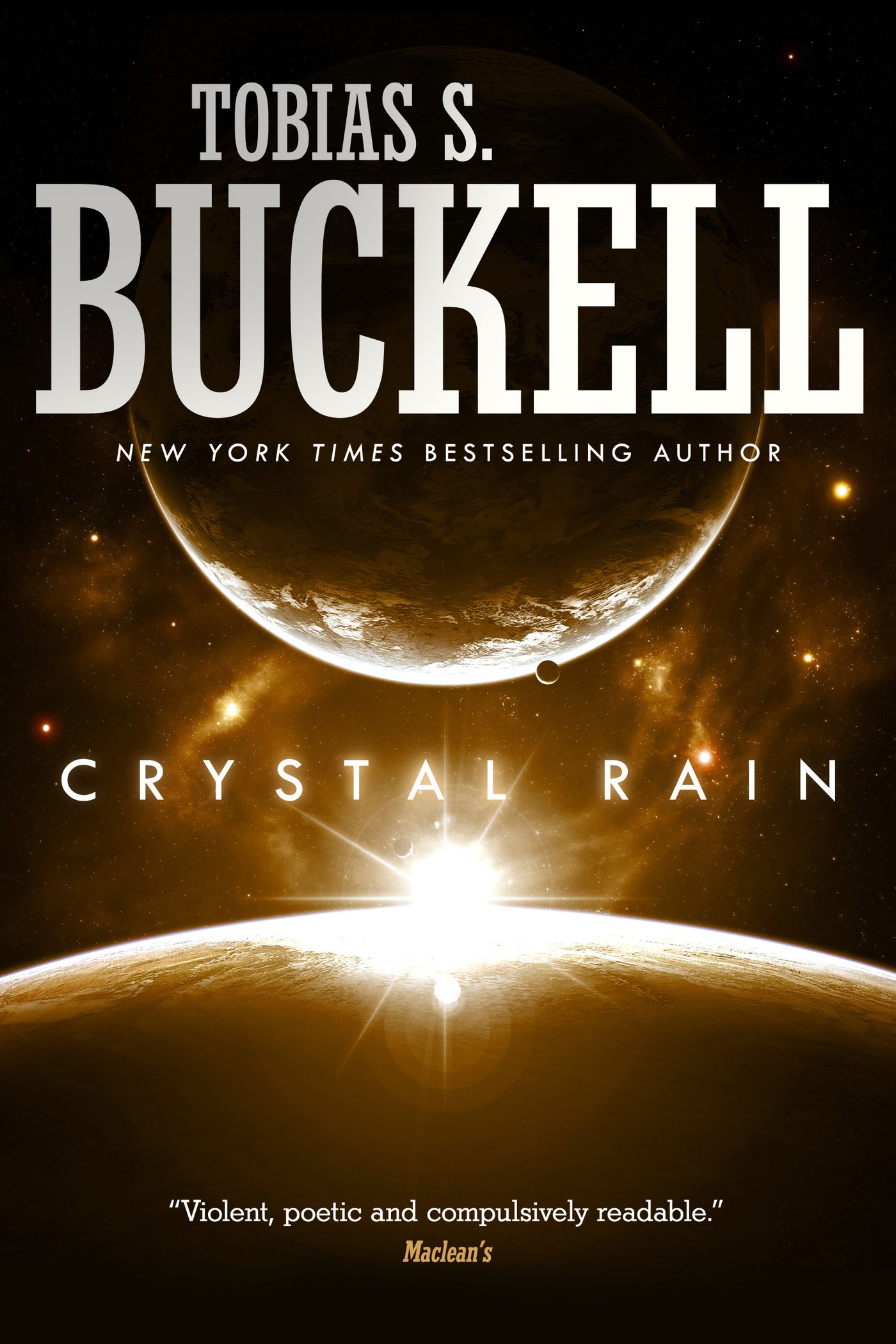
From the Archives: Crystal Rain by Tobias Buckell

I first read Tobias Buckell's Crystal Rain when it initially published in 2006 and I thoroughly enjoyed the novel. In fact, I recall receiving the book.  It was a very snow filled day and I was out shoveling my driveway, a very long driveway at that (well over 100 feet long) and at the time I didn't have a snow-thrower. Thankfully, now I do.  I *think* the book came via UPS, whomever delivered it delivered it right to me since I was outside. I remember feeling as if the book's arrival was a reward for the long hours of snow shoveling.

Back to the book...Prior to reading Crystal Rain, I'd read some of his short stories and liked those as well.  Since Tor is relaunching the series, I thought I'd repost my SFFWorld review from January 2006 here on my blog to give the book the extra attention it rightly deserves. Crystal Rain (and the subsequent books, Ragamuffin and Sly Mongoose) are getting new covers to give them more of a Space Opera feel. I like them a lot though I admit to having a soft spot for the original art by Todd Lockwood (down in the middle of the review). This was an excellent debut and I enjoyed the subsequent books in the series a great deal. So here's what I thought of Crystal Rain back in late 2005 and posted the review on 01/01/2006...


Here it is Tobias Buckell’s Crystal Rain comes with a fair amount of buzz, not the least of which are the quotes from notable writers such as Nalo Hopkinson, Mike Resnick, and Robert J. Sawyer. In addition, Buckell has been crafting short stories for a few years now, with appearances in various anthologies and the pre-eminent genre magazines. What I’ve read of his short fiction, I’ve enjoyed, so I was looking forward to seeing how he could flex his creative muscles in the longer form of the novel. If Crystal Rain is any indication, I’ll be reading more novels by Tobias.

For a first novel, any novel really, Buckell hits a lot of the right notes in this one. The protagonist, John deBrun, has lived for many years; however, he can only remember the last 27 years. He knows he appeared on the shores of Nanagada one day, but everything prior to that is a blur. In the intervening years between washing up without his memory and the start of Crystal Rain, he has married and has brought up a child. We follow John as struggles with this mystery, while, at the same time, he attempts to make his way towards a device his adoptive people think will help stave off the threat of the attacking Azteca. John is pretty complex, but he is only one of a number of memorable characters in the book. The character of Pepper, a man of John’s past who remembers John sets an ominous tone whenever his presence is “on screen,” and whose motivations are almost as much of a mystery as John’s memories.

There are elements of both Fantasy and Science Fiction in this one, with wormhole technology as the method of travel the people employed to reach (and become stranded) on Nanagada. One of the fantasy element flavoring the whole novel is the idea of humans living alongside gods. What I liked was how Buckell brought these elements, as well as a number of elements together in a pepperpot of a delectable, enjoyable story. Other tasty elements in this stew is the almost Dying Earth feel in the way that technology is treated and was phased out, as well as the sense of humanity’s readjustment to civilized society. John’s internal identity struggles parallel those of the external struggles of John’s people staving off the Azteca invasion, which I also thought worked very well.

Original Cover Art by Todd Lockwood


The world comes vividly alive through the action of the plot, as well as the eyes of the character. The alien Earth-like planet seems a veritable jungle of conflict, with gods living amongst men, warring tribes and villages comprising the majority of human habitation. The invading Azteca, a tribe of men resembling Aztecs of our world, provides perhaps a hint of a deeper connection to our world. Floating in the sky are vessels, which seem a combination of blimp and boat. This, coupled with the sea vessel passages, gives the feel of what Robin Hobb did with her Liveship Traders saga, which is a good thing. The exoticness of the locales in both books are similar, if not in specifics, then in the contrast to much of the other science fiction and fantasy on the shelves.

Crystal Rain stands apart from the run-of-the mill fantasy and science fiction, while also providing that sense of wonder SF all too often neglects. Buckell is a deft, assured storyteller who will, hopefully, continue to publish novel-length fiction with the same eye for intricate setting and rounded characterization he’s exhibited here in his debut novel.

Review originally appeared at SFFWorld on January 1, 2006

Friday, November 08, 2013

SFFWorld Round-up: Bach, Dalglish, Robertson, Paolini, and Wexler

Another round up of what's been posted to SFFWorld in today's blog post....

Last week, I posted my review of a contender for my favorite Science Fiction novel of the year, Fortune's Pawn, the first Paradox novel by Rachel Bach:


Devi meets and interacts with the motley crew of the Glorious Fool, – Captain Caldswell, who runs the ship with near military precision; Rupert who is “just a cook” (not); the bird like aeon pilot Basil who literally navigates from a nest; the tall lizard-like xith’cal doctor Hyrek (right, a doctor from a race which enjoys the taste of human flesh); the captain’s daughter Ren who is protected by Rupert; Cotter, the other security mercenary who joined the ship with Devi; and Mabel, the ship’s engineer who has the longest relationship with Captain Brian Caldswell; and Nova, who oversees the ships diagnostics. . Amidst this backdrop, the Glorious Fool is a trading vessel, not unlike the Serenity of Joss Whedon’s Firefly. Of course, we’d have very little story if the vessel were a simple trader. The character with whom Devi has the closest relationship as the novel progresses is Rupert; he is the love interest. He is the unconquerable man who doesn’t give into Devi’s charms immediately; Rupert is initially something of a stonewall. If anything, he may be a little too perfect. The romance between the two takes up a significant portion o

f the narrative energy.
...
I was a fan of the Eli Monpress novels written under the author’s real name Rachel Aaron, so when I learned she was shifting to space-based science fiction (so far, these books seem an equal mix military science fiction, space opera, and adventure SF), I was excited. That excitement was fulfilled. In the Eli Monpress novels, Aaron played with some genre conventions, but here writing as Bach she does much more upending of the genre tropes. For starters, the protagonist is a woman where a majority of protagonists in military SF have been male. That said, Devi is as aggressive on every level of her character as any male protagonist who preceded her in the genre. She goes after the men she wants, goes after the targets at which she aims, and tackles just about every obstacle in her way. She names her weapons and her power armor. Point being, she’s larger than life and in your face and I felt as if I got along well with her voice.

Mark had a look at self-published sensation turned newest Orbit fantasy author, David Dalglish and his fantasy novel, A Dance of Cloaks:


As a debut book in the series, A Dance of Cloaks is a ting-out-the-stall’ kind of book, where the reader is introduced to characters and places that it is clear will all be developed later, and undoubtedly with paths that will cross at some point. There are quite a few different characters to follow here, some major, others minor, but who may become more important later. Of the families, much of the plot deals with the life-changing events around two main characters. In the Trifect group, Alyssa Gemcroft, is the main heroine, the heir to the Gemcroft family fortune, used as a political device by her father Maynard, available for marriage to the right suitor. As you might expect, she rejects this.

...
Whilst the characters are nothing really new, and the plot admittedly rather generic, this is a book that revels in, and can be enjoyed for, its familiarity. With such a book, a reader does not need to spend time wrestling with deep concepts or revelatory stylistic touches. Readers can be assured that what they expect is what they get, to enjoy the plot developments as they happen, feel engaged with a story that uses straightforward language and enjoy a tale that basically is done well. Its purpose is to entertain.

Most recently, I reviewed Freya Robertson's debut novel, Heartwood. Robertson also recently provided SFFWorld with a guest post. Here's the cover, link, and review snapshot:


Robertson introduces many of the players at this gathering including the Holy Knights of the Heartwood, elite defenders of the Arbor as well as the many nations gathering to meet for a potential halt to hostilities. The protagonist, at least for the first third of the novel, seems to be Chonrad, a man who tried but was unsuccessful at becoming a Holy Knight and is sent to represent his nation at the Congressus. The Knights are led by Procella, a woman with whom Chonrad feels a great connection. Other knights include Beata, another female knight and Dean at Heartwood; twins Gravis and Gavius. Additionally, members of other nations, such as Fionnghuala of the Hanairean and Grimbeard, of the Wulfian where war rules all and men just take women are introduced.

...
What started as a novel with great potential conflict and interesting, if familiar, world and story fell under the weight of info-dumps and backstory. I liked the characters, I liked the world, but after the ample world-building in the first third of the novel, I felt ready for the story, particularly since it seemed to be pointed in the direction of multiple quests, to move at a more brisk pace. With each of the quests the characters were split up to undertake, we learned more about the characters. Too many weighty details are revealed about the characters by the characters themselves as inner monologue to allow for narrative the move along at a good pace.

We've also got some new interviews, including:


Wednesday, June 12, 2013

SFFWorld Review Round up - Stephen King, T.C. McCarthy, and Seth Patrick

We've got some new reviews over at the SFFWorld Blog!  Two from Mark, one from me. I'll do this alphabetically by author last name, which leads us to Mark's review of Joyland by the great Stephen King:


By using evocative language and vivid imagery on the cover (shocked red-headed girl in a green outfit), Stephen’s made sure that readers are aware that it’s a pastiche. It’s meant to have the tone and physical properties of a cheap pulp novel from the 1950’s, although as it’s from Stephen, the style and intelligence of the plot elevate it a little from those potboilers of yesteryear.

With such elements in mind, the plot’s pretty simple. It’s a coming of age tale, a story of a young man (Devin Jones), with a broken heart, who takes on a summer vacation job in Heaven’s Bay at a rather seedy and run-down amusement park called Joyland. There’s an old tale of murder (for what old Amusement Park doesn’t have a tale of murder in its shadows?), and Devin has to deal with some hard and deep life-truths along the way. There’s also a touch of psychic prediction - “There’s a shadow over you”, the fortune teller Madame Fortuna tells Devin – which is reminiscent of other King tales, although much of the beginning of the book is Devin working through the summer, learning the carny ‘Talk’, nursing his destroyed ego and making new friends before deciding that he likes the carny life. He decides to stop on instead of going to college, which means that he stays at Joyland after the main summer season, as the park begins to wind down to season closure and refurbishment.


Yesterday, I reviewed Chimera, the concluding installment of T.C. McCarthy's superb Military Science Fiction series, The Subterrene War:


Bleak, dirty, confined, stressful, uncomfortable… these words only begin to hint at the type of story McCarthy tells in Chimera, the concluding volume of the trilogy. Keeping these rather unpleasant themes together was the compelling power of McCarthy’s narrative. In Chimera, Stan is our first person narrator and the angst he feels throughout the novel is palpable. He resents his wife, he initially blames himself for his old partner’s death, and he hates the germline soldiers (genetically engineered super soldiers) most of all. Stan immediately dislikes his new partner whom who Stan gives a racially derogatory nickname/callsign of Chong. About the only characters with which he gets along are his wife’s son (who is the result of an affair with a nameless man from the factory where the genetically engineered soldiers are created) and the artificial intelligence housed in his body armor, Kristen.

When ‘out’ of the theater of war, at home, or in civilian life, Stan, like all citizens, is constantly monitored. He is unable to have any private discussion with his estranged wife and only when he is in the deepest, least civilized sections of the jungles does Stan come close to feeling unsurveilled. This ratchets up the paranoia level and the theme of no privacy is something the great Philip K. Dick returned to often in his fiction.

Over the weekend, Mark posted his review of Seth Patrick's debut, Reviver, one of the best debuts he's read in a while:

Wow. I wasn’t expecting this one to be that good. But it draws you in from the rather visceral and very chilling first chapter. Reading like a TV series script (and admittedly, it would make a great TV series), the reader is soon getting to know Jonah, his soon-to-be-retiring boss, Sam Deering, Jonah’s reviver colleagues and his friends as he tries to uncover the big conspiracy. They develop into characters the reader is interested in and then concerned about, using the idea of ‘What-if?’ and applying it to the logical consequences within a contemporary time-frame. It’s fast, surprisingly accessible and easy to read, and was a difficult-to-put-down novel in the first thirty pages. Whilst the ideas aren’t that new, the way they’re written is engaging and exciting. Most of all, the majority of the decisions the characters make and the actions they take are sensible and logical, although it does go a little ‘action-hero’ at the end.

This one really worked for me. The set-up’s great, the characters are likeable and easily differentiated. Though we do drag in the odd cliché along the way, there’s enough new revelation as well to make the story work.

Tuesday, April 09, 2013

Campbell and Crompton Reviewed at SFFWorld

Two weeks in a row for new reviews? Say it ain’t so! Seriously, I catch up with a late 2012 SF release and Mark reviews a book that provides a somewhat depressing snapshot of the UK’s most important and renowned comic artists.


I’ve been enjoying Jack Campbell’s Military SF/Space Opera hybrid novels set in The Lost Fleet universe for a couple of years now. He turns the tables a bit with The Lost Stars the series which kicks off with  Tarnished Knight  and takes a look at the "other side" of the war depicted in The Lost Fleet.


The narrative focuses on two individuals who form an uneasy alliance at the outset of the novel. Reeling from the defeat at the hands of the Alliance and “Black Jack” Geary, Artur Drakon and Gwen Iceni, once CEOs in the Syndicate hierarchy, must find a way to trust each other and rebuild their broken government. In addition to trying to recover from such a serious blow to their worldview and egos, Iceni and Drakon must quell any uprisings on Syndicate ruled worlds, while deflecting their Internal Services group – arguably the most powerful governmental organization in the Syndicate – as they rebuild their government.


The Tarnished Knight is a fine enough starting place for readers unfamiliar with Campbell’s Lost Fleet novels, for it can easily be read as a story about the issues surrounding post-war rebuilding on the side of the defeated. Campbell alludes to enough of what he’s created in this milieu not to exclude the newer readers. On the negative side, Iceni and Drakon, continually repeat how they must “do things differently than in the past, the Syndicate failed” both in their internal dialogue and to each other and other characters to the point where I was saying to myself “OK, I get it, we all get it.”

Alastair Crompton’s Frank Hampson: Tomorrow Revisited is a retrospective of the popular comic artist. Here’s part of what Mark had to say:


Though not a name many know well these days, his work in the 1950’s until the 1970’s, in particular in the UK, was instantly recognisable and iconic. Although Frank drew Westerns, adventure stories and even Biblical tales, it is his drawings of Dan Dare for the Eagle comic that set a phenomenally high standard, influencing contemporary artists such as Dave Gibbons, Graham Bleathman and Chris Foss. The first edition of the Eagle comic, published on the 14th April 1950, sold a previously unheard of number of copies – widely recognised to be about 900 000 – when comics in the UK typically sold less than 100 000 in a very good week* – and Hampson’s front page spread of Dan Dare, in colour, was seen to be a key factor in the comic’s continued success for the next twenty years. At its peak the Eagle has been estimated to have sold around one million copies a week.


In his engagingly honest Introduction Alastair explains his take on the issue and tries to keep things as even-handed and as accurate as possible through presenting many interviews and transcripts from details at the time. With rare photos and interviews throughout, the book shows what an innovative and inspirational place the offices of the Eagle must have been in the 1950’s and 60’s, although ultimately relentless and unforgiving.

Tuesday, December 04, 2012

The Red Knight by Miles Cameron and Embedded by Dan Abnett

Mark takes a look at a hot new Epic/High Fantasy from an established non-genre author trying something new under a slightly changed name and I pull a review from the (not so old) archives. Let’s take a look, shall we?


A book that’s been generating a fair amount of buzz on both sides of the Atlantic is the subject of Mark’s review. While The Red Knight; the first installment of Miles Cameron’s The Traitor’s Son Cycle publishes in the US in early 2013, Mark reviewed the UK edition (logically since he lives there) which published this past October (2012):


In essence we have a siege tale that starts simply but becomes increasingly more epic, both in scale and complexity. The book begins with The Red Knight setting out with his company of men and women to help people in need. A convent has been attacked and the people inside killed by something monstrous.


In terms of characters there is an impressive range, from the King and his knights to the lower class mercenaries, and from those in court to those living in the Wild. Fantasy readers usually enjoy such a complicated setup, as such a technique does give that impression of a broad canvas. However, some may find the stylistic conceit used here of moving from one character’s perspective to another, often after a mere paragraph, can be a challenge. I must admit that initially with each change it did take me a while sometimes to remember who each character was, what they were doing, and where a character had got to and why. It was a little annoying to find that sometimes once I had then remembered all of this, I was whisked off to another character to start the process again, although given time the characters become recognizable.


I pull a review from the archives today since I don’t yet have a review for the book I’m currently reading (The Coldest War by Ian Tregillis). Last year I read Dan Abnett’s original SF debut and the short review I wrote disappeared from its original place on teh intarwebs so rather than let it be relegated to The Nothing, I beefed up a bit for SFFWorld. Here's the standard linkage, cover, and review preview for Embedded:


In this milieu, the United Status (US) has settled worlds far beyond Earth, and it is on one of these planets in which the action in Embedded takes place. The planet designated Settlement 86, where conflict has existed between the US and the Central Bloc (Russian powers) for 300 years is where protagonist Les Falk has his consciousness literally embedded in the body of Nestor Bloom, a soldier on the front lines of the conflict. When Bloom’s body is shot, then Falk personality becomes the dominant mind in the body. This gives the first person narration familiar to many military SF novels a new twist and one that works very well over the course of the rather than just a change to the norm for change’s sake.

Abnett’s greatest skills in this novel are two fold –his ability to keep the tension high through minimal details. Not that the novel isn’t layered and detailed, but Abnett manages to hold enough information from the reader to keep the curiosity level very high, which translates into rapid page turns. The other skill that is readily apparent was his pacing, although the mystery/tension did help to build great pace.

Tuesday, November 13, 2012

Red Country & Unholy Night at SFFWorld

As is often the case, Mark and I will both receive copies of some of the larger titles and such is the case with the book for which I’ve posted today’s review. Meanwhile, Mark looks at another genre mash-up from one of the first purveyors of the mash-up.

Few authors not with the initials GRRM are as popular in the SFFWorld Forums as Joe Abercrombie. Mark reviewed it a couple of weeks ago and now it’s my turn to catch up with Joe’s Red Country:


A man’s past can’t always stay in the past, it affects his decisions and how he lives his life. Sometimes, that past comes knocking and despite how a man may hide from that past, it may or may not go away. When that past helps the man reach an important goal – such as saving his adopted children from kidnappers – then that past is even more difficult to keep buried. The past…just one of the themes that proves very informative for Joe Abercrombie’s sixth novel, Red Country.


Many have likened the feel and plot to a western novel, and indeed, it is easy to see why. The sparse land, the grey-and-black morality of the characters and the revenge theme all share much in common with some of the classic Western films like The Unforgiven and True Grit. That having been written, the story/film that continued to resonate with the most me as I addictively kept turning the pages was A History of Violence, coincidentally enough, two stars of that film (Viggo Mortsensen and Ed Harris) were in a recent western film Appaloosa.

Familiar themes are powerful, but for me what’s often worked best with Joe’s novels is the dialogue. Each character has a distinct voice, even without the qualifying …Lamb said or Shy asked, it would be pretty easy to determine which character is speaking. It is this quality that separates, among others qualities, Joe from his peers in the genre.

Seth Graham-Smith mashes up “history” with fantasy in Unholy Night and Mark liked the results.


As we approach Christmas 2012 (It’s really not that far away!), the ever-so-busy author turns his trademark mash-up style to the Nativity. The book tells of the ‘real’ story of the three Kings of the Magi. Led by Balthazar, it seems that, at least according to Seth, these enigmatic heralds of the birth of Jesus are not quite the wise old men scriptures would have us believe.

At first the idea of a Fantasy based Nativity story sounds quite preposterous. Yet, if you take away most of the religious connotations, it does make quite an exciting adventure tale. The discovery of the manger is not because the Three Kings followed a star (although there is one of great luminosity over Bethlehem in this tale, heralding the Messiah), but rather because they accidentally came across it whilst attempting a jailbreak. The ‘wise men’ the Bible would have us believe in are, in fact, petty thieves who spend most of their time trying to get out of trouble, rather than the benefactors of gifts to the Messiah.


Tuesday, November 06, 2012

Martin's Fevre Dream and van Thal's Second Pan Book of Horror

It’s a week after Hallowe’en but Mark and I have two reviews that keep the dark mood going.

George R.R. Martin needs no introduction, though some of his early work may. Thanks to the success of A Song of Ice and Fire his back list is being reissued, including the CLASSIC Vampire novel, Fevre Dream, here’s part of what I thought:


Abner Marsh is a man down on his luck; while considered a good steamboat captain, his most recent ship was destroyed in icy water. Joshua York, enigmatic man to say the least, sees something in Marsh that he thinks will be a key to his mysterious goals. The two men met and despite Marsh’s warnings to the contrary, enter a business arrangement to build and operate the greatest steamship to chart the waters of the Mississippi River – the Fevre Dream. The novel is set against the back-drop of the American South shortly before the Civil War, Martin’s novel features a great mix of characters many of whom are black men, both free and slaves.


In a parallel narrative, Martin introduces Damon Julian, also a vampire and whose actions more closely reflect to the evil vampire that has come to be the accepted model of the blood sucker. Julian lives a decadent life in the dark, the plantation which he took over is fraying at the edges and Julian’s reputation in the slave community and the region in general is becoming unsavory. What’s even more unsavory is Sour Billy, the human who keeps Julian’s world in order during the day. Few characters I’ve encountered are as slimy and disgusting as Sour Billy Tipton, in other words, he’d probably be pals with some of Martin’s more lurid characters from A Song of Ice and Fire like Roose Bolton and there’s a part of Sour Billy that reminded me of Ike Clanton as portrayed by Stephen Lang in the film Tombstone.

Mark continues his look back at some classics of genre in Herbert van Thal’sThe Second Pan Book of Horror Stories:


At the time of writing this we approach Halloween (again) and my thoughts turn to Horror stories for this time of year. Two years ago I reviewed the re-release of the first of these collections. This year I had to raid the vaults of Hobbit Towers for this 52-year-old classic.

There are fifteen stories in the collection, ranging from the classic (from Edgar Allen Poe, HG Wells and Bram Stoker, for example) to the rather unknown these days (Guy Preston, Oscar Cook, Stanley Ellin). There’s also the odd surprise: Agatha Christie and Carl Stephenson.


In summary, there are more hits than misses here. Personal favourites would be The Fly, The Black Cat, and The Judge’s House, all of which are recognised as classics. Almost as good, and much more unknown was By One, By Two and By Three and The Specialty of the House.


Tuesday, October 02, 2012

Nightglass and The Soddit at SFFWorld

I dip my toes into a newish fantasy world with a tie-in novel and Mark gets some laughs….


The Pathfinder universe is fairly new in the RPG world, at least compared to Warhammer and Dungeons and Dragons. Like those two; however, the folks at Paizo have started publishing original fiction set in the Pathfinder univers, which leads me to Liane Merciel’s mixed bag of a novel Nightglass:


Nightglass tells the story of a wizard coming of age; though in atypical fashion, the young wizard Isiem isn’t exactly a member of House Gryffindor at Hogwarts and the magic of the Midnight Lord might even make Slytherin whimper. At that core, Merciel explores preconceived notions of good and evil and tries to illuminate a character on the dark side of the divide. His initiation into the dark magic of the Midnight Lord of Nidal comprises the first half of the novel. During these ‘training’ sessions Isiem proves to be very adept at learning and there isn’t much of a concern of whether or not he’ll pass his trials, just the stress inherit in being young and experiencing peer pressure. The second half entails his journey out into the world as an emissary investigating the attacks of the strix – winged humanoids – on a mining village. Here also the ‘accepted’ notion of the nature of these creatures comes into scrutiny through Isiem’s experience. Where the emotional tension was stronger in the first half, the sense of frustrating and physical confinement were stronger in the second half of the novel.

Fantasy parodies have been around since well…Bored of the Rings and an author whose been penning quite a few in recent years is Adam Roberts (A.R.R. Roberts). Most recently, his parody of The Hobbit was re-released and SFFWorld’s own Hobbit Mark reviewed it The Soddit:


The Soddit tells the tale of Bingo ‘Sac’ Grabbins, the titular soddit. Happy with his life in Hobbld-Ahoy! at Grab End, he is sitting on his comfortable sofa when he is disturbed by the arrival of a wizard, Gandef, the ancient magician who is hard-of-hearing.

150 000 book buyers can’t be wrong. Surely? Well, as if you didn’t work it out from the above, it is very silly, and like all ‘humorous’ books of this nature, some will find it hilarious whilst others will be distinctly unmoved, nay, disdainful of its efforts to entertain. Professor Roberts (no, really!) at Royal Holloway, London University never misses a chance to set up and run with a gag here, and, as you might expect, if one doesn’t quite work for you there’s another along a few sentences later to try again. There is actually some semblance of an intelligent mind at work behind all this tomfoolery, though some may be hard-pressed to see it. These books usually work best with a degree of rational thought behind them, and as a Tolkien Scholar Prof. Roberts has an understanding of the mythology.


Tuesday, June 05, 2012

Redshirts and Destiny Quest Reviewed at SFFWorld

I’ve got a review or two to mention today, as usual, one review is written by yours truly whilst Mark is the author of the other review.

Here…we….go….

John Scalzi’ is one of the most popular SF writers today, thanks in no small part to his great blog and of course his entertaining novels. Possibly his most anticipated is Redshirts which publishes today:


In Redshirts, Scalzi plays on one of the older tropes in science fiction, at least that of the expendable characters. The old trope that was codified by Star Trek (the original series) wherein Spock, Kirk, McCoy and a guy wearing a Federation issued Red shirt would land on the planet only for three of the four members of the away party to make it back to the U.S.S. Enterprise. This is par for the course since the Red shirted member of the away team is played by an unknown actor. Except when those characters are real people (or as real as fiction characters from a novel who are fictional characters on a TV Show can be) become ‘aware’ and realize the lesser crew members assigned to away parties are always dying. When Dahl and his companions encounter a man or ‘yeti’ as they call him, named Jenkins (think the mysterious Laszlo from the 1980s comedy gem Real Genius), they learn of the power of Narrative, and specifically the Narrative of a show called The Chronicles of the Intrepid. So yes, Scalzi is going for the whole meta-fiction thing here and for the most part, I felt it worked. No doubt Scalzi’s work on Stargate Universe aka SG:U (criminally cancelled far too early by the network once known as the SciFi Channel), informed a good deal of the inner workings of how a space-based science fiction television show works. The comparisons between SG:U and The Chronicles of the Intrepid end there because – even as Dahl and his fellow Redshirts note - The Chronicles of the Intrepid is written terribly and SG:U was terrific.

Mark takes a look at an interesting mix between game and novel, the first Destiny Quest installment by Michael J. Ward, The Legion of Shadow:


Here’s an unexpected surprise: a game book that’s both retro and forward looking.

From the start though, you pretty much know what you’re going to get: the cover shows a hooded, cloaked man, eyes aglow, stares at you with a horde of equally evil-looking warriors behind him. Around his left hand, a purple orb of glowing electricity, and in his right hand, an enormous staff, seething with arcane power.


For someone used to the Steve Jackson and Ian Livingstone Fighting Fantasy game books from the 1980’s, or Dungeon and Dragons role-playing, you’ve pretty much got the idea of what goes on here. You start as an outcast with no memory of your background or history. This allows you to develop new characteristics as you develop, becoming one of the archetypes mentioned earlier such as a rogue, a mage and a warrior, and realising your destiny. There are quests and sub-quests, demons and monsters, good guys and bad. Ultimately your aim is to defeat the bad guy and his various allies, determined to do you and the world harm. Along the way, the choices you make (or are determined by the throw of a die) affect where you go and what you do.


Tuesday, May 22, 2012

Blackout (Newsflesh #3) by Mira Grant - Review

Only one review to link to here at the o’ Stuff but the book is one I placed very highly on my 2012 list of anticipated releases. Chances are, if you follow me on twitter (@RobHBedford) and if you don’t you should be, you’ve seen me tweeting about it - Blackout, the conclusion to Mira Grant’s Newsflesh Trilolgy:


So, structurally we’ve got our map laid out, the path Grant takes continues to be filled with conspiracy and subterfuge with a little less on the political game inasmuch as the politicians themselves don’t take to the page until the latter portions of the novel. This isn’t to say the game of politics isn’t present, because it very much is and drives the plot of the novel. Much of the politics involves the power play of control between the CDC (Centers for Disease Control) and the EIS (Epidemic Intelligence Service), specifically the information about the Kellis-Amberle virus and the potential for a cure.


So, how does Blackout hold up to the promises laid out in its predecessor volumes? From my reading perspective very well, Grant brings more Applied Phlebotinum to the table in the form of the clones and how Shaun’s immunity came to be. If Grant were a lesser writer, these elements could derail the novel, but thankfully, she’s quite brilliant at explaining these things in a plausible fashion which is balanced by the overall powerfully addictive narrative.


Tuesday, May 01, 2012

Cashore and Lovegrove Reviews at SFFWorld

The theme of this week’s reviews is catch-up and your reviewers are Mark and me.


Mark catches up with the second book in a series just as book three is set to publish. The author of these books is Kristin Cashore and the book is Fire:


Like Graceling before it, Fire is the tale of a young girl, the titular Fire, who is a Graceling: that is, someone who has been born with a special power that enhances the typical capability of a normal human being. Fire’s skill (shown by her rainbow-coloured hair) is the ability to manipulate other people’s thoughts and persuade them to do their bidding. (In another galaxy, some would call it a Jedi-mind-trick.) Living in the Dells, she is initially quite reticent to use such skills, especially against her friends and those who protect her. It also doesn’t help that, as a consequence of her Grace, others are desperate to give her their attention. She has a relationship with her life-long friend Archer, who is fiercely protective of her.


What impressed me more this time was that although we have clear heroes and villains in Fire, the outcomes are less predictable here. We see a much bigger view of the world first seen in
Graceling, and the importance of ‘monsters’, as mutant creatures who love a bit of human flesh is developed nicely. Whereas Graceling mentioned these monsters on the other side of the world it was mainly focused on the effect of the Grace on Katsa and those affected by her, here we see a wider picture of their world as Fire deals with a harsher environment and the political and social machinations that such a society has. There’s also a lot more sexual content here, though not explicit.


A little behind on my book reviews so I dug out one from the archives which was previously posted elsewhere teh intarwebs but is no longer anywhere. With James Lovegrove recently publishing The Age of Aztec, the fourth in his Pantheon sequence, (and me not having read it yet), I figured a good candidate for expanding is my review of book three in the series, The Age of Odin:

The Norse gods are real, and they are preparing for Ragnarok in the 21st Century by enlisting ex-soldiers into their army through the Valhalla project. … The Age of Odin, by British author James Lovegrove, takes this idea and runs with it full tilt. When Gideon “Gid” Dixon, a retired soldier who realizes the only thing in his life which gave him happiness and success was fighting, is enticed by the aforementioned Valhalla project, he cannot pass up the opportunity to join. Gid has a hard time believing the big man in charge of the Valhalla project is actually the Allfather of Norse Myth, Odin. Odin is preparing for the fated final battle, and as Gid joins Odin’s forces, he brawls with and fights alongside Thor, becomes enamored with Freya, is healed by Odin’s wife Frigga and learns of the treacherous deeds of Loki.


The villain of the piece is, of course, Loki. This should be no surprise as Loki, the trickster and half-brother of Thor, is often cast as the villain in Norse-infused stories, especially those published by Marvel Comics. I also really liked Lovegrove’s characterization of Odin, who at times was quite distant from the action.


Tuesday, April 24, 2012

Fuzzy Nation and a Blood Red Baron

Back to a normal Tuesday here at the ‘o Stuff with a review by me and a review by Mark. For whatever reason I missed out on John Scalzi’s’s Fuzzy Nation when it published about a year ago. Shame on me, I know, but I’ve remedied that recently much to my reading joy:


In initial essence, Fuzzy Nation is a first contact story. Jack Holloway is former lawyer turned prospector for ZaraCorp on the planet Zarathustra where he’s searching out precious ore. His one companion, at the beginning of the novel, is his dog Carl when he finds a deposit of the sunstones, the most valuable mineral in the universe that will make him an ultra-billionaire. One of the rules a company like ZaraCorp must abide by is that any work they do on a new planet must not impact any intelligent life native to the planet. Upon his return from this amazing find of sunstones, Jack finds a small, fuzzy creature in his home. Fortunately, Jack once dated the planetary biologist Isabel Wangai whom he asks to ‘meet’ the Fuzzy, which soon turns into a small family of Fuzzys whose visits become more frequent.


I’ve been a fan of Scalzi’s writing since reading Old Man’s War a few years back and visiting his blog every day. His smart, snarky, and engaging style that I (and many, many readers) have come to enjoy is on full display here in Fuzzy Nation. The pacing is extremely brisk, making the 300 pages quite readably and consumable. I’ll admit to wishing there was more to the novel because reading Scalzi is lots of fun. He intersperses humor and thought-provoking ideas seamlessly, from the depiction of how the Fuzzys interact with Holloway’s dog Carl to the ethical pontifications and ramifications of alien life in a place where humans have begun to feel a sense of comfort.
Mark has been on a bit of a Kim Newman kick lately. The trend continues with the re-issue of Bloody Red Baron, the sequel to his landmark novel Anno Dracula:


In this second tale, the set up of Anno Dracula becomes international. We spend most of our time here not in England but in France, following the actions of heroic pilots, both vampire and human, as they struggle to cope with the stresses and slaughter of such desperate battles. When not flying, the pilots would live life almost as dangerously on the ground trying to make their sacrifices worth it. 
Kim here steps it up a notch. The story is as detailed and yet at the same time as much fun as ever. Anyone who has thrilled to stories of WW1 aerial combat and the heroic actions of aviators on both sides will love this, as such events are described in brilliant action sequences. We have dogfights, Zeppelin raids and trench battles which tell in thrilling detail how deadly such fighting must have been. Elsewhere, on the ground, the effect of the War on the French civilians and their towns and cities are told but with the added effect of the war being fought with some un-human elements.

Wednesday, April 18, 2012

Girl Genius, Mike Shevdon, and the Company of the Dead

A new batch of reviews posted to SFFWorld over the past week, two from Mark and one from Nila...

Phil and Kaja Foglio’s Girl Genius comics have been the darling of the Internet for quite a few years. Tor recently bound up the first three issues into book form and Mark had a look Girl Genius Omnibus, Volume One: Agatha Awakens:


There are three issues in this omnibus edition. Issue One introduces us to the main characters and shows us the world Agatha lives in. When Agatha is mugged and has a brooch (that she must not lose) stolen, she comes to the attention of Baron Wulfenbach, and also gains the attentions of the Baron’s son, Gilgamesh (Gil). When banned from the University, Agatha ends up at the Airship City in Issue Two. Issue Three is where Agatha discovers her secret past and true identity.

The story here is great fun, and clearly plays on the traditional steampunk tropes with a great deal of humour and panache. There’s lots of big machines and strange laboratories, with masses of arcane power at work. The characters are imaginative and memorable, from the evil villain to the many mad scientists to Krosp, the bio-constructed talking cat. The drawing is fluid and detailed, and adeptly combines black and white drawings and shades of copper in its initial pages with vivid, vibrant colour, when Agatha is in the Airship City (in Issues Two and Three.)


The charm of Mike Shevdon’s The Courts of the Feyre is still high for Nila, she reviewed the third novel in the series, Strangeness and Charm:


… Niall Petersen … finds himself and his family tearing at each other throats. There are also all the other inmates of the special hospital that held the half-fey mongrels set loose on the world and Garvin, the head of the Court’s Warders, has given Niall the responsibility of bringing them all in before they upset the Human-Feyre treaty. If Niall doesn’t or can't do it, Garvin will send the other Warders and they won’t be as nice. As a matter of fact, they’ll probably kill the mongrels rather than deal with bringing them in. But all Niall wants to do is help them. …

This installment of the Courts of the Feyre series is a fine continuation of Niall Petersen’s story. Again, not as fast paced as the first in the series, and not as spectacular as the second (in my opinion), but I very much enjoyed Strangeness and Charm. Mr. Shevdon continues to show his readers fresh insights about his characters and his wonderful imagination manifests in the fey magic mixes with human blood to create interesting fey-mongrels.


Just in time for the 100th anniversary of the Titanic’s sinking, Mark posted his review of The Company of the Dead by David Kowalski:


Like the Titanic itself, in terms of size this novel is a monster: 800+ pages of fairly small print and not for the faint-hearted.

Pleasingly though, it is a satisfyingly complex tale, one involving alternate history and time travel, with a touch of conspiracy theory and even romance. Considering this is a debut novel, it is quite daunting to see an author cover such a wide range of ideas. And yet, impressively, David manages to juggle these disparate elements into a book that entertains without lecturing.

Our tale here begins with events upon the original Titanic being changed, yet the ship still sinking. Flash forward to 2012 and the descendant of one of the original ship’s officers, John Jacob Lightholler is now the Captain of a new version of the Titanic, sailing across the Atlantic for a commemorative centennial service of the original journey. On Lightholler’s arrival to New York, we find him contacted by Joseph Kennedy, one of the descendants of the Kennedy family, who tells him that he has been honourably discharged from the Titanic, put back into British Naval service by King Edward IX of Britain and is being made to work with the Confederate Bureau of Investigation (CBI). At a time of emerging nuclear weapons Japan seems to be declaring war on Germany and the US. To avert global disaster Kennedy and his team must put the world on the time-track it should be. Lightholler finds himself part of that group that are to travel back in time and correct the minor changes to the past that have diverted history from its predetermined route.

Tuesday, March 27, 2012

Paul S. Kemp and Isaac Asimov at SFFWorld

As it is Tuesday, I present to you, my faithful readers, two new SFFWorld reviews. The usual suspects this week: me and a review from Mark.

I’ve been enjoying Paul S. Kemp’s brand of Sword and Sorcery through his Erevis Cale novels (here’s my recent Awesome Omnibus feature) and was very pleased to learn we wrote, The Hammer and the Blade an original (non-shared world) novel and it would be publishing later this year from Angry Robot Books. So, with all that, Paul was kind enough to pass along a super early advance e-copy of the book to me, the the review of which I posted today:


Through an engaging prologue Kemp introduces the readers to Egil and Nix through a quick dungeon adventure whereby the Priest (Egil) and Thief (Nix) rob the tomb of an ancient entity. The prologue would work excellently as a short story but also sets a solid foundation for the story Kemp will tell in The Hammer and The Blade by giving a sense of the relationship between the two protagonists. Egil and Nix planned on using the payout from their treasure to buy their favorite tavern so they could retire and live out their days in relaxation rather than fighting and adventuring.

Revealing too much more would rob the potential reader from enjoying the novel themselves, though I will say the final quarter of the novel was exhilarating, leading to an extremely satisfying conclusion. What I will speak to, in general terms, are the elements that worked, didn’t work, etc. First and foremost, what comes across very strongly is how much fun Kemp seemed to have writing this story. The protagonists are old chums in the greatest sense of the word and their humorous, sarcastic rapport provides for a smooth way to reveal story elements. This sense of camaraderie extends as Egil and Nix become more acquainted with Rakon’s ‘crew’ over the course of their journey since our heroes and Rakon’s men don’t exactly see eye to eye with the sorcerer’s means and goals.


The ‘catching up with the classics’ theme for Mark continues with a classic novel from Isaac Asimov, The Caves of Steel:


A book that tackles issues of race, bigotry and hatred, written before the US race riots of the 1960’s? This still has a narrative drive and the power to shock. Whilst it is a mystery story, what makes it work is the matter of fact placing into a future regulated society where atomic war has led people to live in vast regimented ‘caves of steel’, where food is regulated (and mainly yeast-based), travel is not by car but by walkway, living space is a premium and jobs are increasingly scarce and under threat of being given to a robot at any time.

What was amusing in my teens - Lije's use of 'Jehoshaphat!' as a swear-word - is a little annoying now and the need to end some chapters on a grand reveal ("Your honour, it was the butler that did it!") belies its pulp origins. The singular view of the Bible as the most important religious book in the world may also jar in today’s more secular global network, though perhaps understandable from a 1950’s viewpoint. So too the use and acceptance of tobacco in social circumstances.

Tuesday, February 07, 2012

Alastair Reynolds and Eric Brown at SFFWorld

We’ve got two SF novels for review this week at SFFWorld. I’m catching up with a book from a few years back and Mark reviewed one of the most anticipated SF titles for 2012.

Mark’s review needs no more introduction than this: Alastair Reynolds’s, Blue Remembered Earth:

The story is focused on Geoffrey, initially a young boy living in Africa with his sister Sunday and his grandmother Eunice. As the story develops we discover that the Akinya family are quite well-to-do, and in the rapidly changing global economy are clearly one of the groups to take advantage of Africa’s burgeoning new-found wealth and economic prosperity. At the beginning of the novel they have Asher-like implants to connect them to the AI global network, the Mechanism, with human-like simulacrums by the end. With an absence of war and famine, it soon becomes clear that Humanity’s future lies in expansion to the rest of the Solar System and beyond, something Geoffrey’s family are quick to take advantage of. They have made a considerable sum mining resources from the solar system, though Geoffrey is more interested in studying elephant psychology in Africa.


It is, in essence, a generational space-family-saga of the type quite common in the 1980’s and 90’s, (see, for example, Michael Flynn’s Firestar series) though where the focus then was often US based, this one is stridently African/Asian, reflecting current trends. Though I’m not convinced that the role of Europe and North America in future space exploration would be quite as low key as it is suggested here, it’s an interesting take. And there are reasons suggested in the novel as to why this is – hints of global catastrophes (both physical and technological) which might allow the dominance of those countries as a consequence.


I read and reviewed ith the first of Eric Brown's Bengal Station Trilogy, Necropath, which is his take on the Psychic Detective:


Jeff Vaughn is a telepath working on Bengal Station assisting the police in several investigations. One of these investigations is related the death of Tiger, a young girl whom he befriended. As Vaughn learns more about the cause of her death – overdose of an exotic drug called Rhapsody – a web of connections to an cult emerge and Vaughn’s life becomes increasingly endangered. He begins to suspect his supervisor, Weiss, of having connections to the illicit trade. Vaughn’s pseudo-partner helps Vaughn in his secret investigations all the while trying to urge Vaughn to come out from behind the cold barrier he’s erected around himself. As their investigations progress, Vaughn learns of a cult that worships a star god that, to this reader, had parallels the Great Old One Cthulhu. All the while Vaughn and Chandra are moving along their investigation, Brown parallels their story with that of Tiger’s sister Su (a lady of the night) as Su searches for Tiger.


Brown makes Vaughn’s ability out to be more of a curse than a power he enjoys using. Being able to read minds is not a pleasant thing and it takes a great deal for Vaughn to block out other’s thoughts. Due to events in his past, he is even more reluctant to use his ability, but he often realizes inaction would bring him more guilt than action. The whole idea of the telepathic individual and the background for the development of these individuals was very well-thought out by Brown, telepathy comes across as very plausible.


Tuesday, December 13, 2011

Jackal, Blackdog, and Dragons - New SFFWorld Reviews

Here we are, another Tuesday at the Blog o’ Stuff and that means some new reviews to mention that have recently been posted to SFFWorld.

Chris Wooding has been one of the more discussed writers at SFFWorld lately, and he’s just published The Iron Jackal, the third Tales of the Ketty Jay novel, which Mark liked a lot :


The heist occurs, though it is unexpectedly messier than anticipated. The artefact is taken and foolishly taken out of its transport case by Darian. A two-bladed sword, the object stabs Darian’s hand and gives him a ‘black spot’, something that, it is told, will kill him. As the tale unfolds, things get complicated for Darian and this has consequences for his motley crew.

If I had any complaints this time around, and I am struggling a little, really, it’s that this time around, more so than at any time previous, I’m noticing the joins a little more. The train heist is reminiscent of the Firefly TV episode The Train Job, the roof chase Jason Bourne, the Thief of Baghdad or Hitchcock’s Vertigo. It’s very well done, it’s clearly an homage, yet unlike previous books in the series, in places I’m getting that feeling of ‘been here before’. Though some of the events here are pretty much telegraphed before they happen, it’s like watching the inevitability of a car crash that keeps you reading.

Standalone fantasy novels, not part of any series, are a rare beast in the genre. That is just one element that makes K.V. Johansen’s Blackdog stand out from the crowd. I posted my review of Blackdog today, which I thought was impressive in its mythic resonance:


Where to begin? I suppose the world itself is good enough – Johansen has created a world that resonates with ancient powers and oozes with mythic resonance. I recall one of my college courses – World Mythology – and the text of world myths on the reading list. Johansen’s novel seems as if it could fit right in with those stories, though thankfully for us as readers she’s fleshed out the bones of the myth, added muscle, organs, and more life to the story to make a compelling novel. It should, then, come as no surprise Johansen’s academic background is Medieval Studies. The knowledge and passion, she has for ancient text comes through very well in the narrative energy of the story and world she created.


Johansen’s hook of showing a goddess coming into her maturity is slightly different in that her protagonist is not just an avatar, but the Goddess herself. That fascinating conceit and the requisite storytelling, characters and world-building back up that hook very nicely. Am I stating the stories are similar? No, not exactly, but the vein of myth coming to life and immensely powerful beings striding alongside the common man is similar. Where Johansen’s storytelling, characters and overall ‘feel’ of the novel finds the most similarity, for me, is in Glen Cook’s writing. The raw and almost primitive milieu reminded me a bit of Cook’s Darkwar.


Mark posted his review The Cardinal's Blades, the first in a series that has been called 'The Three Musketeers with dragons’:


The Cardinal’s Blades are the legendary group rumoured to have carried out secret missions on the cardinal’s behalf. Disbanded after some 'nasty business during the siege of La Rochelle’, Richelieu and the Crown have need of them again, as there are signs that the Black Claw, a dragon-led secret society, are up to no good, dealing in secret with France’s enemy, Spain. Led by the beautiful-blonde-looking Vicomtesse de Malicorne, the Black Claw are the Blades’ nemesis in this tale.

The first part of the novel therefore introduces us, in the third person, to the original members of the group, led by Captain LaFargue, as they are summoned to return to Paris. This means that we meet a motley group of superb swordsmen and women, all currently pursuing alternative lifestyles. We’re introduced to the characters that make up the band. These include Nicolas Marciac, who spends his time running up debts and duelling, living off the money he makes in such matters. Red spectacle-wearing Saint Lucq is a half-dragon, half human assassin. Arnaud de Laincourt is a Blade suspected of being a traitor to France. We have to add to this a strong heroine, Baroness Agnes de Vaudreuil. The weak point for me was the unfortunately named LePrat (who manages to get injured!) is a bit of a misstep, though clearly just one of those names that just translates badly internationally...

Tuesday, November 29, 2011

David Weber Reviewed, Edgerton and Berg Interviewed

Two more reviews were posted to SFFWorld this past week, one from me and one from Mark.

David Weber’s Safehold saga continues to impress and entertain me. I realize it isn’t perfect (those damned phonetically spelled names and infodumps), but the conceit/premise of the story is intriguing and the way Weber handles some of the characters keeps me wanting to find out what happens next, so for me the good to great really overwhelms the niggles. So, without further adieu, here’s my review of the fifth (and most recent as of November 2011) installment in the saga, How Firm a Foundation:


One of the undercurrents throughout the series has been the cautious development of technology due in large part because the Gbaba, the enemies who nearly exterminated humanity, are able to detect when any civilization reaches a certain technological level. While this point has informed the background and the “why” of humanity’s current situation, it has just been that – a background item. Well, here in How Firm a Foundation, Merlin discovers something in a distant part of the world that could be seen as a dampener to the evolving technology of the Charisan empire and the future fate of the ‘archangels’ who set the current society on its rather stagnant state of development. What this did, in my mind, was put something of an endgame to the situation. A warning was made that something would happen in approximately 1,000 years which gives Weber a bottom line to meet, a head at where the conflict will arrive. This is a welcome development to a long-running series.


In the end, I’d sum up How Firm a Foundation, and
Safehold in general a few ways. There are stories where you realize they aren’t perfect and you can enjoy the story/novel despite those flaws because the brilliant outshines the dull in a large percentage. Maybe it’s a dense narrative that takes some wading through to get to the golden parts. This book and this series might be described in that way. Weber’s detailed narrative is sometimes overly descriptive and perhaps a bit repetitive. However, the good parts – and they occur enough in the narrative – are superb. The character interactions, the revelation of a previously conceived belief as a complete falsehood, seeing Clynthan rage and start to lose his composure, the emotions that are evident between Merlin and Caleyb and so forth, really help to overshadow some of the denser plot elements.


We’ve also been interviewing quite a few authors lately at SFFWorld, some which slipped through the cracks of my radar in recent weeks.

Carol Berg, who has been relatively popular in our forums as of late, was interviewed recently. Carol's the author of The Rai-Kirah trilogy (Transformation, Revelation, and Restoration), The Bridge of D'Arnath (Son of Avonar, Guardians of the Keep, The Soul Weaver, and Daughter of Ancients), as well as the current Novels of the Collegia Magica (The Spirit Lens, The Soul Mirror, and The Daemon Prism).


Here’s an excerpt of the interview:

4. Most of your protagonists, save for Anne in The Soul Mirror, are male. Are you more comfortable writing male characters than female ones? Did you have to tackle The Soul Mirror differently since the novel dealt with a heroine instead of a hero?

I do enjoy writing male protagonists. Maybe because I have spent a lot of years observing males. Maybe because I love a challenge! I never set out consciously to choose my protagonists. They sort of come to me in the initial inspiration for the story. Certainly I have to approach a female narrator/protagonist differently, in the same way I have to approach the warriors Seyonne and Aleksander differently from the librarian Portier. I like writing strong women who participate in and drive the action of the story, yet I'm not a advocate of chicks in chainmail. And indeed, Anne wasn't my first; there is also Seri, the heart and soul of the four Bridge of D'Arnath books. Another strong, extraordinary woman, though among all the principals of those books, she alone has no power for sorcery.


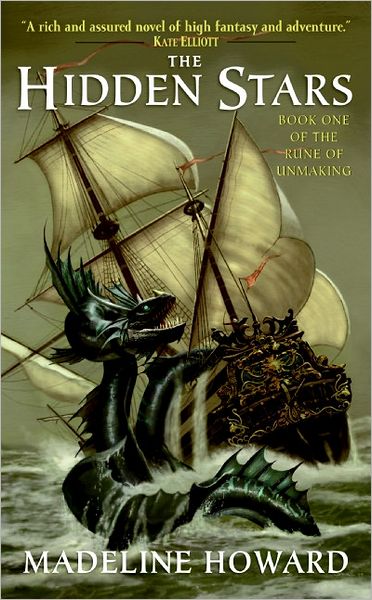
We also posted an interview with Teresa Edgerton (who also writes under the name Madeline Howard). Some of her books include: The Green Lion Trilogy, The second Celydonn trilogy, The Goblin Moon Duology, and under the Madeline Howard pen name The Rune of Unmaking (The Hidden Stars, and A Dark Sacrifice).


Here’s an excerpt of the interview:

SFFWorld: Yes, you use symbolism a lot in both books, and now that I think of the style of writing you are trying to re-create, I can see all the pieces of the puzzle clicking - nice! How much research did you do for these books? Do you invest the same amount of research for all your books?

Edgerton: Well, it depends. With some books I already know the setting pretty well. When I was writing the Green Lion books and the later trilogy, I had already researched alchemy pretty extensively. I was familiar with the medieval period, and only had to read up on a few subjects. With Goblin Moon and it’s sequel, I wanted to do more research, but it was more difficult finding books on that particular period ... or at least, I didn’t know how to find them.

By the time I was writing The Queen’s Necklace (TQN) I did know how to find them, and where my research notes for Goblin Moon filled up three or four steno-pads, I filled up binder after binder with research for TQN, and was going to libraries thirty miles away to find the books that I wanted. Only a small fraction of that research made it into the book, of course. But it will be there when I want it.

For the
Rune of Unmaking books, where my characters spend a lot of their time traveling, then I had to read about weather and geography, and what plants could be expected in the high mountains, and what life might be found in the deep places of the ocean, and things like that. Again, a lot of it never makes it into the books. For the latest book in the series, I’ve had to research mines and deserts.