Showing posts with label The Dagger and the Coin. Show all posts

Sunday, March 20, 2016

Books in the Mail (W/E 2016-03-19)

Two of these, at least, I know I will be reading.
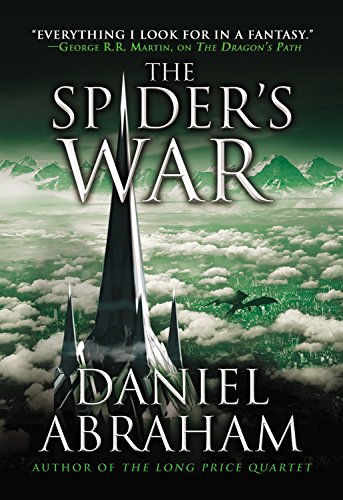
The Spider’s War (The Dagger and the Coin #5) by Daniel Abraham (Orbit Trade Paperback 03/08/2016) – The final novel in this fantastic series. I almost don’t want to read it because that means it will be over.


The epic conclusion to The Dagger and The Coin series, perfect for fans of George R.R. Martin.


Lord Regent Geder Palliako's great war has spilled across the world, nation after nation falling before the ancient priesthood and weapon of dragons. But even as conquest follows conquest, the final victory retreats before him like a mirage. Schism and revolt begin to erode the foundations of the empire, and the great conquest threatens to collapse into a permanent conflict of all against all.


In Carse, with armies on all borders, Cithrin bel Sarcour, Marcus Wester, and Clara Kalliam are faced with the impossible task of bringing a lasting peace to the world. Their tools: traitors high in the imperial army, the last survivor of the dragon empire, and a financial scheme that is either a revolution or the greatest fraud in the history of the world.
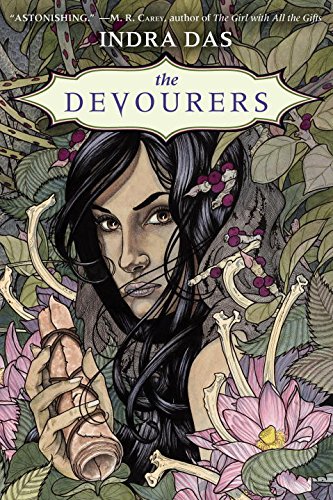
The Devourers by Indra Das (Del Rey Hardcover 07/12/2016) – Das’s debut which is getting a nice push. The ARC looks like a finished copy and is adorned with a very pretty cover. .

"I'm a werewolf," he says. Smoke flares out of his mouth in curls that wreath his long black hair, giving him silver-blue locks for a passing second. I don't see him throw away the match, but his foot moves to rub it into the soil.

In present-day Kolkata, college professor Alok Mukherjee meets a man who claims to be a werewolf. Alone and estranged after a divorce, Alok is drawn to the stranger's hypnotic allure, unable to tell delusion from truth, trickery from magic. In a dusty caravanserai in seventeenth-century Mumtazabad, Cyrah, a young wanderer, meets a man who says he is a monster. Their encounter fills her with revulsion and dread, yet changes her forever.

Beginning in Mughal India by the foot of the Taj Mahal and culminating in the lush, dangerous forests of the Sunderbans in twenty first century India, The Devourers is a story about shapeshifters, men with second selves who prey on humans. But it is also about what it means to be human and of the transformative powers of love. Utterly gripping and wholly original, it reinvents the modern fantasy novel for India, imbuing it with depth, emotion and richness.

On a cool evening in Kolkata, India, beneath a full moon, as the whirling rhythms of traveling musicians fill the night, college professor Alok encounters a mysterious stranger with a bizarre confession and an extraordinary story. Tantalized by the man’s unfinished tale, Alok will do anything to hear its completion. So Alok agrees, at the stranger’s behest, to transcribe a collection of battered notebooks, weathered parchments, and once-living skins.

From these documents spills the chronicle of a race of people at once more than human yet kin to beasts, ruled by instincts and desires blood-deep and ages-old. The tale features a rough wanderer in seventeenth-century Mughal India who finds himself irrevocably drawn to a defiant woman—and destined to be torn asunder by two clashing worlds. With every passing chapter of beauty and brutality, Alok’s interest in the stranger grows and evolves into something darker and more urgent.

Shifting dreamlike between present and past with intoxicating language, visceral action, compelling characters, and stark emotion, The Devourers offers a reading experience quite unlike any other novel.
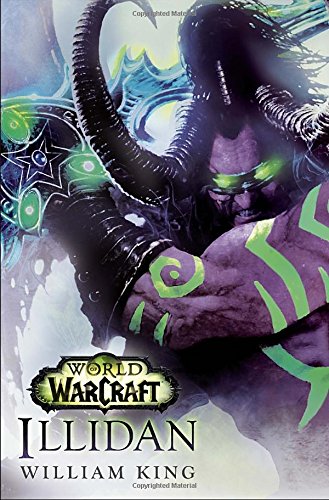
World of Warcraft: Illidan (Tyrion and Teclis #1) by William King (Del Rey Hardcover 04/12/2016) – William King is well-experienced in the world of Media Tie-ins, having penned numerous Warhammer fantasy novels. This one is obviously timed in preparation for the new Warcraft movie.

Behind the legend stands an individual hungry for justice and vengeance—as the adventure, intrigue, and heroism of World of Warcraft rise to a new level.

You are not prepared.

Illidan Stormrage is one of the most powerful beings ever to walk the lands of Azeroth. He is also one of the least understood. Behind his legend, beneath his enigmatic mission, lies a brilliant mind whose machinations are comprehended by few—and trusted by even fewer. Illidan’s righteous reign of justice and vengeance has begun.

Long ago, the night elf sorcerer Illidan infiltrated the demonic Burning Legion to ward off its invasion of Azeroth. Instead of hailing him as a hero, his own kind branded him the Betrayer, questioning his intentions after he appeared to aid the demon lords. For ten thousand years, he languished in prison—vilified, isolated, but never forgetting his purpose.

Now the Legion has returned, and there is only one champion who can truly stand against it. Released from his bonds, Illidan prepares for the final confrontation in the alien realm of Outland, gathering an army of grotesque fel orcs, serpentine naga, cunning blood elves, and twisted demon hunters to his side. He alone knows what deeply hidden motives guide his hand; he alone understands the price that must be paid to defeat the enemies of creation. Yet as before, he is assailed by those who see his schemes as a cynical quest for power, including the night elf Maiev Shadowsong, his former jailor. Warden Shadowsong and her Watchers have pursued the Betrayer to Outland to exact retribution for his crimes, and she will not rest until Illidan is in her custody . . . or in his grave.


Alight (Generations Trilogy #2) by Scott Sigler (Del Rey Hardcover 04/05/2016) – I listened to Scott’s first podcast two novel Infected and Contagious and loved Alive when I read it last year. This is the hardcover/finished version of the ARC I received a couple of weeks ago.
In Alive, Scott Sigler introduced readers to an unforgettable young heroine and a mysterious new world reminiscent of those of The Hunger Games, Divergent, and Red Rising. Now he expands his singular vision in the next thrilling novel of this powerful sci-fi adventure series.


“If it’s war they want, they messed with the wrong girl.”


M. Savage—or Em, as she is called—has made a bewildering and ominous discovery. She and the other young people she was chosen to lead awoke in strange coffins with no memory of their names or their pasts. They faced an empty, unknown place of twisting tunnels and human bones. With only one another to depend on, they searched for answers and found the truth about their terrifying fate. Confronted by a monstrous enemy, they vowed never to surrender—and, by any means, to survive.

The planet Omeyocan may be the sanctuary Em and her comrades seek. But the planet for which they were created turns out not to be a pristine, virgin world. Vestiges of a lost civilization testify to a horrifying past that may yet repeat itself. And when a new enemy creeps from the jungle shadows, Em and her young refugees learn there’s nowhere left to run. They face a simple choice: fight or die.

In the midst of this desperate struggle, their unity is compromised from within—and a dangerous zealot devoted to a bloodthirsty god moves to usurp Em’s command, threatening to lead them all down a path to violent doom.

Friday, August 01, 2014

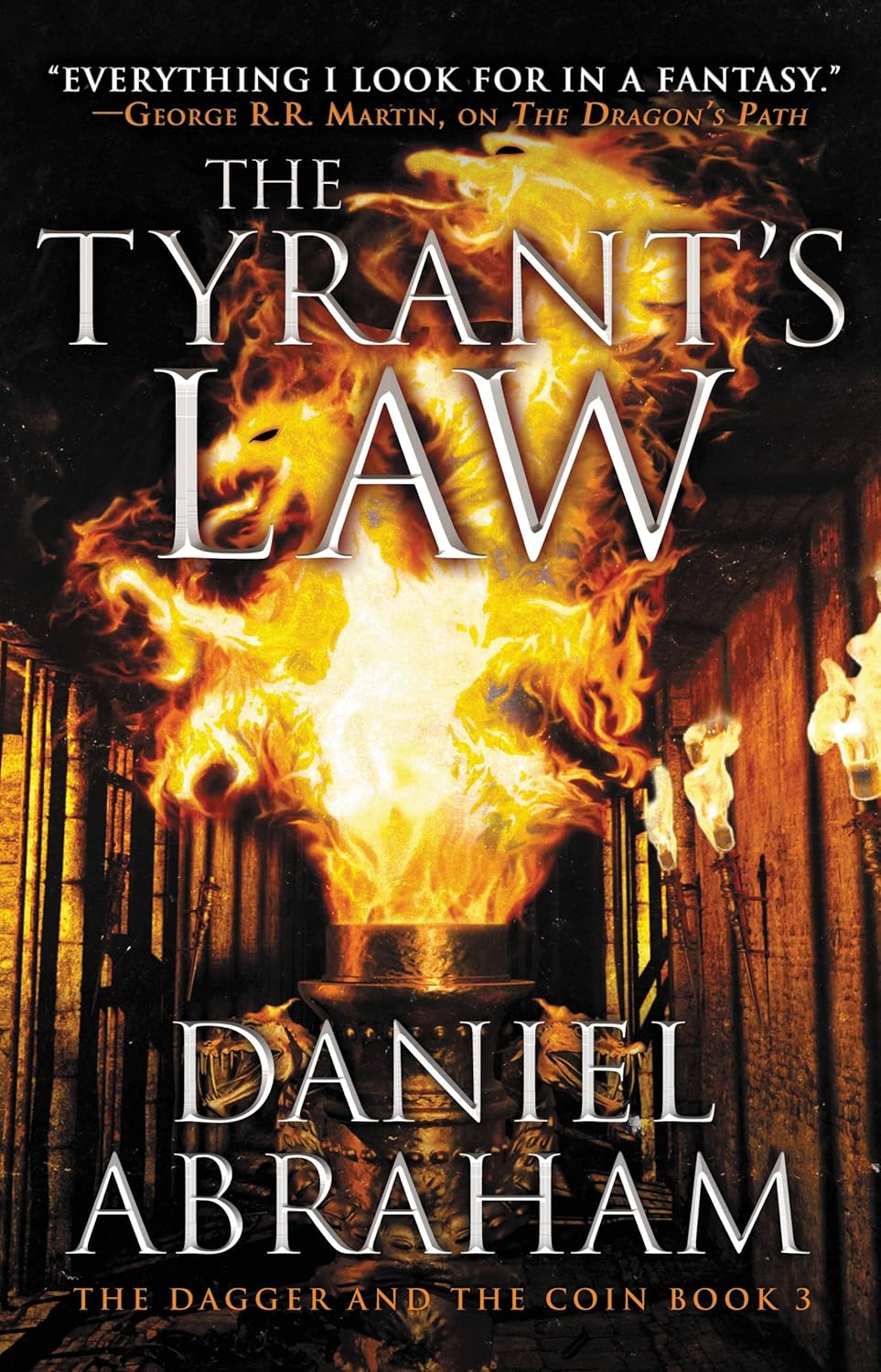
The Tyrant's Law by Daniel Abraham (From the Archives)

With the fourth installment of Daniel Abraham's The Dagger and the Coin sequence publishing next week, I figured I would repost my review of the third installment, The Tyrant's Law which originally appeared on Tor.com...


Banking and ancient races, these are two of the main forces driving the narrative of the characters of and world events in Daniel Abraham’s The Tyrant’s Law. The novel is the third book of his ongoing series The Dagger and the Coin, and is further proof that Daniel is crafting what is arguably one of the finest long form epic stories of the 21st Century.

The main players of the series have been scattered, following their own character arcs despite each of those arcs being connected to the Lord Regent of Antea Geder Palliako (more on that below). Geder is ruling the empire in the place of the young prince Aster, whose father died in the prior installments. Fueling much of Geder’s power is the growing cult of the spider goddess, churches of which have been established throughout the empire.

Geder’s powerful tyrannical influence in the world has left Clara Kalliam’s family in disgrace, her husband killed and branded as a traitor in the previous novel The King’s Blood. Though she was raised to POV character in the previous novel, she has much more impact and is a greater presence here in The Tyrant’s Law. Clara’s sons have spoken out against their father and one of her sons in particular, Jorey, has re-won the favor of Geder since the two were childhood friends. Meanwhile, Clara’s been cast down the social ladder and gets a better idea of how much of an impact Geder’s tyrannical reign of power is affecting people. From the bottom of society, Clara is moving pieces on a chessboard of her own making in order to take down Geder.

Cithrin bel Sarcour’s past dalliance with Geder provides much tension as she ruminates on how to improve the world from her standpoint as a Medean banker. Her role in the bank provides great access to power and control, though she’s still beholden to the rules of the kingdom as enforced by the word of Geder. Abraham does not provide easy choices for his characters, and perhaps Cithirn exemplifies this most profoundly. While he doesn’t outright torture them in the same way Robin Hobb tortures her characters, Abraham’s character’s decisions come with consequences that are far from pleasant, despite the decision the character makes. It is rarely a ‘best’ choice but rather a ‘least bad’ choice.

The fourth POV character is Captain Marcus Wester, a man who left Cithrin in the previous volume with many unresolved feelings and with little warning to his former ward. Wester is acting as a companion and protector for former actor and apostate of the spider goddess cult, Kit. The two men’s storyline forms something of a quest as the two men search for the heart of the spider herself as well as magical items they hope will help to bring down the cult of the spider goddess. What they eventually find is a more surprising reality than they expected.

I’ve previously remarked in how empowering Abraham’s female characters are – they operate as active characters who take control of their lives rather than react to the men around them. Clara’s story arc was perhaps the strongest, whether this was because she was new or because it was the most complex. The fact that she is a widow is a great indicator that she has a fresh start, Clara takes that proverbial ball and runs with it, awakening many aspects of herself she thought she knew – her mind, her drive for justice, her sexuality. She walks a thin line which divides the surface appearance of her actions and the true intent of her actions. As the series progresses, I suspect this line will only become thinner as her maneuverings have a greater effect on the world at large.

In Geder, the super-villain protagonist arc continues to a greater degree from the previous volume. Despite how other characters feel about him, particularly Clara and Wester, it is difficult to dispute some of the decisions he makes and at times, even empathize with those decisions. He isn’t entirely unlikeable, which adds to his strength as a character. Geder sees himself as acting in the best interest of the land he is ruling. The proactive decisions he makes about the empire and how to enforce its strength and growth, are in some senses, reactions to how he perceives others characters view him. An event towards the end of the novel will likely prove to be the tipping point that pushes him over the edge into true Lex Luthor / Walter White territory and cement him as the human-facing Big Bad of the series.

By keeping the viewpoint to four characters, Abraham gives himself the freedom to provide readers a greater insight to each of the characters and to impart upon them believability, plausibility and empathy. In this sense, the intimacy we get as readers allows us to feel a greater sense of urgency of the epic events of the novel as a whole as they affect both the world and those characters we’ve come to know.

On the one hand, it is difficult to distill into one review the pure enjoyment the settles into me when I read these books (or as I’m coming to realize, anything Daniel Abraham writes). As the pages would slide past, the small movements of Abraham’s narrative come together to former a great whole that informs the novel as it barrels forward with great momentum. I’ve long been a fan of Epic Fantasy and when it is handled properly, expertly, there’s no form of entertainment I’d rather be enjoying. Such is the case with the books in The Dagger and the Coin. Everything he’s done in the previous novels so well, Abraham continues to do well here in The Tyrant’s Law.


The series is highly recommended and so is this particular installment, but with the caveat that you go and immediately read The Dragon’s Path and The King’s Blood.

(This review originally appeared on Tor.com on May 10, 2013)

Wednesday, January 04, 2012

2011 Reading Year in Review

I’ve done this for a few years now (2010, 2009, 2008, 2007, 2006), so in order to maintain the middling credentials as a genre blogger/book reviewer I have, I'm doing it again for 2011.

As I have in the past, I’ll start with some stats…According to goodreads, I read (or at least attempted to read) 77 books in 2011. I say attempted because a few books I simply dropped because nothing about the book compelled me to keep reading. Many of those, 40, were new/2011 releases, but I have been trying to get back into some of the older stuff and the fact that nearly half of what I read was pre-2011 means I did just that.

In 2010, I posted 46 reviews to SFFWorld and 5 to the Sacramento Book Review /San Francisco Book Review, plus a couple here at the blog.

Some of the older stuff included catching with series I’ve been following like Dredsen Files, Robert Jordan’s Wheel of Time, David Weber’s Safehold and of course a re-read of the entire A Song of Ice and Fire series in preparation for both A Game of Thrones on HBO and A Dance with Dragons

Here are some stats:
  • 32 can be considered Fantasy
  • 40 2011/current year releases
  • 25 books by authors new to me
  • 32 can be considered Science Fiction
  • 9 can be considered 2011 debuts
  • 6 can be considered Horror
  • 12 Books by women (Not necessarily 12 different women because, for example, I read 4 total novels [one novel and an omnibus] by Elizabeth Moon)

All that said, on to the categories for the 2011 … Robloggies? ManBearPiggies? Stuffies? Sullys? I don’t know! As I said last year, this isn’t a typical top 10 or 12 or anything, but whatever you want to call them, here are some categories for what I read in 2011 and what I put at the top of those categories.


Rob Favorite Science Fiction Novel(s) Read in 2011


It’s already getting tough because three books vie for this spot and I might give a slightly different answer today compared to a week from today. The best way to go over these three books is chronologically, that is the order in which I read them.

I’ve only read one Eric Brown novel prior to reading The Kings of Eternity, but that is going to change. I found the book amazing with a powerfully addictive narrative strength:
In 1999 a reclusive writer named Daniel Langham shuns all forms of publicity living a truly introverted life on a remote Greek Island. His only real contact with the outside world is the restaurant owner where he eats every day. That is until he meets Caroline, an artist who intrigues Daniel both for her beautiful art as well as her charming personality. Because Daniel is so reclusive, he is unwilling to trust anybody very easily and his fears of being discovered on the remote island come to fruition when an investigative report hunts him down. Daniel finds solace both in the words he writes as well as the journal of his grandfather, Jonathon Langham.

In 1935 a writer named Jonathon Langham is summoned to the cottage of his editor Jasper Carnegie, along with fellow writer Edward Vaughan to witness a strange phenomena. Carnegie has everything planned for his friends and almost tortuously reveals what he wishes to show his friends. When he brings them to a clearing in Hopton Wood, Langham and Vaugham behold a portal to another world that appears strange, wondrous, and alien. Repeated viewings bring a visitor in the form of a dwarf-like alien on the run from aliens of another race who are hunting him. This meeting, of course, has a great impact on Langham, Vaughan, and Carnegie such that they are friends for the remainder of their lives.


Daniel Abraham is no stranger to the genre, though his novel with his friend George R.R. Martin’s assistant Ty Franck under the James S.A. Corey name is new. The author team with one name launched a classic Space Opera in 2011, a novel laced with noir and horror. Leviathan Wakes is the first installment of The Expanse and here’s what I said about it:
Holden’s crew is very much a family and from my most recent reads, I was reminded of the crew of the Ketty Jay from Chris Wooding’s terrific Retribution Falls. I mentioned in my review of that book, the parallels I found with Firefly. The landscape in Leviathan Wakes, though confined ‘only’ to our solar system plays off both epic and personal, space after all is large, but the sense that all the characters have a comfortable level of knowledge of the solar system much like seasoned business travelers would have a good working knowledge of the United States. Part of what makes the solar system so believable is how the problems of big business seemingly controlling things from behind the scenes and the clash of societies mirrors today’s world, just on a larger canvas.


Much like Abraham did in The Dragon’s Path, the narrative is told through a cycling of third-person POV characters, though here we only see the aforementioned Miller and Holden. Again, this style of storytelling makes sense considering Abraham is something of a protégé of George R.R. Martin and Franck is GRRM’s assistant, and this is by no means a negative thing. Martin does this better than any writer, so why not adopt a style that proved effective, unless you can’t pull it off. Fortunately for readers, this one specifically, Corey pulled it off very well.


The last of the 2011 standout novels I’d classify as Science Fiction for two reasons: (1) Science is the impetus behind the state of the world and (2) the spine of the book says “Science Fiction” as opposed to “Horror” or “Fantasy.” Deadline is the second novel of The Newsflesh Trilogy, Mira Grant’s Zombie-Apocalypse trilogy. The second novel maintained the same tension and narrative power as the first and has set the bar high for the concluding volume. Here’s some of what I said about Deadline:
As the layers of conspiracy are revealed, Grant examines the ethics involved in the medical profession, specifically those researchers involved in curing diseases, the power of government, and how those two – when at absolutes – can lay the foundation for an apocalypse. The ethical dilemmas were handled, I felt, very well and engaging through the characters of Dr. Connolly and Dr. Abby. Dr. Abby is introduced in the early stages of the novel as a rogue scientist with a giant mastiff immune to the Kellis-Amberle virus who is in constant hiding from the CDC. Reading through their ideological positions and their conflicts with each other, which was punctuated by the matter of fact and almost cold dialogue between Connolly and Maggie was some of the more ethically thought-provoking science fiction I’ve read in quite some time.


The Newsflesh Trilogy is turning into one of my favorite SF stories and one that is continuing to surprise me – up until the very end of Deadline. This second installment raises the stakes considerably and brings new players into the game, while maintaining the blistering pace of Feed, its predecessor. I can’t say enough good things about this novel, which has made the concluding volume Blackout, quite possibly my most anticipated novel publishing in 2012.


Rob’s Favorite Fantasy Novel(s) Read in 2011


2011 was another strong year for Fantasy, with more impressive debuts and highly anticipated books/installments in popular ongoing sagas (A Song of Ice and Fire, The Kingkiller Chronicle, Sword of Truth) – guess which one of those makes the cut?

As I did with the best SF, I’ll run through the top books in the order in which I read them.

Though published in January, I didn’t get around to it until April, Among Others was a powerful novel that hit so many notes perfectly – Coming of Age Novel, a novel about The Power of Story, Witchcraft, the Outsider – that it worked wonderfully for me and a book I think may require a second reading:

A novel like this is very difficult to sum up without giving away too many spoilers or revealing the joy of discovering what Mor experiences. Essentially, Among Others is epistolary novel told through Mor’s diary. Though I haven’t read too many novels structured in this manner, I wonder if they all hold the same addictive, powerful and voyeuristic appeal as does Walton’s novel. What made this novel work so well for me, and many readers of SF, is Mor’s unbridled love of the genre and perhaps more importantly, how it essentially saved her and allowed her to move on from the tragedy she experienced into the next stage of her life. The novel can be seen as a testament to not only the power of story and the written word, but also the power of community so strongly associated with SF. In fact, as I was reading the novel I very much wanted to visit some of the books Mor read. I made a journey to the local used bookshop to pick up some older SF contemporary with many of the novels Mor read, as well as Walton’s debut novel The King’s Peace.


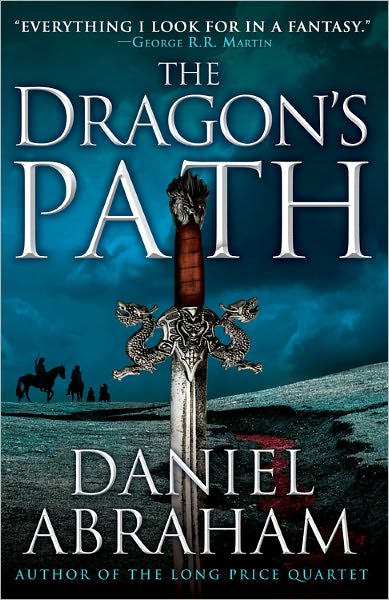
Another appearance from Daniel Abraham here, this time a book he wrote all by his lonesome. The Dragon’s Path is the first novel in the series he's calling The Dagger and the Coin:

The novel starts with a prologue, hinting at the return of a very dark magic. The Spider Goddess, to be specific, and how she will consume the world. The POV character in this prologue does not receive a name other than “The Apostate.” The remaining chapters are titled based upon the character on whom Abraham focuses his engaging third person omniscient point of view. If this structure is somewhat familiar (especially to those who’ve read Daniel’s mentor George R.R. Martin) then the meat giving that structure bulk does stand apart. For example, the orphan hero is a very popular character type, especially in fantasy fiction. But how often is this orphan taken in by bankers and taught their trade? Not very often, from the many fantasy novels I’ve personally read. In the character of Cithrin Bel Sarcour, Daniel Abraham has given readers that character and watching her grow over the course of the novel was very enjoyable and plausible. At first shy and downtrodden, Cithrin comes into her own and becomes a very confident, assured character by novel’s end.


The plot revolves around power struggles for a throne under hints and threats of war, familial political machinations (primarily from Killian Dawson’s POV), the coming of age of two of the three primary protagonists (Cithrin and Geder), and the redemption of the third (Wester). Where Abraham further separates his novel from other Epic Fantasies dealing with war is where he shows how the wars begin, and through the economic maneuverings that often power the undercurrent of war. On the surface it may not seem that such a premise would make for the most compelling reading, but Abraham infused the narrative with that all important addictive quality of “I need to know what happens next.” In fact, my wife noted while I was reading the book that I couldn’t put the book down and was always reading it. She doesn’t make such a remark very often and I read about a book or two a week.


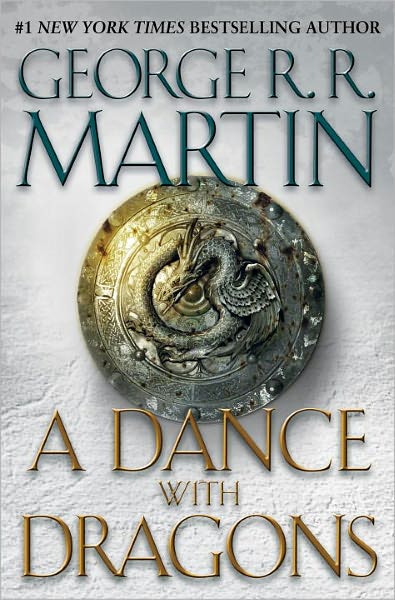
The last of the Fantasy trio should be no surprise: A Dance with Dragons by George R.R. Martin , I didn’t do proper review of this beast, just a little response on goodreads


Rob's Favorite Debut(s) of 2011


Two of these novels could have easily been in the Fantasy category, but I wanted to spread the love, so to speak.

My favorite debut of the year was from Ace books and was a bit of a controversial title over in the SFFWorld forums. I speak of Mark Lawrence’s Prince of Thorns, the first installment in The Broken Empire trilogy. A crazed, many-ogonistic protagonist, a crapsack world, and powerful narrative made this book impossible for me to stop reading:
Prince Jorg was forced to watch his mother and brother tortured and killed as he was entangled in the thorny briar, unable to move or tear his eyes away from the carnage. This happened when he was nine years old. Fast forward a few years and he’s left the confines of his father’s kingdom and is leading a band of cutthroat bandits and mercenaries extracting coin; questing for revenge upon Renar, the ruler who killed his mother and brother; and pretty much doing whatever they want. As the title of the series, The Broken Empire, implies, the world is not whole. Scattered kingdoms, and that word applies quite loosely, vie for power against the Hundred, the dark powers seemingly in control of the world.


Prince Jorg was forced to watch his mother and brother tortured and killed as he was entangled in the thorny briar, unable to move or tear his eyes away from the carnage. This happened when he was nine years old. Fast forward a few years and he’s left the confines of his father’s kingdom and is leading a band of cutthroat bandits and mercenaries extracting coin; questing for revenge upon Renar, the ruler who killed his mother and brother; and pretty much doing whatever they want. As the title of the series,
The Broken Empire, implies, the world is not whole. Scattered kingdoms, and that word applies quite loosely, vie for power against the Hundred, the dark powers seemingly in control of the world.


The next debut author released three novels over the course of three months, a publishing strategy that has proven very successful in the past (Naomi Novik and Brent Weeks, to name just two). Kevin Hearne kicked off an Urban Fantasy series focusing on a 2,000 year old Druid (Atticus) and his Irish Wolfhound familiar (Oberon) in modern Arizona as he runs into various supernatural entities. The first book is titled Hounded. Hexed and Hammered are the other two, but here's an excerpt from my review of Hounded:

Atticus is a 2,000-plus year old Druid who lives with his Irish Wolfhond Oberon in Tempe, Arizona; runs a shop that specializes in herbal remedies and arcane books; communes with Celtic and native American tribal gods, witches and all sort of supernatural characters. When his arch enemy cranks up the hunt for Atticus, the Druid decides to stop running and confront the Celtic God Aenghus Óg. Aenghus has a somewhat fair reason to have hounded Atticus (whose true name is Siodhachan O’Suileabhain), appropriated Aenghus’s magical sword Fragrach during a battle. So, Aenghus sends his minions after Atticus and the minions get more powerful as the novel progresses until there’s an all-out spectacular battle of magic, gods, and Tuatha Dé Danann to cap off this fine novel.


Primarily for the heavy Celtic flavor, I’d also recommend these books to readers who enjoyed Mark Chadbourn’s Age of Misrule trilogy. Hearne’s pacing and humor make the page turnings rather quickly, he’s got an addictive storytelling style. As a person who grew up with dogs and currently has a dog, I was very impressed with Hearne’s ability to really “get” the relationship between human and canine companion so much so that I imagine my dog thinking some of the same things Oberon says to Atticus. In the relationship between Atticus and Oberon, I was also reminded of Vlad Taltos and his familiar Loiosh, or even Harry Dresden and Bob the Skull. Having the protagonist/sidekick relationship allows for good story progression without the protagonist monotonously spouting a monologue at the reader and Hearne captured this element quite brilliantly, perhaps my favorite aspect of the novel.


Since I’m doing this in threes, why not continue with the debuts? The third debut that knocked my socks off was one of the grittiest, dirtiest, bleakest military SF novels I’ve ever read. It also came across as brutally honest and genuine. I refer to T.C. McCarthy’s Germline

Few novels I’ve read have depicted the dirtiness, pain, monotony and sheer distress involved in war with such believability. Wendell is not a hero, he has serious drug problems, which have led to and compounded his family problems, he isn’t the nicest or bravest guy in the world, and he has a tendency not to turn his writing assignments in on time. One thing at which Oscar excels; however, is endearing himself to the soldiers with which he follows on their tours of duty. Here is where McCarthy shows nice touches, after a minor bit of hazing from the Marines, Wendell fits in with the Marine nicknamed Ox. The camaraderie between them throughout the novel is one of the strengths and something that continually returns as Oscar travels through various points in the war zones.


Adding to Wendell’s instability are the genetics – squads of genetically engineered female supersoldiers placed on the front lines as the elite fighting forces. For reasons that come to light as the novel progresses the only supersolders are females. Just when the novel seems to be about Wendell’s struggles for sanity, cleanliness and war, in comes the relationship angle and the question of “What is humanity?” The genetics are perfected humans, at least physically, but they unfortunately have a very short shelf life, very few living beyond 18-20 years. When Oscar first sees one from a distance, he’s fascinated, though his comrades in arms try to dissuade him from engaging with the genetics. When he does meet and talk with one in particular, Sophie, his fascination grows and becomes a physical attraction that one might say leads to obsession.


Favorite Backlist / Book Not Published in 2011 Read in 2011


I’m not including Mr. Martin’s A Song of Ice and Fire in this category since (1) I’ve previously read all the books save A Dance with Dragons (2) That really wouldn’t be fair. So, here goes:

The top spot goes to novel that was recently nominated for the prestigious Hugo award. It involves zombies, a political campaign, the power and evolution of news reporting. I speak of course, of Mira Grant’s FEED:


The characters are terrific and believable. Georgia is a bottom-line no-nonsense character who upholds telling the truth as the ultimate ideal. Shaun is the more adventurous type and can be seen as a charming and intelligent character from Jackass – think Johnny Knoxville or Bam Margera fighting zombies for our entertainment. The relationship between the brother and sister, adopted after their parents the Masons had to kill their own son when he became a zombie, is one of trust, love, and respect. Shaun and George are not related by blood; however, their bond is no less strong because of it. In presidential candidate Peter Ryman, Grant gives readers what seems to be the ideal man running for the most powerful job in the world. The relationship between Ryman and his wife Emily is painted as ideal as well. As much as the characters themselves are incredibly well drawn, it is in their one-on-one relationships that Grant’s ability to lend emotion to her characters really shines. Georgia/Shaun, Peter/Emily are not the only two, but the best examples in the book. When a third character comes into the picture of the paired characters; however, is when things start go, for lack of a better term, a little wonky. Again, I feel revealing the specifics might take away from the true power of Grant’s story, so I leave it to the reader to explore these themes in the novel.


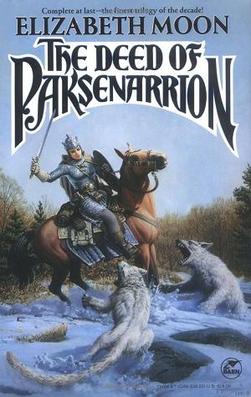
The number two slot goes to an omnibus that is in my personal Omnibus Hall of Fame PeterWilliam) The Deed of Paksenarrion by Elizabeth Moon.


I don’t have a review of it up anywhere, but I liked nearly everything about the three books contained in the big grey/blue book published by Baen. What’s more impressive is that these three books are the first three published by Elizabeth Moon. I think she developed the character of Paks very well throughout the novel and the world came across as quite real. Rumor has it Mrs. Moon sort of wrote these books as a reaction to how Paladins are portrayed in Dungeons and Dragons and on one hand I can see that. On the other, for my reading sensibilities, the omnibus just simply worked. This is one I’d point to if somebody was looking for what is now considered Classic High/Military Fantasy.

Rounding out the triumvirate for this category is the first book in a massively popular series by an author whose work I’ve been finding myself drawn to reading over the past couple of years with growing regularity. (I’m sure you readers are sick of me saying that). The author is David Weber and the book is the first of his Honor Harrington series On Basilisk Station:


Since this novel is set in space and deals with spaceships, a space navy, and a space station, a space battle is inevitable and rollicking. The last 100 pages or so depicting the conflict was terrific reading. Perhaps what made the book so enjoyable for me; however, was Weber’s wonderful handling of characters in tense situations. For example, there's a lot of tension in the air between Honor Harrington and one of her officers, particularly her Executive Officer McKeon. Weber depicts it very well and the resolution of that tension comes off nicely and plausibly. The level of respect that grew from their initial tension was as emotionally satisfying (perhaps more so for me) than the thrilling space battle. Tangentially, Weber relays a great deal of information about the universe set up through narrative info dumps as well as dialogue between the characters. The term info dump often holds an air of negative connotation, but in this case, it worked very well for me.

Weber openly acknowledges the Honor Harrington novels are basically
Horatio Hornblower novels IN SPACE, but that does not deter from any enjoyment I experienced reading On Basilisk Station. Another admirable aspect of what Weber does with his characters in this novel is the balance between believable and heroically over the top. My only problem with his book is the somewhat rocky start. The first few chapters were a little scattershot, in terms of setting up the remainder of the novel. However, once Honor took center stage there was no turning back for and On Basilisk Station turned into a truly entertaining, engaging, and addictive novel.


MVP Author of 2011


For the first time in two years, of doing this on my year-ender Brandon Sanderson doesn't get the mention. It should come as no surprise that it is …


The fact that “in the US it [A Dance with Dragons] had the highest single and first-day sales of any new fiction title published this year” is a testament to his fans and the continuing power of the written word.


Of course, the popularity of the book series is on the rise in small part to a little TV show on a relatively obscure cable network . Remember how I said before I re-read the four books leading up to the release of book 5? Yeah, I guarantee many other fans did just that, both the long-time fans and the new fans thanks to the show.


Hell, George was named by Time.com as one of their "People Who Mattered in 2011", Game of Thrones received many award nominations including a win for Peter Dinklage. I’m just scratching the surface here folks.

Honorable mention goes to Seanan McGuirre / Mira Grant – she published three books in 2011 (two in her popular October Daye urban fantasy series, the middle book of her superb Newsflesh trilogy, and spent a good portion of the year as a Hugo nominee.


Favorite ‘New To Me’ Author(s) of 2011


I’ll mention two, as I did last year. One author is squarely in the Fantasy genre, the other skirts the line between genres and perhaps has created a genre – bucklepunk.

The bucklepunk guy, is of course, Chris Wooding. I’d seen good things about his writing, particularly from readers across the pond who’ve been reading Chris’s work for a few years. This year, the fine folks at Bantam Spectra published the first two books in his Tales of the Ketty Jay, the first of which is Retribution Falls:

Sky Pirates of the Future could easily be the tagline for Chris Wooding superbly entertaining SF novel Retribution Falls, if it were written half a century ago. Perhaps Wooding could have thrown that tagline into the subtitle since the sense of wonder, thrill of adventure, and pure fun that is laced throughout the entirety of the novel evokes those pulpy stories which helped to provide a basis for today’s SF.

As the novel proceeds from the point when the too good becomes the crew of the Ketty Jay’s potential downfall, Wooding does an excellent job of revealing the character’s back stories. I thought this a particularly clever method for getting to know and care about the characters as the character’s history and growth read seamlessly along with the action pieces of the novel.

Wooding starts the novel out very strongly, with Frey and Crake in a sticky situation that immediately establishes what I mentioned before – Frey’s #1 concern is the Ketty Jay, even more than the life of a crew member. In some ways, this reminded me of the beginning of Scott Lynch’s Red Seas under Red Skies, except that here in Retribution Falls, we don’t know the characters quite as well. Nevertheless, the scene itself establishes the overall feel for the book and the beginnings of solid character development.


The other author is squarely in the Fantasy section of town, and at this point, the Sword and Sorcery district. Michael J. Sullivan published his first novel in 2009 electronically and with a small press. Orbit re-released his first two novels in what is now in my Omnibus Hall of Fame - Theft of Swords. I mentioned him fair amount on the blog this year and I interviewed him for SFFWorld. Here's a bit from my review:

Theft of Swords contains The Crown Conspiracy and Avempartha, the first two novels in the series. Both books are just over 300 pages. In The Crown Conspiracy, readers are introduced to the anti-heroic duo of Royce Melborn, thief, and Hadrian Blackwater, mercenary. The two call themselves Riyria and are known as a competent duo, working outside the thieves’ guild taking on jobs for nobles who would otherwise not want to get their hands dirty. Off the bat, Sullivan gives readers fully formed protagonists who are mature and not the typical farmboys of epic fantasy. In fact, the feel I got throughout The Crown Conspiracy was more of a Sword and Sorcery adventure rather than Epic Fantasy. Of course, the comparison many people have made to Royce and Hadrian is to Fritz Leiber’s Fafhrd and the Grey Mouser. The relationship between Royce and Hadrian comes across as something that is long-standing, but as of yet, Sullivan has yet to reveal how the two rogues became partners. This is good, and a pattern of storytelling which Sullivan employs throughout The Crown Conspiracy and a method at which he excels..

Orbit was very smart to (1) snap up these books, (2) pair up two books into one omnibus, and (3) publish the three books in three months. Sullivan’s story fits in great with some of the recent books published by Orbit– I’d recommend the books to people who enjoyed the ‘old-school fantasy’ aspect of Daniel Abraham’s The Dragon’s Path and Brent Weeks
Night Angel Trilogy.


Favorite Publisher of 2011


If you’ve made it this far along the blog post, and you are familiar with who publishes what books, then this shouldn’t come as a surprise…


Orbit Books had a terrific year, though a fair amount of that carried over from 2010 as multiple books they published were on multiple award shortlists. For my reading time, no publisher produced books that worked as consistently from book-to-book for me. That is, on the whole, all the books I read published by Orbit worked for me in a big way. From the smart The Dragon’s Path by Daniel Abraham, to the aforementioned Theft of Swords by Michael Sullivan, to the two novels I read by Mira Grant to the uncompromising debut by T.C. McCarthy as well as Philip Palmer’s Hellship to the rollicking top 3 SF book Leviathan Wakes, it all worked in a big way for me.

This isn’t to say that other publishers didn’t publish great stuff I enjoyed, just that nothing I read from Orbit fell into the disappointment/clunker/meh category. I can't say the same for the other publishers whose books I read in 2011.

Odds and Ends of 2011


For my birthday, I received a Kindle Fire and I absolutely LOVE IT! At this point, I’ve only read one full book on it, but I’ve downloaded a bunch from Baen Fifth Imperium and the free books available through the Baen Free Library so perhaps I’ll do a read through of the Honor Harrington saga in the coming year.

Sully, the dog who became part of our family last year and is looking at you above this section, is now a year older. She's just as loveable, sweet and a pure joy to have in our lives and everything Mrs. Blog o' Stuff and I could have hoped for when we finally decided to bring a dog into our home.

So, in conclusion 2011 was a mixed bag. It was a good reading year for me, but some really crappy things (well, one major crap thing) in my personal life that I hope is on the way to resolving itself. I hope.

Looking Ahead to 2012


Sully and her boyfriend Cooper have their backs turned on 2011 and are waiting to see what 2012 has in store for them, and all of us.

What does 2012 bring?
  • Season 2 of Game of Thrones
  • More Walking Dead
  • The Dark Knight Rises
  • Prometheus
  • The Hobbit (part 1)
  • The Avengers
  • Caine's Law the fourth Act of Caine by Matthew Stover
  • The final Wheel of Time novel
  • Caliban's Law the second in James S.A. Corey's The Expanse
  • The Wind through the Keyhole by Stephen King (Dark Tower 4.5)
  • The King's Blood book 2 of Daniel Abraham's The Dagger and the Coin
  • The final novel of Mira Grant's Newsflesh Trilogy

Looks like a decent batch of major releases on the small screen, big screen, and page for me. Let's just hope some of it lives up to the hype.

Wednesday, April 27, 2011

Abraham & Bennett Reviewed at SFFWorld

We’ve posted two new reviews to SFFWorld over the past week and both books happened to be published by the fine folks at Oribt. The book for which I posted a review is the launch of a new series by Daniel Abraham titled The Dagger and the Coin. The book itself is The Dragon's Path and looks to be a contender for my favorite 2011 release. Reading this book makes me realize I need to revisit Daniel’s Long Price quartet. Daniel seems served VERY well by the publisher switch from Tor to Orbit. Anyway, under the cover shot is s the snippet of my review:


The plot revolves around power struggles for a throne under hints and threats of war , familial political machinations (primarily from Killian Dawson’s POV), the coming of age of two of the three primary protagonists (Cithrin and Geder), and the redemption of the third (Wester). Where Abraham further separates his novel from other Epic Fantasies dealing with war is where he shows how the wars begin, and through the economic maneuverings that often power the undercurrent of war. On the surface it may not seem that such a premise would make for the most compelling reading, but Abraham infused the narrative with that all important addictive quality of “I need to know what happens next.” In fact, my wife noted while I was reading the book that I couldn’t put the book down and was always reading it. She doesn’t make such a remark very often and I read about a book or two a week.

A world rich with history and a variety of races serves as the backdrop for these characters. A world once ruled by dragons, dragons who in the history of this world, dabbled with genetic manipulation for lack of a better term. As a result, this world has 13 branches of humanity. In many ways, I was reminded a bit of the races of Steven Erikson’s Malazan saga for the manner in which the races interact with each other. Daniel provides an essay on these races on his Web site (http://tinyurl.com/dandcraces), though a glossary in the book would have also been helpful for reference. So would a map, but on his blog and in the forums where he can be found (http://asoiaf.westeros.org), Daniel indicated future printings of this book and/or installments of the series would include such ancillary materials.


Mark reviewed the second book by Robert Jackson Bennett, The Company Man:


It is a clever little novel which makes you feel immersed into a world of commercial skulduggery, union strikes, corrupt management and mob unrest. Reminiscient of Metropolis, it highlights not only the opportunities that technological development can offer but also shows the dark underbelly of such urban living. It is clear that there is a price to pay for such development. Progress, yes: but at what cost?

The book does slow down in the middle, but the final dénouement that elevates the tale to one worthy of the genre is very well done There is a deus ex machina moment that made me think for a while afterwards, ‘What happens next?’ . The book finishes clearly at an appropriate point but one that left me pondering more.