Showing posts with label Marianne De Pierres. Show all posts

Friday, May 30, 2014

Friday Round-Up of SFFWorld reviews: de Pierres, Bach, and Abercrombie

Here's a collection of SFF linkery I (or my various internet genre colleagues) have posted this week.

Tuesday, Mark Chitty posted his review of a book I enjoyed earlier in the year (my review for Tor.com), Marianne de Pierres's Peacemaker:


My first impression of Peacemaker was, quite simply, cool. The setting – a Wild West style landscape set in the future – cried out to me as somewhere that could tell some very interesting stories. While the sci-fi side of the coin is perhaps not quite as prevalent as I would have hoped, it really didn’t matter. There were touches here and there to remind you that this was the future, but it was the western elements that really enriched the story.
...
There are also mystic elements to Peacemaker, particularly in Virgin’s spirit pet, Aquila. When she turns up it sets many aspects of the story into motion, and Virgin’s understanding of why and how she is there is never firm. Something that is clear from the outset is that Sixkiller is a font of knowledge, but he rarely offers opinions, and Virgin doesn’t trust him to delve and ask questions


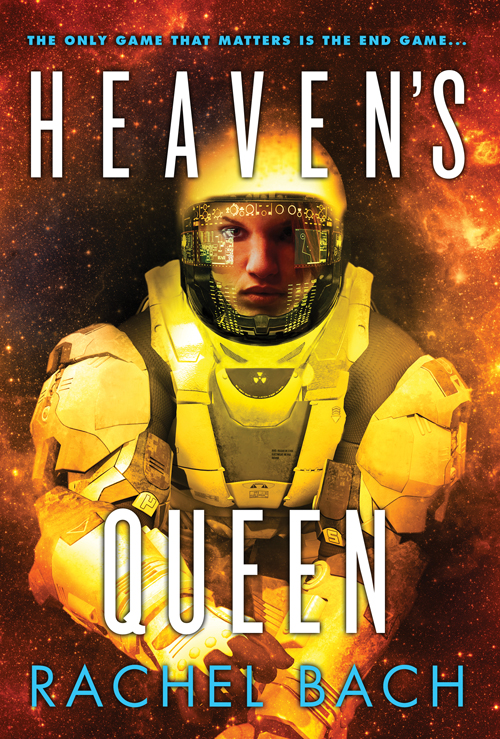
On Wednesday, my review of Heaven's Queen, the concluding (for now, I hope) volume of Rachel Bach's highly charged space-opera series Paradox:


Rachel Bach has crafted a stable foundation over two books in the Paradox series and has left readers like myself hoping for a payoff that both works with that foundation, but also surprises. When we last left Devi, she was an outlaw, having run off from her mercenary group with just her former lover Rupert Charkov by her side. Their relationship is not quite what it once was, Devi now knowing that Rupert wasn’t all that he said he was, she (understandably) finds it difficult to fully trust him at first.. More importantly, he was withholding some very important information from her. This adds more tension to their already strained relationship, but through everything that has affected the two lovers, their true feelings for each other is the core strength of their relationship. Devi, despite her anger and frustration, can’t bury her feelings for Rupert. On the other hand, Rupert continually admits his devotion to her, and almost puppy-dog like fashion.
...
Perhaps what I appreciated most was the candor of the dialogue between Brian Caldswell and Devi leading up to the climax of the novel. Their conversations came across as a fairly level-headed disagreement between two characters who both felt extremely passionate about their opposing viewpoints. Both characters even acknowledged the validity of the other’s argument.


Today, Mark Yon (aka Hobbit) posted a review of Half a King,  Joe Abercrombie's foray into "young adult" or books for younger readers, or whatever you call books that are less squelchy and cursey than his usual fare:


...a Viking-esque, young adult tale that is less gory, less sweary and yet all the more enjoyable for it. It has an Abercrombie tone, it must be said, although I’m still trying to work out what exactly I mean by that, but the writing is as tight and as dexterous as ever.
The forty chapters, generally no more than half a dozen pages each, give the novel an episodic format, but not too fragmented. The characters and their values are identifiable, and, for the most part, likeable.
Our hero, Prince Yarvi, is an outsider, initially put into a position unwanted and yet necessary by circumstances outside his control. Against opposition, he must prove his worth and show that he is capable of dealing with the many problems brought to him. ‘A king must lead’, it is pointed out early in the book.
The twist in the story is that he must do this all the while with a physical disability – he is ‘Half a King’ because he has only one fully formed and functional hand. Consequently seen by many, including his father, as a weakling, (and to my mind rather like Miles Vorkosigan before him), Yarvi has personal demons and practical issues to deal with as well as his unwanted new commitments.

Thursday, April 24, 2014

Review Round-up: Addison, de Pierres, and McIntosh / SFFWorld & Tor.com

It's been a couple of weeks since I rounded up the book reviews I've posted, so here goes, starting with the 'oldest' first.  That book is Defenders by Will McIntosh and has become the measuring stick by which I will judge all SF I read this year.  This was a stellar, elegant novel that was as close to perfect as I've read in SF in quite some time:


McIntosh tells the story from three primary points of view: Oliver Bowen, Kai Zhou, and Lila Easterlin and an occasional POV chapter from Dominique Wiewall. Oliver is a scientist working for the government who soon becomes a liaison to the Luyten, specifically to the Luyten known as Five. Kai was mentally connected to Five during the war, Lila’s family was killed in the war against the Luyten, and Dominique Wiewall is highly placed in the government and the creator of the Defenders. Through the first half of the novel, we get to know these characters, how the war with the Luyten affected them (drastically, natch) and the path this put them on to deal with the world once the Defenders were created in to save the human race.

... 

What makes Defenders such an incredible novel is McIntosh’s pure elegance, the beauty of its simplicity. Each element of the novel, the characters, the situations, the world, the results of the world’s actions, organically feed into each other as the novel progresses. Oliver could very easily have been the typical geeky scientist and there are elements of that in him; he’s a bit socially awkward for example. However, it isn’t a defining trait. Wiewall could, in the hands of a writer with lesser skill at fleshing out characters, been the proverbial bitch on wheels so many women in power are painted as with shallow strokes. However, in the (relative to other characters) small amount of space we are in Wiewall’s head, she comes across as a woman who is admirably head-strong, as well as flawed and nervous. In other words, she’s reads like a real, living and breathing person.

The second review on this round-up is one that didn't work for me nearly as well as did Defenders. I refer to Katherine Addison's The Goblin Emperor.  This book has been getting nearly universal love/acclaim from the folks in my twitter/blogger stream, but it didn't work for me. In other words, I'll just call this one Ancillary Justice 2014: The Fantasy Version:


The true strength of this novel is the character of Maia. He makes decisions that go against convention and surprise those advisors he takes into his innermost circles. To say his opinions and decisions to problems goes over in a refreshing manner is an understatement. He actually treats all of his subjects as people rather than annoyances, and acts in the personal interests of his siblings who still live. What makes Maia such an easy character to empathize with is that he is experiencing life in the Untheileneise Court for the first time.


...

What all of these elements were for me was a barrier erected between the core elements of the novel that worked very well (strong protagonist, inventive setting) and the cumbersome elements (overlong linguistic affectations and idiosyncratic naming conventions) that ultimately prevented me from enjoying the novel. While I understand and enjoy novels that challenge me and challenge conventions of the genre in terms of form, gender assumptions, etc., there’s a line that “challenging” crosses and becomes an impediment to enjoyment. Unfortunately that was the case with The Goblin Emperor.

Last, most recent, and most certainly not least is Peacemaker by Marianne de Pierres, which was a blast and was posted to Tor.com just yesterday. I was very pleased that Marianne jumped into the comments to shed some light on a couple of things. In other words, a case of an author APPROPRIATELY addressing a review of her work:

Told from Virgin’s point of view, de Pierres’s narrative is very intimate. We see everything through her eyes, including the United States Marshall assigned to shadow her on the strange goings-on at the park, Nate Sixkiller. He comes across as polite and mannered in a classic cowboy sort of fashion, yet quite stoic and unbending.


...

Virgin Jackson is a very well-rounded character: she’s successful in her chosen vocation, she’s got a romantic life and friends, etc. In some ways she reminds me a bit of the character Kate Beckett from Castle, as both are fierce, strong women who followed in their father’s footsteps. Because we are literally in Virgin’s head, we get a better sense of her relationship to her father. He died under mysterious circumstances, and she has carried on in his place, seeing the park preserved and safe. Virgin is much more than a simple “action girl,” however. Virgin isn’t perfect or invincible—while she does take part in her fair share of daring moments, she is also rescued from danger equally. Much to her consternation, Sixkiller happens to be the one saving her at times.

Sunday, February 16, 2014

Books in the Mail (W/E 2014-02-15)

Here's the weekly rundown of review books I received...


Heaven's Queen (Volume 2 of The Paradox Series) by Rachel Bach (Orbit, Trade Paperback 04/22/2014) – I recently finished th is second book in the thrilling Space Opera / Military Science Ficiton / Urban Fantasy hybrid and this series is turning into an absolute blast. My review of Fortune’s Pawn.


From the moment she took a job on Captain Caldswell's doomed ship, Devi Morris' life has been one disaster after another: government conspiracies, two alien races out for her blood, an incurable virus that's eating her alive.


Now, with the captain missing and everyone -- even her own government -- determined to hunt her down, things are going from bad to impossible. The sensible plan would be to hide and wait for things to blow over, but Devi's never been one to shy from a fight, and she's getting mighty sick of running.

It's time to put this crisis on her terms and do what she knows is right. But with all human life hanging on her actions, the price of taking a stand might be more than she can pay.


Peacemaker by Marianne De Pierres (Angry Robots, Mass Market Paperback 04/29/2014) – First in what looks to be a fun, action packed futuristic SF series. Immediate comparison to Joel Shepherd’s Cassandra Kresnov and Rachel Bach’s Paradox series.


Virgin Jackson is the senior ranger in Birrimun Park – the world’s last natural landscape, overshadowed though it is by a sprawling coastal megacity. She maintains public safety and order in the park, but her bosses have brought out a hotshot cowboy to help her catch some drug runners who are affecting tourism. She senses the company is holding something back from her, and she’s not keen on working with an outsider like Nate Sixkiller.


When an imaginary animal from her troubled teenage years reappears, Virgin takes it to mean one of two things: a breakdown (hers!) or a warning. When the dead bodies start piling up around her and Nate, she decides on the latter.

Something terrible is about to happen in the park and Virgin and her new partner are standing in its path…


Lascar’s Dagger (Book One of The Forsaken Lands ) by Glenda Larke (Orbit, Trade Paperback 03/18/2014) – The start of a brand new epic fantasy trilogy from Glenda Larke, author of The Stormlord series—full of scheming, spying, action and adventure.


FAITH WILL NOT SAVE HIM.

Saker looks like a simple priest, but in truth he’s a spy for the head of his faith. It’s a dangerous job, and more lives than merely his own depend on his secrecy.

When Saker is wounded by a Lascar sailor’s blade, the weapon seems to follow him home. Unable to discard it, nor the sense of responsibility that comes with it, Saker can only follow its lead.

It will put him on a journey to strange shores, on a path that will reveal terrible secrets about the empire, about the people he serves, and likely lead to his own destruction. The Lascar’s dagger demands a price,