Sunday, August 17, 2014

Books in the Mail (W/E 2014-08-16)

Three big books this week.  Well, six books. Er..rather six novels and three books, since one of those books is a gigundo omnibus.



Species Imperative (Omnibus) by Julie E. Czerneda (DAW Trade Paperback 9/02/2014) – An omnibus of Czerneda’s Species Imperative trilogy, a series about alien biology in an interstellar future. This is thick ratkiller of an omnibus and I hope to get to it soon..


A threat to entire worlds. Where on that scale does one woman fall?


Dr. Mackenzie "Mac" Connor’s goal in life is to be left in peace to study her salmon and their migration. She has no interest in the Interspecies Union, space travel, or the mysterious Chasm, an expanse of dead worlds filled with the ruins of alien civilizations. The only cloud on Mac’s horizon is having to meet with the Oversight Committee to defend any research intrusions into the protected zones on shore.

But what Mac wants no longer matters. There’s another, darker, migration underway, this time across space. What created the Chasm has awakened once more, to follow its imperative to feed on living worlds. How can it be stopped?

Aliens have asked Mac to find that answer. She knows it may mean sacrificing all she loves, including Earth itself. She’s determined to find another way.

But, first, she must survive.

The Chasm of the past was only a trial run, for this species intent on replacing all life with its own. And they’ve learned her name.
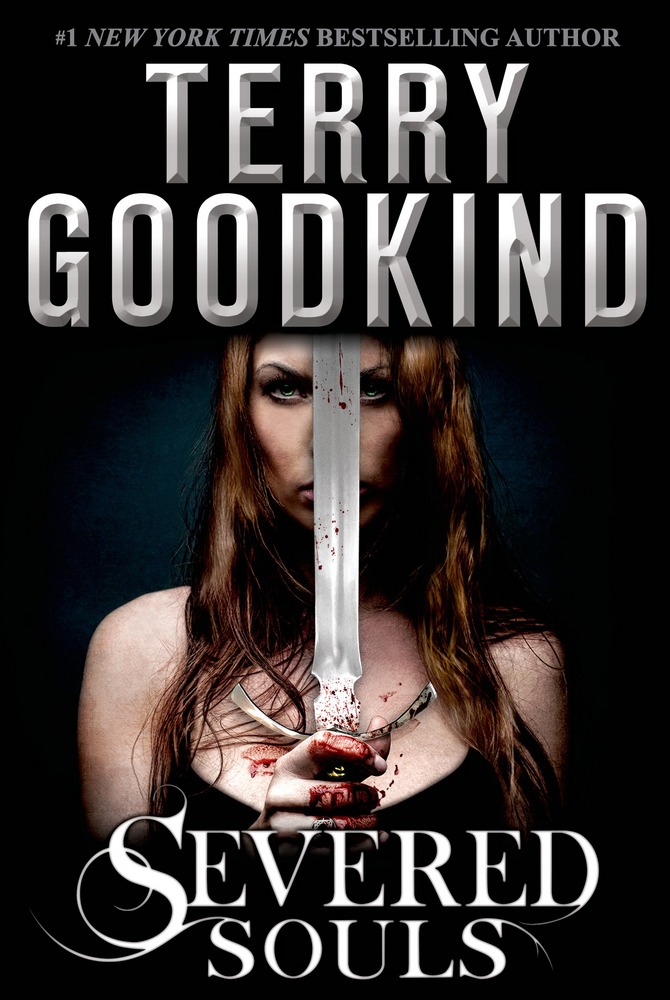


Severed Souls (Sword of Truth #14) by Terry Goodkind (Tor Hardcover 08/19/2014) – Another not-a-fantasy novel by Terry Goodkind, I wonder if Kahlan and Richard will be apart for long patches of the plot and doubt whether the other loves the other


From the far reaches of the D'Haran Empire, Bishop Hannis Arc and the ancient Emperor Sulachan lead a vast horde of Shun-Tuk and other depraved "half-people" into the Empire's heart, raising an army of the dead in order to threaten the world of the living. Meanwhile, far from home, Richard Rahl and Kahlan Amnell must defend themselves and their followers from a series of terrifying threats, despite a magical sickness that depletes their strength and which, if not cured, will take their lives...sooner rather than later.


"Richard saw the point of a sword blade sticking out from between the man’s shoulder blades. He spun back toward Richard after throwing the woman out of the opening, ready to attack. It seemed impossible, but the man looked unaffected by the blade that had impaled him through the chest.

It was then, in the weak light from the fire pit off to the side, that Richard got his first good look at the killer.

Three knives were buried up to their brass cross-guards in the man’s chest. Only the handles were showing. Richard saw, too, the broken end of a sword blade jutting out from the center of the man’s chest. The point of that same blade stuck out from the man’s back.

Richard recognized the knife handles. All three were the style carried by the men of the First File.

He looked from those blades that should have killed the big man, up into his face. That was when he realized the true horror of the situation, and the reason for the unbearable stench of death."

From Terry Goodkind, author of the Sword of Truth series, comes a sweeping new novel of Richard Rahl, Kahlan Amnell, and their world.
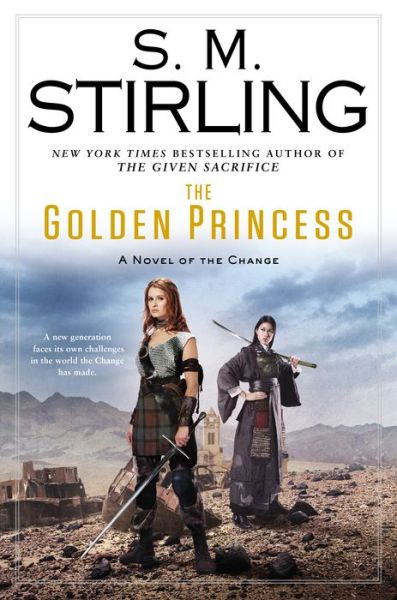


The Golden Princess (A Novel of the Changev/ Rudi’s Children) by S. M. Stirling (Roc Hardcover 09/02/2014) – Like clockwork, it’s September and time for a new novel in Stirling’s Change universe where technology stops working.


A new generation faces its own challenges in the world the Change has made.

Princess Órlaith, heir to Rudi Mackenzie, Artos the First, High King of Montival, now wields the Sword of the Lady—and faces a new enemy. Fortunately, she also has a new ally in Reiko, Empress of Japan, who has been pursued to America by a conquering army from Asia.

To combat their mutual foe, Órlaith and Reiko embark on a quest to find the fabled Kusanagi-no-Tsurugi, the Grass-Cutting Sword, one of the three great treasures of the Japanese Imperial House. But dreams have revealed that the road to Kusanagi lies through the meganecropolis of the City of Angels, the greatest and most perilous of the dead cities...and beyond it, to a castle in the fearful Valley of Death. And their relentless enemy will stop at nothing to prevent them from succeeding.

For across the Pacific, the great arc of land that stretches from the dark kingdom of Korea to the realm of Capricornia in Australia is threatened by war. Now all the survivors of the Change must choose sides...

Friday, August 15, 2014

Friday Roundup: Hobb @ SFFWorld, Abraham @ Tor.com, and Buettner @SF Signal

I haven't posted one of these link round-ups in a couple of weeks. More importantly, this week I posted a new review to SFFWorld, the first in a little over a month.  That isn't to say I haven't been reviewing, but as my plethora (OK, under 700) of twitter followers likely know, I've been posting quite a few reviews to Tor.com over the past few weeks.  So, what does today's fancy link round-up include?

Let's start with my latest review for SFFWorld, a book that I hadn't realized how much I was looking forward to reading it until I stuck my head into it: Fool's Assassin by Robin Hobb.  Admittedly, I was a bit nervous about this one based on how badly I bounced off of her second Soldier Son novel, Forest Mage (more for the story than anything, because through everything Hobb has incredible prose), which was the last book by Robin Hobb I read despite her writing five novels since then. All of that having been said, I was more than satisfied with Fool's Assassin and chances are it will be one of (maybe THE) top fantasy novel for me by year's end.


Years have passed since readers were last privy Fitz’s thoughts, he is now married to his boyhood love Molly, his daughter Nettle (whom Molly’s first husband Burrich raised as his own and is now very much enmeshed in the life of Buckkeep court) has appointed him the Holder of the Withywoods Estate she’s been bequeathed. In short, life for the man many know as Tom Badgerlock is far more bucolic than the courtly intrigue in which he spent much of his life embroiled. Then one Winterfest, a traveling group of minstrels and performers arrive; these strangers are very different indeed and bear little resemblance to any folk to have passed through Withywoods as far as any of the staff and people can remember. Life soon returns to its leisurely pace for Molly and Fitz until Molly boldly proclaims she is pregnant. This is something she and Fitz always wanted for many of the children she bore were from Burrich, her first husband and the man who served as a father figure to Fitz.

Much of the novel from this point deals with Fitz as a father to this new child, a child who appears healthy but much smaller than any child should. This young girl, whom Molly and Fitz come to name Bee, is not very communicative and is very withdrawn. She shirks away from Fitz and bonds immediately to Molly. Because of her diminutive size and silence, she is thought by many of Withywoods to be mentally slow and damaged. As the novel progresses, Hobb conveys the emotional turmoil a parent might experience with a child who is so out of what is considered normal.

Last week, my review of another incredible Epic Fantasy novel went live at Tor.com - The Widow's House by Daniel Abraham.  Abraham is climbing the ranks of my personal favorite genre writers and this book raises his stature on that list even more.


In The Widow’s House, the fourth installment of The Dagger and the Coin sequence, author Daniel Abraham continues to deftly explore positions of power, and how perception lends credence to reality. Abraham tells the story through the same points of view as in the previous volume, though these characters have evolved quite a bit since we first met them. Clara Kalliam, widow, mother, plotter against the Lord Regent; Cithrin bel Sarcour, ‘rogue’ banker, former lover and scorner of the Lord Regent; the aforementioned Geder, Lord Regent and emotional basket case; and Captain Marcus Wester, a hardened man of war. Abraham bookends the novel with two additional points of view: a prologue from the POV of the last Dragon Inys, and an epilogue from a soldier’s point of view.

What is most fascinating about this novel, and the story as a whole as Abraham has allowed it to unfold, is how he is playing with archetypes, both propping them up and shattering them. War is most often fought in Epic Fantasy with the standard machinations of war—men with weapons. What if the solution to winning a war is to not fight the war; to pull the proverbial rug out from under the war and completely change the rules? It is an intriguing concept that has been simmering throughout the series as Abraham set Cithrin and Geder, as seeming allies at first, and now characters at ideological cross purposes.

Lastly (and most recently), my latest Completist column went live at SF Signal and features a more recent series than some of the recent column installments. Robert Buettner's Orphange / Jason Wander 5 book Military Science Fiction series.


This series is set approximately 40 years in the future with Earth being attacked by aliens who come to be known as Slugs. Many of the people chosen for this interstellar war are orphans, people whose families were destroyed in the attacks, which take the form of large stone projectiles, with no nuclear armaments, hurtling through space, which destroy the surrounding area where they land, most often populated cities like Pittsburgh or Indianapolis. It is with this premise Robert Buettner introduces the reader to the world of Orphanage and its protagonist, Jason Wander whose hometown is the destroyed Indianapolis.

The premise of alien invasion and a humanity that fights back is a familiar one in Science Fiction, and military Science Fiction specifically. Furthermore, the first person narrative Buettner employs is quite common in Military SF. However, it is no less effective. Rather, Buettner builds an effective, empathetic protagonist in Jason Wander. With his experience as a former Military Intelligence Officer, it should come as no surprise how effectively Buettner conveys military life.


Sunday, August 10, 2014

Books in the Mail (W/E 2014-08-09)

This week...


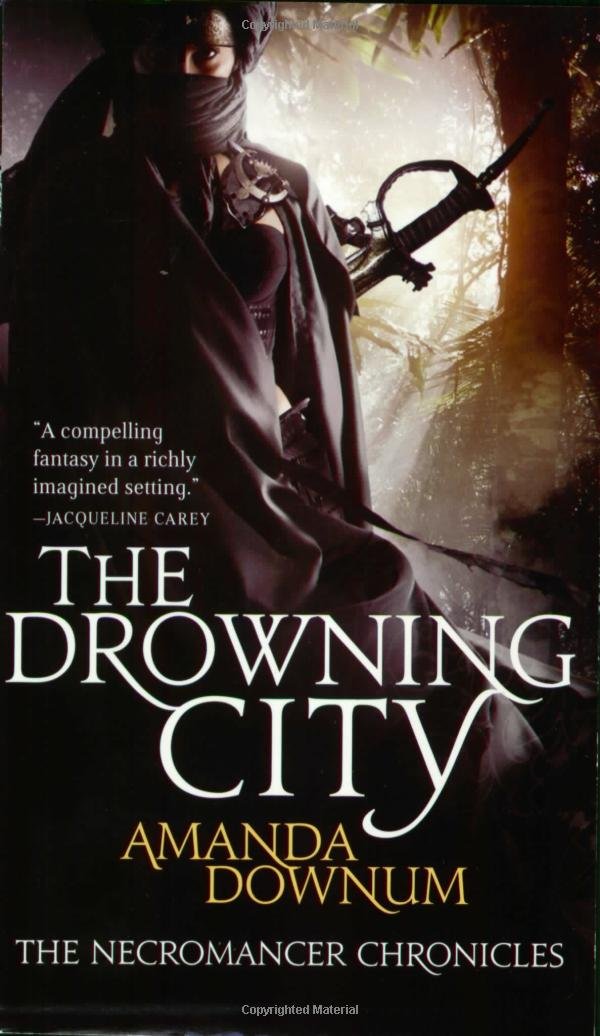
The Drowning City (Book I of The Necromancer Chronicles) by Amanda Downum (Orbit Mass Market Paperback 09/01/2009) – Downum’s debut and launch of the trilogy, which published 5 years ago. I’ve had my eyes on this series for a bit, my colleague Mark Yon favorably reviewed this one when it first published.


Symir -- the Drowning City. home to exiles and expatriates, pirates and smugglers; and violent revolutionaries who will stop at nothing to overthrow the corrupt Imperial government.


For Isyllt Iskaldur, necromancer and spy, the brewing revolution is a chance to prove herself to her crown. All she has to do is find and finance the revolutionaries, and help topple the palaces of Symir. But she is torn between her new friends and her duties, and the longer she stays in this monsoon-drenched city, the more intrigue she uncovers -- even the dead are plotting. 

As the waters rise and the dams crack, Isyllt must choose between her mission and the city she came to save.


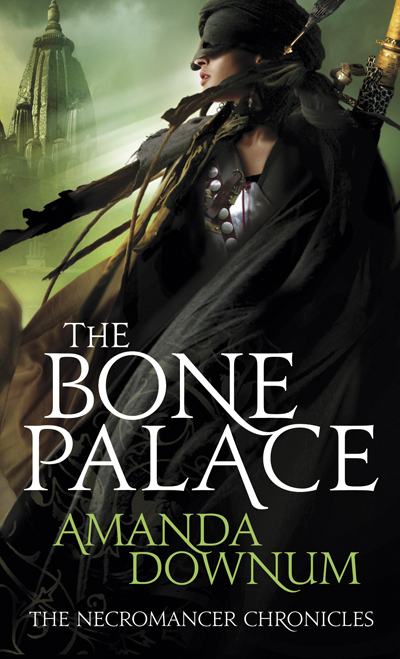
The Bone Palace (Book II of The Necromancer Chronicles) by Amanda Downum (Orbit Mass Market Paperback 12/1/2010) – Second in the trilogy, which published just a year after the first. Liz Bourke’s brief review of the series at Tor.com further convinced me I wanted to give these books a try


Death is no stranger in the city of Erisín-- but some deaths attract more attention than others.


When a prostitute dies carrying a royal signet, Isyllt Iskaldur, necromancer and agent of the Crown, is called to investigate. Her search leads to desecrated tombs below the palace, and the lightless vaults of the vampiric vrykoloi deep beneath the city. But worse things than vampires are plotting in Erisín...

As a sorcerous plague sweeps the city and demons stalk the streets, Isyllt must decide who she's prepared to betray, before the city built on bones falls into blood and fire.


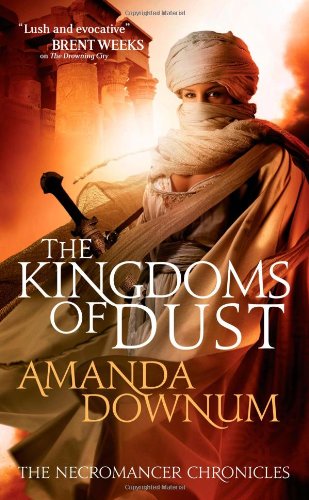
The Kingdoms of Dust (Book III of The Necromancer Chronicles) by Amanda Downum (Orbit Mass Market Paperback 03/02/2012) – When the fabulous Ellen Wright (Orbit’s publicist) tweeted asking if “there's a backlist Orbit book/series you want to read” to let her know, I immediately thought of these books..


With her master dead and her oaths foresworn, necromancer and spy Isyllt Iskaldur finds herself in exile. Hounded by assassins, she seeks asylum in Assar, the empire she so recently worked to undermine.


Warlords threaten the empire's fragile peace, and the empress is beset by enemies within the court. Even worse, darkness stirs in the deep desert. Ancient spirits long held captive are waking - spirits that can destroy Assar faster than any army.

Accompanied by an outcast jinn, Isyllt must travel into the heart of the desert to lay the darkness there to rest once more. But her sympathies are torn between the captive spirits and the order of mages sworn to bind them. And whichever choice she makes could raze the empire to dust.


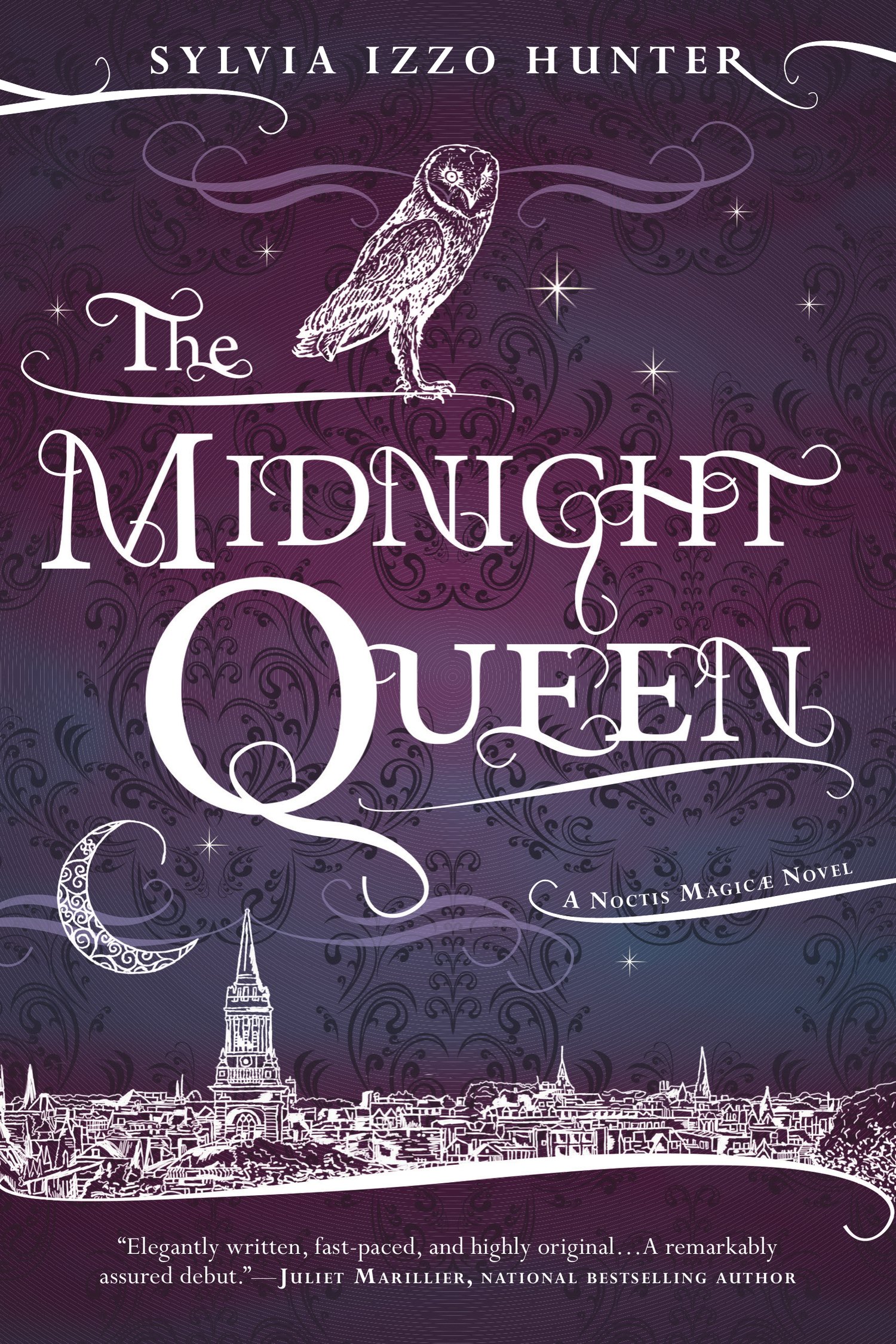
The Midnight’s Queen (Noctis Magicae Book One) by Sylvia Izzo Hunter (Ace Trade Paperback 09/02/2014) – Hunter’s debut; I’d been hearing good things about this from her agent for quite a while. Looking forward to this one, this is the physical copy of the e-ARC I received in June. The fine folks at Tor.com have posted an excerpt.


“In the hallowed halls of Oxford’s Merlin College, the most talented—and highest born—sons of the Kingdom of Britain are taught the intricacies of magickal theory. But what dazzles can also destroy, as Gray Marshall is about to discover…


Gray’s deep talent for magick has won him a place at Merlin College. But when he accompanies four fellow students on a mysterious midnight errand that ends in disaster and death, he is sent away in disgrace—and without a trace of his power. He must spend the summer under the watchful eye of his domineering professor, Appius Callender, working in the gardens of Callender’s country estate and hoping to recover his abilities. And it is there, toiling away on a summer afternoon, that he meets the professor’s daughter.

Even though she has no talent of her own, Sophie Callender longs to be educated in the lore of magick. Her father has kept her isolated at the estate and forbidden her interest; everyone knows that teaching arcane magickal theory to women is the height of impropriety. But against her father’s wishes, Sophie has studied his ancient volumes on the subject. And in the tall, stammering, yet oddly charming Gray, she finally finds someone who encourages her interest and awakens new ideas and feelings.


Sophie and Gray’s meeting touches off a series of events that begins to unravel secrets about each of them. And after the king’s closest advisor pays the professor a closed-door visit, they begin to wonder if what Gray witnessed in Oxford might be even more sinister than it seemed. They are determined to find out, no matter the cost…


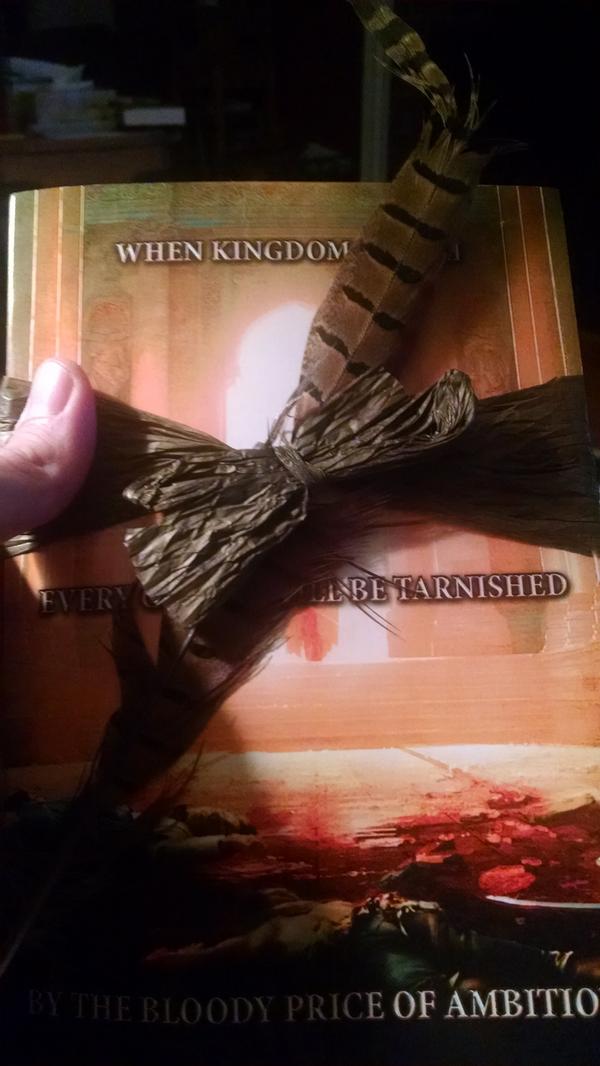
The Falcon Throne (The Tarnished Crown Book One) by Karen Miller (Orbit Hardcover 09/09/2014) – First in a brand new series for Miller, who is one of Orbit’s most successful authors. This is also her first hardcover, so a promotion for her as well. The Fabulous Ellen (Orbit’s PR Sorceress) sent out the review copy tied up with a feather. Very cool.


NO ONE IS INNOCENT. EVERY CROWN IS TARNISHED.
A royal child, believed dead, sets his eyes on regaining his father's stolen throne.

A bastard lord, uprising against his tyrant cousin, sheds more blood than he bargained for.

A duke's widow, defending her daughter, defies the ambitious lord who'd control them both. 

And two brothers, divided by ambition, will learn the true meaning of treachery.

All of this will come to pass, and the only certainty is that nothing will remain as it once was. As royal houses rise and fall, empires are reborn and friends become enemies, it becomes clear that much will be demanded of those who follow the path to power. 


The Emperor’s Blades (Book One of The Chronicle of the Unhewn Throne) by Brian Staveley (Tor Trade Paperback 08/26/2014) – I am glad to get a copy of this because Brian really stood out on the panel at NYCC in October 2013 on which he participated and I’ve seen such good things about this book.


In The Emperor's Blades by Brian Staveley, the emperor of Annur is dead, slain by enemies unknown. His daughter and two sons, scattered across the world, do what they must to stay alive and unmask the assassins. But each of them also has a life-path on which their father set them, destinies entangled with both ancient enemies and inscrutable gods.


Kaden, the heir to the Unhewn Throne, has spent eight years sequestered in a remote mountain monastery, learning the enigmatic discipline of monks devoted to the Blank God. Their rituals hold the key to an ancient power he must master before it's too late. 

An ocean away, Valyn endures the brutal training of the Kettral, elite soldiers who fly into battle on gigantic black hawks. But before he can set out to save Kaden, Valyn must survive one horrific final test. 

At the heart of the empire, Minister Adare, elevated to her station by one of the emperor's final acts, is determined to prove herself to her people. But Adare also believes she knows who murdered her father, and she will stop at nothing—and risk everything—to see that justice is meted out.


Friday, August 08, 2014

Parasite by Mira Grant - A Review & Hugo Potential

This is a bit of an expanded version of my review/Hugo Appreciation Post for Mira Grant's Parasite, which originally appeared on Tor.com on July 25, 2014.


Mira Grant (aka Seanan McGuire) has achieved a level of notoriety many authors would hope to achieve, she has many fans and her books can often be found on awards ballots, her 2013 novel Parasite is no exception. While her Newsflesh trilogy (FEED, DEADLINE, BLACKOUT) was published as mass market paperback, Grant was promoted to hardcover for Parasite.

Admittedly, the central conceit of Parasite is a large pill to swallow, faith while leaving some logic at the door. In Grant’s near future thriller, the majority of the world has ingested an Intestinal Bodyguard, a tapeworm parasites to help our weakened immune systems. On top of that, all the tapeworm parasites people have ingested are controlled by one company – SymboGen. So yeah, if you can get past those two large grains of salt for the plot’s conceit, I would suggest you hold on because Grant does unfurl a very briskly paced narrative in Parasite.

Grant seems very comfortable utilizing the first person narrative; she did so in her Newsflesh trilogy and here in Parasite employs the first person to tell the story through the voice and experience of Sally “Sal” Mitchell. Sal is a young woman who has miraculously recovered, thanks to her SymboGen implant, from a vehicular accident that left her in a coma. Parasite opens about six years after Sal awakens having relearned how to function in society. Simple things like talking, walking, and the basic tenets of living had to be relearned. She is also a ward of her parents (her father conveniently works as an epidemiologist for USAMRIID, the US Army’s Infectious Disease unit), who treat her like a child. Her sister, Joyce (also conveniently an epidemiologist like her father) seems to like the new Sal better than the previous incarnation of her sister. In a sense, Sal is only 6 years old, but she won’t hear any of that. She has a job at working with animals, a boyfriend (Nathan Kim, who conveniently is a doctor specializing in parasites), and she is required to report in with SymboGen, specifically the head of the company Dr. Steven Banks, and a psychiatrist so her mental and physical health can be monitored.

Sal yearns to be more independent, apart from her parents and not under such scrutiny from SymboGen. She begins to see strange things: people are becoming mindless sleepwalkers (NOT ZOMIBES); sometimes violent but definitely not themselves. First a young girl and her parent, then a man and his dog, at which time Sal’s affinity towards animals comes into play. She calls the dog, Beverly, away from its shambling (NOT A ZOMBIE) owner and effectively gains a four-legged companion. These transformations from people into (NOT ZOMBIES) “sleepwalkers” continues and escalates as the novels progresses.

In SymboGen, Grant has given us the requisite not-so-benign Medical MegaCorp. The majority of the chapters are prefaced with quotes from “interviews” with SymboGen’s Steven Banks and an unpublished autobiography of co-founder Dr. Shanti Cale who has disappeared. The third founder, Richard Jablonsky, committed suicide prior to the events of the novel. So yeah, that all makes for quite a shady organization. Many chapters are also prefaced with quotes from a fictional and very creepy children’s book Don’t Go Out Alone. (I for one would buy a fancy limited edition of Don’t Go Out Alone should it come into existence).

Grant unpacks a lot of the science behind the tapeworms through character dialogue and it mostly works, though the frenetic pacing before such scenes pushed me to read through those passages very quickly and to re-read them. I said earlier that there’s the leap of logic over a grain of salt required to fully absorb oneself in Parasite, and I would also suggest that that one stick the coincidences alongside that large grain of salt. There are quite a few conveniences with the characters; most prominently that Sal’s father is high up in the military division responsible for defensive / countermeasures against biological warfare where sister Joyce also works. Her boyfriend just happens to have a strong connection in the world of parasites and later familial connections which are revealed come across as very convenient.

There was one particular scene of (NOT ZOMBIES) sleepwalkers giving Sal some problems when she was home alone with her new dog Beverly that was very effective. Grant captures an extremely claustrophobic feel in that scene, which also highlighted just how helpful a loving, protective dog could be in such a situation. This was in the latter half of the book, and the emotional fallout, as well as the story fallout as a result of that scene ratcheted up the tension for the remainder of the novel.

Having read and enjoyed the Newsflesh trilogy there were quite a few familiar beats in the novel. Sal could be an analogue to George/Georgia (Newsflesh’s protagonist) and Tansy felt like a cousin to Becks. That said; the character whom Tansy felt most similar to on a larger comparative scale is Harley Quinn, the Joker’s girlfriend/sidekick. The other thing that I found frustrating is the lack of the word Zombie. The “sleepwalkers” exhibited all of the signs associated with zombies, from the shambling to the attacking. On the other hand, the great film 28 Days Later also eschewed such strict zombie classification. Lastly, this novel, more than any I can recall reading (at least recently) ends like a freight train zooming at high-speed into a gigantic wall. The pacing was moving along very quickly for much of the last half just before a Kick-WHAM reveal and the novel ends to the point where I wonder if this was one book awkwardly split into two.

I will say that Grant has a powerful narrative that managed to pull me through its twists and turns regardless those above-mentioned quibbles. Parasite is an at times fun, at others, frustrating read. It is equal parts horror, conspiracy thriller, and science fiction novel with a large influence of Stephen King in its text. (Grant/McGuire, like myself, is a big fan of Stephen King). I found myself reading the book very quickly, being absorbed in the story, and enjoying what I read as I read it, so on the whole I’d say Parasite was a successful book for me.

Is it worthy of a Hugo though? That’s an easier question, I don’t think so. Like Charles Stross (also on this year’s ballot), it seems Grant’s name is almost an automatic thing on awards ballots in recent years. Science/biology/parasitology is such a large component of the novel, so it fits the genre mode. But the size of the grain of salt in the adage of “take it with a grain of salt” as it relates to the central conceit (the majority of the world happily ingesting tapeworm parasites) in Parasite, I think, is far too large. The narrative pulled me along, but I’m not sure Parasite will stand with me for a long time afterwards. While an enjoyable novel, it isn’t one that to me says Award Winner.


Review post-script/confession:  I really enjoyed Grant's Newsflesh trilogy when I read them, I found them gripping page turners in the truest sense. The narrative pull of the novels allowed me to overlook some of the quirks of the books.  I'll admit reading other people's reviews of Grant's work, as well as listening to some podcasts where her work was discussed, sort of put me off diving into Parasite immediately. Those reviews and podcasts pointed out some of those quirky elements I'd overlooked because the narrative pull of the books. I felt those reviews/podcasts called into judgement my (for lack of a better term) credibility as a reader and reviewer.  However, Parasite pulled me in quite quickly even despite some of the "quirks" I mentioned above (major coincidences and the fact that the word Zombie is not uttered in the novel). 

Wednesday, August 06, 2014

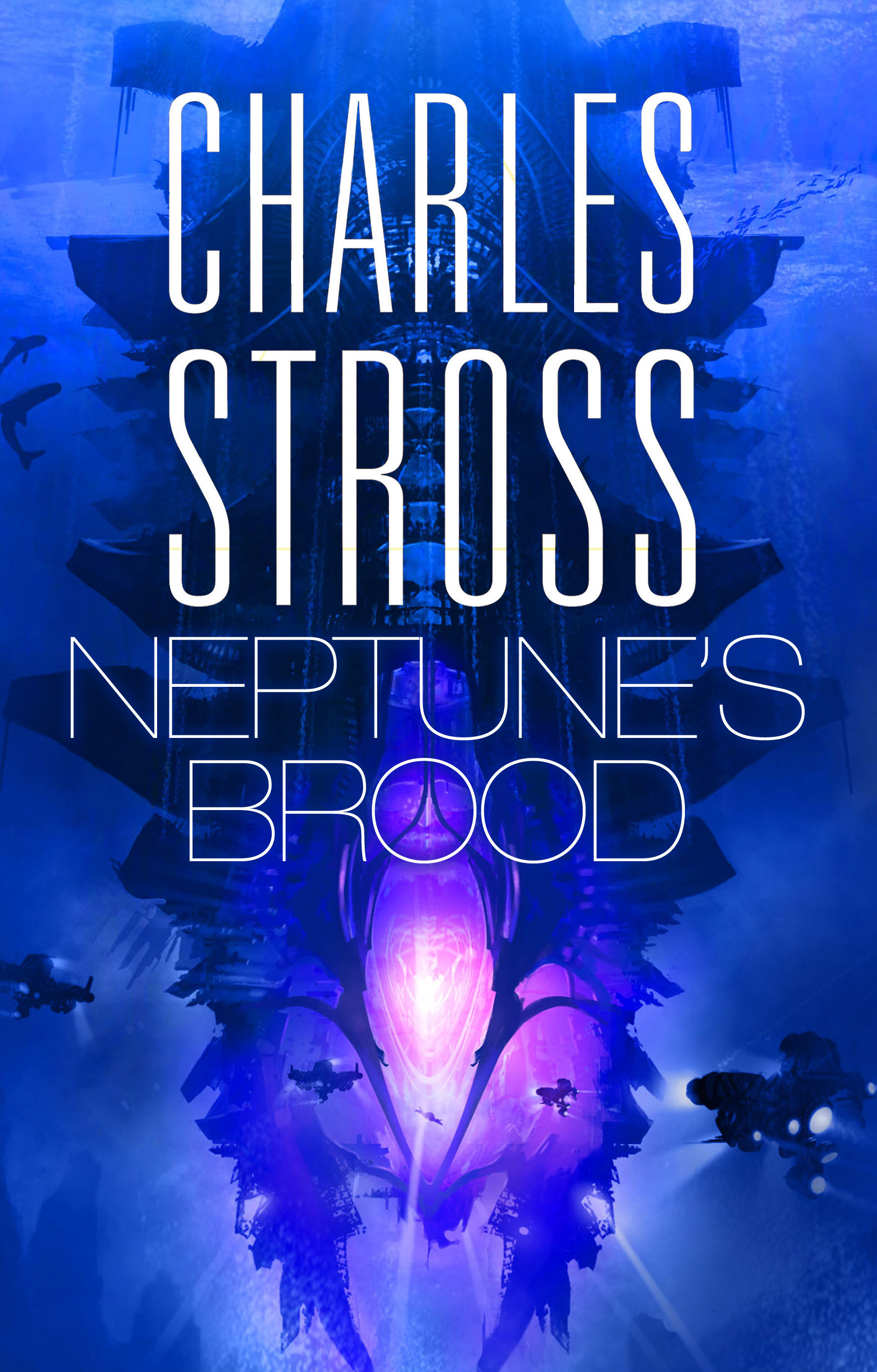
Neptune's Brood by Charles Stross - A Review & Hugo Potential

This is a bit of an expanded version of my review/Hugo Appreciation Post for Charlie Stross's Neptune's Brood,which originally appeared on Tor.com on July 17, 2014.


Charles Stross is a mainstay on genre award ballots every year; 2014 marks his seventh appearance on the short list for the Hugo Award for Best Novel. There’s good reason for these accolades because when it comes to plausible and well-thought out future scenarios, few can invent better scenarios than Stross. Neptune’s Brood, in this case, imagines a post-human, far future where we as humanity have become a thing of the past often referred to as Fragiles. The novel is many things, but a primary thrust is economics in the future and a supposed defrauding scam as it features Krina Alizond-118 on her journeys through the galaxy.

The first novel set in the far
future of Neptune's Brood
Neptune’s Brood is a "sort-of"* sequel to Stross’s 2006 novel, Saturn’s Children (also nominated for a Hugo) set thousands of years into the future of that novel (itself already far into humanity’s future).  Stross takes the post-human universe he created in the previous novel and builds a framework for the economics of the milieu while telling a story that has much in common with a mystery/thriller while also focusing on the notion of identity of the individual.  Heady stuff, no?

*Different characters and further in the future than Saturn's Children. but Neptune's Brood easily stands on its own.

The novel focuses primarily on Krina Alizond-118 as she searches for her missing “sister” Ana Graulle-90 (which in this sense indicates they are cloned from the same being). Krina, with her deep knowledge of the history of accounting and banking, manages to get passage on a space vessel after being convinced to offer her services as a banker. It isn’t long before Krina becomes involved with interstellar pirate bankers, learns more about her sister, and receives body modification to become a mermaid on the water world of Shin-Tethys to find her missing or perhaps dead sister.  On top of all of that, Krin tells us, in her first person narrative, she has a stalker and discovers what amounts to a 2,000-year old money laundering scam which hinges on an object which might be in the possession of her sister. So yeah, lots of stuff going on here.

For my tastes; however, I didn’t fully connect with a lot of the story.  There were multiple info-dumps throughout the story, many of which begin with Krina stating that she was going to tell us a story. In one such instance Krina even says “I am now going to bore you to death with the political economy of Shin-Tethys.” I realize there’s a heavy dose of snark in that statement, but t it still niggles at me that a character would tell us she is going to bore us to death and is almost an invitation to skip ahead. A lot of the info-dumps relay the minutia of the future banking system (slow, medium, and fast money) and how Krina is able to circumvent the system as well as the two-thousand year old FTL-scam which brings Krina more focused on finding her sister. While the concept is quite intriguing, at times I felt lectured at and that I was reading an academic piece rather than a piece of fiction. All of that having been said, in the end, I can see why the novel would work for so many people, while realizing it didn’t fully work for me.  But this is only half the discussion since…

In terms of its worthiness/chances on winning the Hugo Award for best novel, Neptune’s Brood does indeed seem like the type of novel that should be at least short-listed. Aside from the fact that Stross is the author and seems to appear on these lists regularly, the novel takes a rather unexplored concept – economics, and couches the discussion of that concept in a (relatively) familiar setting for Science Fiction – that of the far future while also checking off the post-human, body-modification, and adventure boxes in the novel. From a superficial level, then, Stross strikes a good balance between new approach and familiar elements.

So where does this rank against the other Hugo nominees? It is hard to argue against Ancillary Justice winning because the book has won nearly every award for which it was short-listed.  The Wheel of Time is also hard to ignore as a nominee considering the size of its fan base, but it is difficult to know how much of those fans will be casting final ballots.  Parasite by Mira Grant marks her fourth consecutive nomination. I haven’t (yet) read the book, but seems to hit the same spot as it did for readers of her entertaining Newsflesh trilogy, so seeing her name here is not much of a surprise.  This, at last, brings us to Larry Correia’s Warbound, the third book in his Grimnoir Chronicles, again, one I haven’t read though I have enjoyed the Monster Hunter books he’s written. Larry clearly has his fans, too.

That said and simply judging Neptune’s Brood against its competitors, I’ve got to think Stross will eventually receive the award for Best Novel.  Though Neptune’s Brood has received the same kind of praise previous works by Stross have, I’m not sure this is Charlie’s year considering his competition. On the other hand, this convention is as close to his own backyard for Stross so there may be some support from potentially local attendees to push Neptune’s Brood to the top.

Sunday, August 03, 2014

Books in the Mail (W/E 2014-08-02)

Just one book this week, I suspect there's still some jet lag from San Diego Comic-Con last week.


Storm Siren by Mary Weber (Thomas Nelson Hardcover 11/19/2014) – This is Weber’s debut novel and the first in series.


As a slave in the war-weary kingdom of Faelen, seventeen-year-old Nym isn’t merely devoid of rights, her Elemental kind are only born male and always killed at birth—meaning, she shouldn’t even exist.


Standing on the auction block beneath smoke-drenched mountains, Nym faces her fifteenth sell. But when her hood is removed and her storm-summoning killing curse revealed, Nym is snatched up by a court advisor and given a choice: be trained as the weapon Faelen needs to win the war or be killed.

Choosing the former, Nym is unleashed into a world of politics, bizarre parties, and rumors of an evil more sinister than she’s being prepared to fight . . . not to mention the trainer whose dark secrets lie behind a mysterious ability to calm every lightning strike she summons.

But what if she doesn’t want to be the weapon they’ve all been waiting for?

Set in a beautifully eclectic world of suspicion, super abilities, and monsters, Storm Siren is a story of power. And whoever controls that power will win.

Friday, August 01, 2014

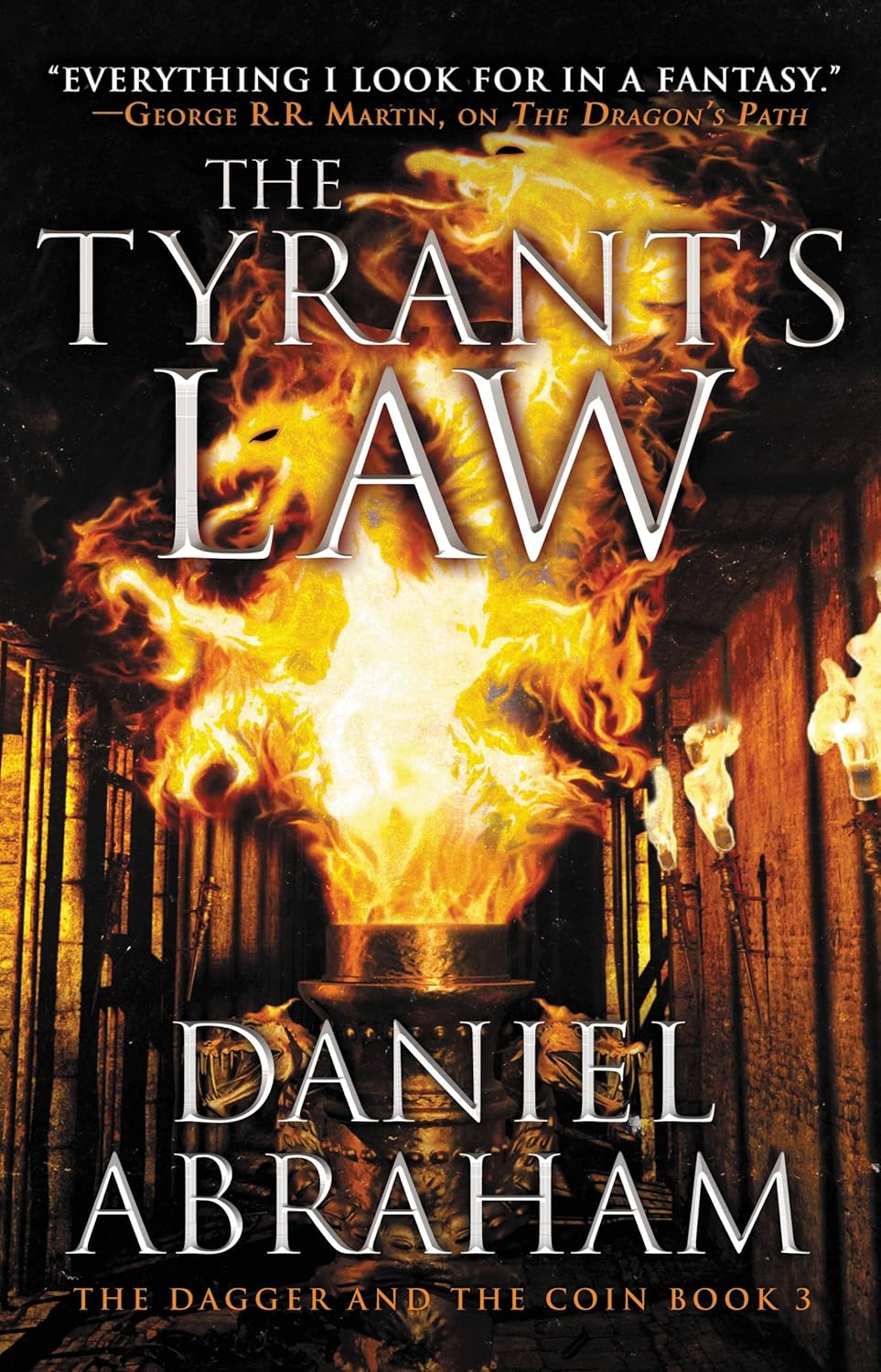
The Tyrant's Law by Daniel Abraham (From the Archives)

With the fourth installment of Daniel Abraham's The Dagger and the Coin sequence publishing next week, I figured I would repost my review of the third installment, The Tyrant's Law which originally appeared on Tor.com...


Banking and ancient races, these are two of the main forces driving the narrative of the characters of and world events in Daniel Abraham’s The Tyrant’s Law. The novel is the third book of his ongoing series The Dagger and the Coin, and is further proof that Daniel is crafting what is arguably one of the finest long form epic stories of the 21st Century.

The main players of the series have been scattered, following their own character arcs despite each of those arcs being connected to the Lord Regent of Antea Geder Palliako (more on that below). Geder is ruling the empire in the place of the young prince Aster, whose father died in the prior installments. Fueling much of Geder’s power is the growing cult of the spider goddess, churches of which have been established throughout the empire.

Geder’s powerful tyrannical influence in the world has left Clara Kalliam’s family in disgrace, her husband killed and branded as a traitor in the previous novel The King’s Blood. Though she was raised to POV character in the previous novel, she has much more impact and is a greater presence here in The Tyrant’s Law. Clara’s sons have spoken out against their father and one of her sons in particular, Jorey, has re-won the favor of Geder since the two were childhood friends. Meanwhile, Clara’s been cast down the social ladder and gets a better idea of how much of an impact Geder’s tyrannical reign of power is affecting people. From the bottom of society, Clara is moving pieces on a chessboard of her own making in order to take down Geder.

Cithrin bel Sarcour’s past dalliance with Geder provides much tension as she ruminates on how to improve the world from her standpoint as a Medean banker. Her role in the bank provides great access to power and control, though she’s still beholden to the rules of the kingdom as enforced by the word of Geder. Abraham does not provide easy choices for his characters, and perhaps Cithirn exemplifies this most profoundly. While he doesn’t outright torture them in the same way Robin Hobb tortures her characters, Abraham’s character’s decisions come with consequences that are far from pleasant, despite the decision the character makes. It is rarely a ‘best’ choice but rather a ‘least bad’ choice.

The fourth POV character is Captain Marcus Wester, a man who left Cithrin in the previous volume with many unresolved feelings and with little warning to his former ward. Wester is acting as a companion and protector for former actor and apostate of the spider goddess cult, Kit. The two men’s storyline forms something of a quest as the two men search for the heart of the spider herself as well as magical items they hope will help to bring down the cult of the spider goddess. What they eventually find is a more surprising reality than they expected.

I’ve previously remarked in how empowering Abraham’s female characters are – they operate as active characters who take control of their lives rather than react to the men around them. Clara’s story arc was perhaps the strongest, whether this was because she was new or because it was the most complex. The fact that she is a widow is a great indicator that she has a fresh start, Clara takes that proverbial ball and runs with it, awakening many aspects of herself she thought she knew – her mind, her drive for justice, her sexuality. She walks a thin line which divides the surface appearance of her actions and the true intent of her actions. As the series progresses, I suspect this line will only become thinner as her maneuverings have a greater effect on the world at large.

In Geder, the super-villain protagonist arc continues to a greater degree from the previous volume. Despite how other characters feel about him, particularly Clara and Wester, it is difficult to dispute some of the decisions he makes and at times, even empathize with those decisions. He isn’t entirely unlikeable, which adds to his strength as a character. Geder sees himself as acting in the best interest of the land he is ruling. The proactive decisions he makes about the empire and how to enforce its strength and growth, are in some senses, reactions to how he perceives others characters view him. An event towards the end of the novel will likely prove to be the tipping point that pushes him over the edge into true Lex Luthor / Walter White territory and cement him as the human-facing Big Bad of the series.

By keeping the viewpoint to four characters, Abraham gives himself the freedom to provide readers a greater insight to each of the characters and to impart upon them believability, plausibility and empathy. In this sense, the intimacy we get as readers allows us to feel a greater sense of urgency of the epic events of the novel as a whole as they affect both the world and those characters we’ve come to know.

On the one hand, it is difficult to distill into one review the pure enjoyment the settles into me when I read these books (or as I’m coming to realize, anything Daniel Abraham writes). As the pages would slide past, the small movements of Abraham’s narrative come together to former a great whole that informs the novel as it barrels forward with great momentum. I’ve long been a fan of Epic Fantasy and when it is handled properly, expertly, there’s no form of entertainment I’d rather be enjoying. Such is the case with the books in The Dagger and the Coin. Everything he’s done in the previous novels so well, Abraham continues to do well here in The Tyrant’s Law.


The series is highly recommended and so is this particular installment, but with the caveat that you go and immediately read The Dragon’s Path and The King’s Blood.

(This review originally appeared on Tor.com on May 10, 2013)

Monday, July 28, 2014

Wars to End All Wars: Alternate Tales from the Trenches Published!

As a member of the SFFWorld team (lead US book reviewer, forum moderator) for the past decade and more, I've come across quite a few folks: fans, published authors,  and people behind the scenes. One of those people is writer and  editor N.E. White.  Nila has been editing anthologies comprised mainly of stories from members of the SFFWorld writing community, which is a very vibrant and strong community. I'd even say over the past few years, the writer's forum/community has been the most consistent and active of the many subforums. Each year Nila has compiled anthology, she has featured a big name, published writer. The first anthology featured Michael J. Sullivan and Hugh Howey, last year's featured Mark Lawrence and this year's anthology features another favorite author: Elizabeth Moon. (Yes, that New York Times best selling and award winning Elizabeth Moon who wrote a trilogy of books that resides in my Omnibus Hall of Fame).

My part in this was small, I read most of the submitted stories, provided feedback (whether the story should our shouldn't be included) and gave each story a full edit. So, without further ado, here's Wars to End All Wars: Alternate Tales from the Trenches.

Alternate tales set during the first World War, this short story collection takes history and tweaks it.

2014 marks the 100th anniversary of the start of World War 1. Seven authors, including the award-winning Science Fiction and Fantasy author, Elizabeth Moon, commemorate that event by writing stories set during the great war, adding their own, sometimes speculative, interpretations and answering the question, "What if...?"


Here's the full table of contents:


  1. “The Girl with the Flaxen Hair” by Igor Ljubuncic
  2. “Wormhole” by Lee Swift
  3. “Jawohl” by Wilson Geiger
  4. “Tradition” by Elizabeth Moon
  5. “On the Cheap” by Dan Beiger
  6. “One Man’s War” by G.L. Lathian
  7. “The Foundation” by Andrew Leon Hudson
The book is currently only $.99 and can be found at your favorite here:

Barnes and Noble, Kobo, iTunes, etc. generally take a little longer.

Sunday, July 27, 2014

Books in the Mail (W/E 2014-07-26)

Small batch of arrivals this week. I suspect many of the folks who normally would send me stuff are heavily involved in San Diego Comic Con...


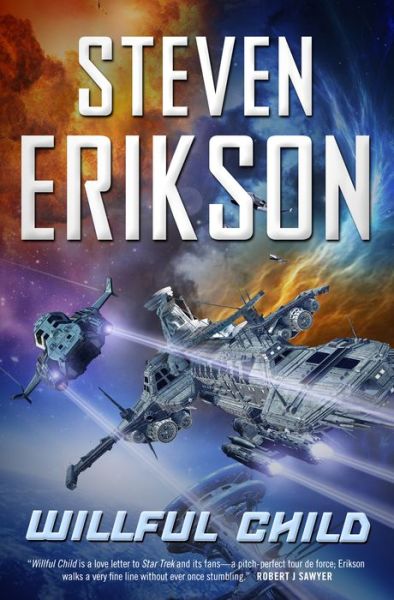
Willful Child by Steven Erikson (Tor Hardcover 11/04/2014) – Erikson changes tune here with is first Science Fiction novel, which has a Space Opera/Military SF feel.


From the New York Times Bestselling author Steven Erikson comes a new SF novel of devil-may-care, near calamitous and downright chaotic adventures through the infinite vastness of interstellar space.


These are the voyages of the starship A.S.F. Willful Child. Its ongoing mission: to seek out strange new worlds on which to plant the Terran flag, to subjugate and if necessary obliterate new life-forms, to boldly blow the...

And so we join the not-terribly-bright but exceedingly cock-sure Captain Hadrian Sawback and his motley crew on board the Starship Willful Child for a series of devil-may-care, near-calamitous and downright chaotic adventures through ‘the infinite vastness of interstellar space.’

The New York Times bestselling author of the acclaimed Malazan Book of the Fallen sequence has taken his lifelong passion for Star Trek and transformed it into a smart, inventive, and hugely entertaining spoof on the whole mankind-exploring-space-for-the-good-of-all-species-but-trashing-stuff-with-a-lot-of-high-tech-gadgets-along-the-way, overblown adventure. The result is an SF novel that deftly parodies the genre while also paying fond homage to it.

Assail (A Novel of the Malazan Empire) by Ian Cameron Esslemont (Tor Hardcover 05/21/2013) – I’ve only read Night of Knives in this second Malazan sequence, so I’ve got some catching up to do with ICE’s brand of Malazan stories. Mark Yon and I interviewed with him up at the SFFWorld last year.

Tens of thousands of years of ice is melting, and the land of Assail, long a byword for menace and inaccessibility, is at last yielding its secrets. Tales of gold discovered in the region’s north circulate in every waterfront dive and sailor’s tavern, and now countless adventurers and fortune-seekers have set sail in search of riches.

Into this turmoil ventures the mercenary company, the Crimson Guard. Not drawn by contract, but by the promise of answers: answers to mysteries that Shimmer, second in command, wonders should even be sought.

Arriving also, part of an uneasy alliance of Malazan fortune-hunters and Letherii soldiery, comes the bard Fisher kel Tath. And with him is a Tiste Andii who was found washed ashore and cannot remember his past life, yet who commands far more power than he really should. Also venturing north is said to be a mighty champion, a man who once fought for the Malazans, the bearer of a sword that slays gods: Whiteblade.

And lastly, far to the south, a woman guards the shore awaiting both her allies and her enemies. Silverfox, newly incarnated Summoner of the undying army of the T’lan Imass, will do anything to stop the renewal of an ages-old crusade that could lay waste to the entire continent and beyond.


Sunday, July 20, 2014

Books in the Mail (W/E 2014-07-19)

Just one book this week, but a major release for 2014...


The Widow’s House (The Dagger and the Coin #4) by Daniel Abraham (Orbit Trade Paperback 08/05/2014) – Any time a Daniel Abraham book arrives, I’m happy, I’ll be reviewing this for Tor.com


THE RISE OF THE DRAGON AND THE FALL OF KINGS

Lord Regent Geder Palliako's war has led his nation and the priests of the spider goddess to victory after victory. No power has withstood him, except for the heart of the one woman he desires. As the violence builds and the cracks in his rule begin to show, he will risk everything to gain her love or else her destruction.

Clara Kalliam, the loyal traitor, is torn between the woman she once was and the woman she has become. With her sons on all sides of the conflict, her house cannot stand, but there is a power in choosing when and how to fall.

And in Porte Oliva, banker Cithrin bel Sarcour and Captain Marcus Wester learn the terrible truth that links this war to the fall of the dragons millennia before, and that to save the world, Cithrin must conquer it.
THE RISE OF THE DRAGON AND THE FALL OF KINGS

Lord Regent Geder Palliako's war has led his nation and the priests of the spider goddess to victory after victory. No power has withstood him, except for the heart of the one woman he desires. As the violence builds and the cracks in his rule begin to show, he will risk everything to gain her love or else her destruction.

Clara Kalliam, the loyal traitor, is torn between the woman she once was and the woman she has become. With her sons on all sides of the conflict, her house cannot stand, but there is a power in choosing when and how to fall.

And in Porte Oliva, banker Cithrin bel Sarcour and Captain Marcus Wester learn the terrible truth that links this war to the fall of the dragons millennia before, and that to save the world, Cithrin must conquer it.

Friday, July 18, 2014

Link Round-up Corey @ SFFWorld, Mind Meld @ SF Signal, Stross @ Tor.com

It has been a while since I did one of my link round-ups of my reviews and assorted writings, so here goes...

Last week I posted my review of what will likely be one of my favorite SF novels of the year (I might even decide to register for Hugo voting so I can nominate it), Cibola Burn by James S.A. Corey, the fourth book in their superb Expanse series:


Returning as one of the primary viewpoint characters is James Holden, captain of the Rocinate. Holden is one of the most famous men in the solar system, thanks to the events detailed in the previous three novels of THE EXPANSE (Leviathan Wakes, Caliban’s War, and Abaddon’s Gate). As in those novels, Corey tells the story through multiple Points of View: Elvi Okoye, one of the scientists on New Terra charged with cataloguing the various life forms and the environment; Havelock, a security officer aboard one of ships orbiting New Terra; and Basia Merton, one of the first colonists who arrived (squatters, one might say) on New Terra and part of a group unhappy with the RCE.
...
The conflict between the colonists and RCE is not the only problem on this new world, even if it is the primary “human-level” problem, so to speak. Globally, New Terra is not a completely lifeless world. An ancient civilization, the one thought to be responsible for the protomolecule has left ancient remnants of itself scattered around the planet. These things are hybrids between machines and organic life and some of them are waking up.
Holden is still haunted by the ghost or borrowed personality of Miller, the investigator from Leviathan Wakes who has been prodding and guiding Holden in all things related to the protomolecule. Though Holden is perturbed by this continued haunting, Miller’s voice is absolutely essential to the novel.

Earlier this week (Wednesday) the second Mind Meld I curated for SF Signal was posted, wherein I ask:


Participants for this one included:


Lastly, I reviewed and gave a Hugo handicapping assessment to Charles Stross's Neptune's Brood at Tor.com, which didn't completely work for me:


Neptune’s Brood, in this case, imagines a post-human, far future where we as humanity have become a thing of the past often referred to as Fragiles. The novel is many things, but a primary thrust revolves around economics in the future and a supposed defrauding scam as it features Krina Alizond-118 on her journeys through the galaxy.
...
The novel focuses through first-person narration on Krina Alizond-118 as she searches for her missing “sister” Ana Graulle-90 (which in this sense indicates they are cloned from the same being). Krina, with her deep knowledge of the history of accounting and banking, manages to get passage on a space vessel after being convinced to offer her services as a banker. It isn’t long before Krina becomes involved with interstellar pirate bankers, and eventually receives body modification to become a mermaid on the water world of Shin-Tethys in order to search for Ana. On top of all of that, Krina tells us, she has a stalker and discovers what amounts to a 2,000-year old money laundering scam which hinges on an object which might be in the possession of her sister. So yeah, lots of stuff going on here.


Sunday, July 13, 2014

Books in the Mail (W/E 2014-07-12)

A trio of books arrived this week and each of them look very inviting...


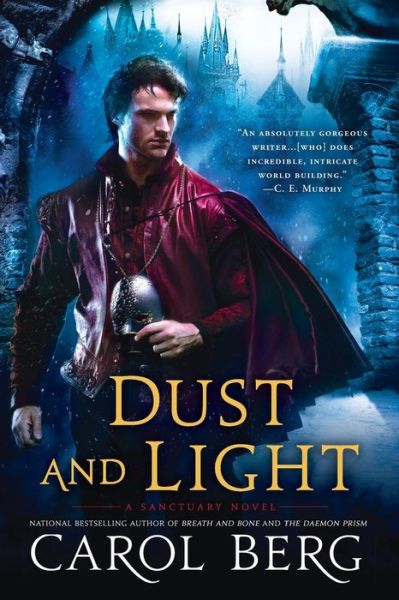
Dust and Light (A Sanctuary Novel #1) by Carol Berg (Roc, Trade Paperback 08/05/2014) – Berg has been on my radar for a couple of years, even more so over the past few years as a few SFFWorld forum members whose opinion I trust (Erfael, NickeeCoco, and suciul specifically) and my friend Sarah Chorn, have recently been raving about her work. This book looks like it is friendly to readers who haven’t read her previous books, which is just what I need.

National bestselling author Carol Berg returns to the world of her award-winning Flesh and Spirit and Breath and Bone with an all-new tale of magic, mystery, and corruption....

How much must one pay for an hour of youthful folly? The Pureblood Registry accused Lucian de Remeni-Masson of “unseemly involvement with ordinaries,” which meant only that he spoke with a young woman not of his own kind, allowed her to see his face unmasked, worked a bit of magic for her....After that one mistake, Lucian’s grandsire excised half his magic and savage Harrowers massacred his family. Now the Registry has contracted his art to a common coroner. His extraordinary gift for portraiture is restricted to dead ordinaries—beggars or starvelings hauled from the streets.

But sketching the truth of dead men’s souls brings unforeseen consequences. Sensations not his own. Truths he cannot possibly know and dares not believe.

The coroner calls him a cheat and says he is trying to weasel out of a humiliating contract. The Registry will call him mad—and mad sorcerers are very dangerous....


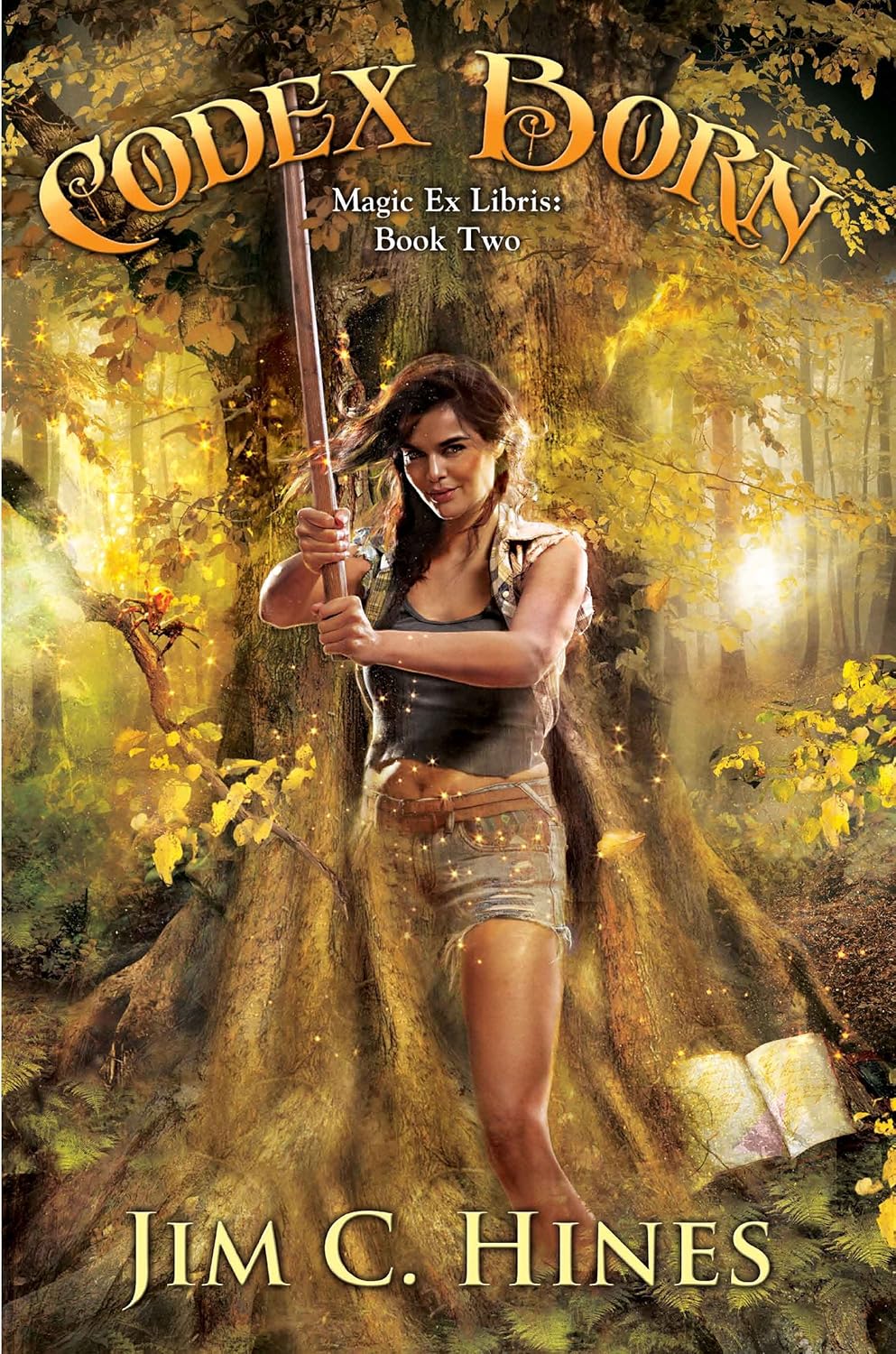
Codex Born (Magic Ex Libris #2) by Jim C. Hines (DAW Books, Hardcover 08/05/2014) – I read and thoroughly enjoyed Libriomancer when I read it a few years ago and look forward to picking up Isaac’s story here.

Five hundred years ago, Johannes Gutenberg discovered the art of libriomancy, allowing him to reach into books to create things from their pages. Gutenberg’s power brought him many enemies, and some of those enemies have waited centuries for revenge. Revenge which begins with the brutal slaughter of a wendigo in the northern Michigan town of Tamarack, a long-established werewolf territory.

Libriomancer Isaac Vainio is part of Die Zwelf Portenære, better known as the Porters, the organization founded by Gutenberg to protect the world from magical threats. Isaac is called in to investigate the killing, along with Porter psychiatrist Nidhi Shah and their dryad bodyguard and lover, Lena Greenwood. Born decades ago from the pages of a pulp fantasy novel, Lena was created to be the ultimate fantasy woman, strong and deadly, but shaped by the needs and desires of her companions. Her powers are unique, and Gutenberg’s enemies hope to use those powers for themselves. But their plan could unleash a far darker evil…


The Rise of Aurora West (Battling Boy #2) by Paul Pope (First Second Books, Hardcover 09/30/2014) – Pope is one of the most prominent figures in the independent and non-traditional comic world. This thing looks like it will be a blast.

The extraordinary world introduced in Paul Pope's Battling Boy is rife with monsters and short on heroes... but in this action-driven extension of the Battling Boy universe, we see it through a new pair of eyes: Aurora West, daughter of Arcopolis's last great hero, Haggard West.

A prequel to Battling Boy, The Rise of Aurora West follows the young hero as she seeks to uncover the mystery of her mother's death, and to find her place in a world overrun with supernatural monsters and all-too-human corruption. With a taut, fast-paced script from Paul Pope and JT Petty and gorgeous, kinetic art from David Rubin, The Rise of Aurora West (the first of two volumes) is a tour de force in comics storytelling.

Tuesday, July 08, 2014

Books I Enjoyed Most Thus Far in 2014 - First Half Six-Pack Plus 2 Shots

We are in the first full week of July 2014 which means we’ve passed the half-way point of 2014. Therefore, subsequently, ergo, here is my mid-year six pack – the books I’ve enjoyed most through the first half of 2014. What makes this a bit challenging (besides my natural tendencies to make simple things complex) is that a book I read a few months back doesn’t technically publish until the second half of 2014 and one of the books I enjoyed most was published a number of years ago. I’ll give those two special mention at the end. Also making things difficult is that so many of the books hover in the same qualitative region. Nonetheless, here are the six books published between January 2014 and June 2014 I enjoyed the most, in the order I read the books.

Breach Zone by Myke Cole (Shadow OPS #3) - "Harlequin, who was painted as something of an antagonist in the first novel in the series, grew out of that role in the second novel and for all intents and purposes in Breach Zone he’s the star and de-facto hero even if he shares the spotlight. One of the undercurrents of the novel, from my reading, is how one adjusts to being the hero. Due to his actions in Fortress Frontier, Harlequin is thrust into the spotlight as a voice supporting the rights of Latent people – those who possess magical abilities. He finds this transition from on the battle-lines military man to man in the spotlight difficult, it isn’t something he wanted or something he enjoys. That said, Cole manages to make Harlequin’s ultimate acceptance of this new role a believable growth of character.
...
Breach Zone works on many levels; one of which is overriding themes of character evolution in the face of conflict and a globally changing environment. Each of the four primary characters – Britton, Bookbinder, Scylla, and Harlequin are not the same characters they were at the novel’s beginning and more drastically, at their introduction in Control Point. That’s an easy line to map out, characters change, but the true mark of the writer’s skill is illustrating in a believable fashion how characters change and evolve. On both the book level of Breach Zone and the trilogy level of the Shadow OPS series, Cole has exhibited great skill in making me believe in these characters: their motivations, their reactions to events that affect them, and their ultimate evolution because of these things."


Honor’s Knight by Rachel Bach (Paradox #2) - "Bach ratchets up the politics in Honor’s Knight and dials back the romantic element a bit. There’s also an ongoing discussion in the novel about the price of security and safety, in that can the fate of humanity be measured against the life of innocent girls who lose their identity and humanity? A difficult question to answer, and sometimes the easiest answers prove to be the incorrect answer in the long run. In other words, war breeds difficult moral choices, which leads to drastic consequences. The black ink-like substance afflicting Devi also happens to be like kryptonite to the phantoms, but Devi has little control over it and when it comes out on her skin.
...
With the Paradox series, Rachel Bach is crafting a sequence that hits so many of the right buttons – compelling characters, great plotting, thought provoking and difficult choices. Bach does some interesting things with character, giving readers a strong woman in a role most often associated with male characters and she does it so well. Readers who enjoy Elizabeth Moon’s Vatta’s War novels would very likely enjoy these books."


Locke & Key: Alpha & Omega by Joe Hill & Gabriel Rodriguez - "I think my copy of Alpha & Omega had a lot of dust mites in it or maybe I’m allergic to the glue used on the binding because my eyes kept watering up. Seriously though, it isn’t always the case that storytellers can promise something in the early stages of a story and not only deliver on that promise, but surpass the hopes of what may come. Hill and Rodriguez, for me, far surpassed my expectations.
...
So, with Locke & Key complete, Hill and Rodriguez have finished taking readers on a journey over five years in the travelling. It had highs and lows, we saw the maturation and redemption of many of the characters. Strike that, Kinsey, Tyler, and Nina were all redeemed by story’s end; Lucas’s soul was saved, Tyler’s conflicted thoughts and feelings with his father were resolved, and Bode was returned to the boy we first met.
Bravo to all those involved in producing Locke & Key; it is a superb literary achievement."


Defenders by Will McIntosh - "In the near future, Earth is attacked by the Luyten, giant alien starfish intent on taking over the world and making it their own. As humanity fights back, the world bands together in their goal to find a weapon that will successfully combat the Luyten forces. Making this more difficult is the fact that the Luyten can read our thoughts. It isn’t to revealing of a spoiler to say that a weapon is crafted in the form of 16 foot tall super-soldiers created from human DNA.
...
What makes Defenders such an incredible novel is McIntosh’s pure elegance, the beauty of its simplicity. Each element of the novel, the characters, the situations, the world, the results of the world’s actions, organically feed into each other as the novel progresses. Oliver could very easily have been the typical geeky scientist and there are elements of that in him; he’s a bit socially awkward for example. However, it isn’t a defining trait. Wiewall could, in the hands of a writer with lesser skill at fleshing out characters, been the proverbial bitch on wheels so many women in power are painted as with shallow strokes. However, in the (relative to other characters) small amount of space we are in Wiewall’s head, she comes across as a woman who is admirably head-strong, as well as flawed and nervous. In other words, she’s reads like a real, living and breathing person."


Cibola Burn by James S.A. Corey (The Expanse #4) - "Corey tells the story through multiple Points of View: Elvi Okoye, one of the scientists on New Terra charged with cataloguing the various life forms and the environment; Havelock, a security officer aboard one of ships orbiting New Terra; and Basia Merton, one of the first colonists who arrived (squatters, one might say) on New Terra and part of a group unhappy with the RCE.
...
Corey has always populated these novels with strong characters. We’ve come to know Holden fairly well over the course of these four novels, and while it is great to see returning characters (Bobbie Draper was a POV character and she returns as a POV character in the prologue here), meeting new people is always a feature. The standout here was Elvi, a determined scientist who fits the mold of ‘scientist hero’ in the same vein as many protagonists from the Golden Age aside from her gender. One of the most telling things we learn through her is how the “life” on New Terra cannot be really measured by any known means.
One narrative trick Corey pulled off very well was showing the same conversation from the sides of both participants. For example, an Elvi chapter may end with a conversation between her and Holden. The next chapter featuring Holden as the POV character will show his side of the conversation early in the chapter. It may seem a simple thing, but it comes across very fluid and gives a natural feel to the narrative."


The Shadow Throne by Django Wexler (The Shadow Campaigns #2) - "The King is dying, people are vying for power with his death on the horizon and as a result, one of our new (and a most welcome one at that) point of view characters is the king’s daughter, Raesinia. However, the young princess is far more than she appears. Soon after Wexler introduces her, she jumps out of her window only to “survive” the fall. Raesinia is also working as something of a revolutionary with the populace, realizing that Duke Orlanko, the true power in Vordan, is close to seizing all the power he has been craving. 
That introduction to Raesinia is one of the most shocking and powerful character introductions I’ve come across in quite some time and with it, Wexler sets the tone for the novel.One of the things that Wexler does so well in both of these novels is to really lay down a level playing field for gender and sexuality.

The groundwork was laid in The Thousand Names with Winter’s character and again, the theme continues when she is reunited with her friend / companion / lover Jane, whom she last saw in the women’s prison from which she escaped prior to the beginning of The Thousand Names. What I found most effective in this point is how matter-of-factly Janus works with Winter and Jane to bring their female-only battalion into the military fold. In fact, Winter is the one who made the biggest deal out of it and was surprised at how amenable (and frankly figured into his plans) Janus was to Winter’s plan. Janus places the same rules and restrictions as he would on any military unit, but adds the caveat that the men alongside whom they serve may not be as friendly."


Those two honorable mentions are Elizabeth Moon’s Trading in Danger (published just over 10 years ago) and Robert Jackson Bennett’s City of Stairs, publishing in September of this year which is about when my review will post.

Sunday, July 06, 2014

Books in the Mail (W/E 2014-07-05)

Only two books on this shortened week, one of which is an eArc.


The Little Green Book of Chairman Rahma by Brian Herbert (Tor Hardcover 07/08/2014) – This solo outing for Herbert is a near future environmental SF thriller.

A revolution has taken over the government of the United States and the environment has been saved. All pollution has been banned and reversed. It's a bright, green new world. But this new world comes with a great cost. The United States is ruled by a dictatorship and the corporations are fighting back. Joining them are an increasing number of rebels angered by the dictatorship of Chairman Rahma. The Chairman's power is absolute and appears strong, but in The Little Green Book of Chairman Rahma by Brian Herbert, cracks are beginning to show as new weapons are developed by the old corporate powers, foreign alliances begin to make inroads into America's influence . . . and strange reports of mutants filter through the government's censorship.


Blightborn (Book 2 of The Heartland Trilogy) by Chuck Wendig (Skyscape Mass Market Paperback 07/29/2014) – The writing machine that is Chuck Wendig gives us the sequel/second book in the this trilogy, the first (Under an Empyrian Sky) of which I enjoyed
a great deal.


Cael McAvoy is on the run. He’s heading toward the Empyrean to rescue his sister, Merelda, and to find Gwennie before she’s lost to Cael forever. With his pals, Lane and Rigo, Cael journeys across the Heartland to catch a ride into the sky. But with Boyland and others after them, Cael and his friends won’t make it through unchanged.


Gwennie’s living the life of a Lottery winner, but it’s not what she expected. Separated from her family, Gwennie makes a bold move—one that catches the attention of the Empyrean and changes the course of an Empyrean man’s life.

The crew from Boxelder aren’t the only folks willing to sacrifice everything to see the Empyrean fall. The question is: Can the others be trusted?

They’d all better hurry. Because the Empyrean has plans that could ensure that the Heartland never fights back again.

Chuck Wendig’s riveting sequel to Under the Empyrean Sky plunges readers into an unsettling world of inequality and destruction, and fleshes out a cast of ragtag characters all fighting for survival and, ultimately, change.